Tuesday, July 13, 2021

July 2021: Lost Manuscripts

Lost manuscripts proved to be a challenging topic for the July 2021 meeting, but the collectors met the challenge and pulled from their respective collections books which nearly did not come into print.  "Lost Manuscripts" was an abbreviated subject which more broadly included books which were almost never published because the manuscript may have been lost, forgotten, stolen, misplaced, burned, or otherwise put in jeopardy; fortunately, the manuscript was rediscovered, reclaimed, or rewritten.  The authors and titles ranged from the renowned to the obscure; some of the stories of peril were well known while others were quite unexpected.

Some of the books shown during the meeting fell rather neatly into a single risk category while others faced multiple risks of never being published.  Two of the manuscripts were tucked away and forgotten for some period; they were later rediscovered or reclaimed and ultimately published.  Three manuscripts were either burned—in whole or in part—or at least at imminent risk of being incinerated.  Two manuscripts fell into one of these previous groups, but remain unpublished; for that reason, they received their own category.  Finally—because bibliophiles enjoy books about books—two books formed a fourth category of books about lost books.


Forgotten Manuscripts

The Christian Psalter

Patullo, Margaret.  The Christian Psalter: A New Version of the Psalms of David, Calculated for All Denominations of Christians. Edinburgh: For the Author, 1828.  Margaret Patullo was a life-long Scots Presbyterian who lived in Perth, Scotland.  In her later years she began a practice of daily Bible devotions, which included an in-depth study of the Psalms.  She began composing metrical paraphrases of the Psalms in which she sought to incorporate New Testament theology into the Old Testament songs, hence The Christian Psalter.  Her hope was that her texts would find their way into worship.

Title page of The Christian Psalter

When she completed paraphrasing all 150 psalms in the mid-1820s, she took her manuscript to her minister and asked him to read through them and make suggestions for improvement.  As he read her Psalms, he realized that the poetry was not the best, and rather than confront her with his evaluation, he tucked the manuscript into a desk drawer in his office, hoping the elderly lady would forget about it.  After almost 4 years, she asked him to return her manuscript.  When he handed it to her he said, “I’m sorry, but there is nothing I can do to improve this,” meaning she needed to start over to make it acceptable.  She interpreted his criticism to mean her work was so good that even her Presbyterian pastor could not improve it.  Using some of her limited funds, she paid to have enough copies printed to give to her friends and stock the bookstores in Glasgow and Edinburgh.  As her friends began to read her poems, they questioned the quality of the poetry and, fearing a newspaper critic might get a copy and write a scathing review, they bought up every copy and destroyed them in an attempt to prevent her feelings from being hurt.

Psalm 84 from The Christian Psalter

Her Psalter was the first complete Book of Psalms to be composed by a woman, and Margaret went to her grave thinking that she had done an exceptional job of versifying the Psalms—so good that even her minister couldn’t improve them—and that all the printed copies sold out quickly in her native land.  Copies of her Psalter are very difficult to obtain today.


The Tenth Man

Greene, Graham.  The Tenth Man.  Original copy of unpublished manuscript, no date [1944].  Following the success of Paramount Pictures' adaptations of This Gun for Hire (1942) and Ministry of Fear (1944), Graham Greene signed a contract to write a screenplay for MGM Studios.  He wrote out a story he had been considering as early as 1937.  In 1944, he submitted a treatment entitled The Tenth Man.  MGM—most likely, Samuel Marx, the studio's Story Editor—did not like the story, or at least did not see it as a successful film, and decided not to produce it.

First and last pages of Greene's manuscript

The story lay forgotten in the archives of MGM Studios until it was found in 1984, forty years later.  Greene himself had forgotten the story, and upon being informed of the rediscovered manuscript thought, incorrectly, it might have been only a two- or three-page sketch.  It was, in fact, a full 101-page story.  MGM sold the story and serial rights for a substantial sum—and would also receive author's royalties—to Anthony Blond, a British writer who longed to become a publisher.  Blond courteously sent the manuscript to Greene to see if he might want to make any revisions; Greene, surprisingly, liked the story and chose to leave it as originally written.  Blond agreed to publish the book with Greene's regular publishers in part because he was not affiliated with a publishing house of his own.  The book was first published in 1985, less than a year after the story's discovery.

Sample pages showing hand corrections and typing into the margins 

This "original copy" of the MGM manuscript came from Samuel Marx, though its precise history is unknown.  Marx was the Story Editor at MGM under Irving Thalburg in the 1930s, and succeeded Thalburg after his death as a principal producer from the late 1930s to the 1950s, when he left MGM for Desilu Productions.  He oversaw the MGM story department when Greene's story was submitted, but his role in its 1984 rediscovery is uncertain.  This copy, though, was gifted in 1984 from Marx to a friend and colleague, as noted by a subsequent gift inscription dated the same year.

The Tenth Man, signed first edition

Greene, Graham.  The Tenth Man.  New York: Simon and Schuster, 1985.  First edition.  An introduction by the author recalls the story's history along with sketches of two other forgotten film ideas he wrote, "Jim Braddon and the War Criminal" and "Nobody to Blame."   This copy is signed by the author on the first preliminary page.


Burned Manuscripts

Strange Case of Dr. Jekyll and Mr. Hyde

Stevenson, Robert Louis.  Strange Case of Dr. Jekyll and Mr. Hyde.  Norwalk, CT: Easton Press, 1980.  Illustrated by Edward A. Wilson.

The Strange Case of Dr. Jekyll and Mr. Hyde and Weir of Hermiston

Stevenson, Robert Louis.  The Strange Case of Dr. Jekyll and Mr. Hyde and Weir of Hermiston.  London: The Folio Society, 2006.  Illustrated by Grahame Baker Smith.

An early story claimed Stevenson's wife burned the first draft manuscript of Strange Case of Dr. Jekyll and Mr. Hyde after reading it.  She may have scorched it critically, just not literally; Stevenson did that himself, and the story he originally conceived was reduced to a pile of ash.

Stevenson wrote the tale in 1885 from his seaside residence in Bournemouth, England, while confined to a bed with some form of hemorrhage.  His wife, Fanny, regularly read his drafts and offered written feedback in the margins, and her primary critique of this tale was that Stevenson has "missed the allegory."  She argued the tale was written as a story, not an allegory; the effect of the tale was an allegory of the duality of the two natures of humankind—good and evil—which reside within each of us in a continual struggle for dominance. 

Having reflected on his wife's critique, Stevenson tossed the manuscript onto the fire.  Stevenson's grandson, Lloyd Osbourne (who may or may not have inserted himself into this part of the story), recalled, "Imagine my feelings as we saw those precious pages wrinkling and blackening and turning into flames.”  Stevenson told Fanny he burned the manuscript so he could not be tempted to try to salvage it; burning it forced him to start anew and write the allegorical tale she advocated. 

Stevenson rewrote the tale in less than a week, about the same amount of time he took to write the first draft.  He then spent another six weeks refining the draft after completing the initial revision.  The book was first published by Longmans, Green & Co. in 1886.


C. S. Lewis's Lost Aeneid: Arms and the Exile

Reyes, A. T., ed.  C. S. Lewis's Lost Aeneid: Arms and the Exile.  New Haven, CT: Yale University Press, 2011.  This bilingual edition of Virgil's The Aeneid presents the Latin text in parallel with C. S. Lewis's English translation of most of the epic poem.  Lewis began translating The Aeneid in 1935 and worked on it periodically throughout his life.  He delighted in reading his translation to his fellow Inklings, and the epic poem's influence is seen throughout both Lewis's published works and his personal letters.

In 1964, a year after Lewis's death, his brother, Warren, began cleaning out The Kilns, Lewis's home.  Warren sorted through his brother's papers and manuscripts and kept those he thought significant, and instructed Lewis's gardener, Fred Paxford, to burn the remaining papers in a bonfire.  Paxton bought a little time which allowed Walter Hooper, Lewis's former secretary and literary executor, to sort through the papers and salvage anything he considered important; Warren gave Hooper until the end of the day to carry away whatever he wanted.  Hooper claimed what he could, but most of the papers were ultimately destroyed in a bonfire which burned steadily for three days.

Hooper spent the next five decades slowly sorting through and organizing the materials he salvaged.  In the process, he found fragments of Lewis's Aeneid translation in various notebooks.  With the help of A. T. Reyes, a classic languages instructor and visiting scholar at Oxford University's Wolfson College, they pieced together a nearly complete translation.  If Lewis had fully completed his translation, the missing fragments were likely lost in the bonfire.  Lewis's lyrical translation of The Aeneid was first published by Yale University Press in 2019, edited by Reyes along with his introduction, glossary, commentary, and synopses of the missing sections.


The Crows of Pearblossom

Huxley, Aldous.  The Crows of Pearblossom.  New York: Random House, 1967.  The Crows of Pearblossom is the only children's story written by Huxley.  He wrote the story during the Christmas holiday in 1944 as a gift for his five-year-old niece, Olivia.  After Christmas, Olivia gave the manuscript back to her uncle with the request that he illustrate it.  Huxley returned home, where the manuscript lay unillustrated and forgotten until Huxley's home and all its contents—including his papers and manuscripts—were destroyed in the 1961 Bel Air Fire.  Huxley died two years later, in 1963.

Dedication page and history of the story

Fortunately, one copy of Olivia's Christmas present had been penned for her next-door neighbors, Mr. and Mrs. Yost, whom Huxley mentions in the story.  Mr. Crow's friend, Old Man Owl, lives in "the tall poplar in Mr. Yost's garden."  At some point, either after the fire or after Huxley's death, the Yosts rediscovered the sole remaining manuscript of the story and returned it to Olivia.  It was first published shortly thereafter by Random House in 1967, with illustrations by Barbara Cooney.


Unpublished Manuscripts

Fairfax's Psalms

Fairfax, Thomas, Lord.  The Psalmes of King David Paraphrased into Verse Which May Be Song According to the Tunes Used in Churches, by the Right Honorable Tho. Lord Fairfax.  Manuscript in the hand of Lord Fairfax, 1669.  Thomas, Lord Fairfax was an unlikely writer of sacred verse, namely paraphrases of the Psalms.  He had served as Commander-in-Chief of the British military forces under King Charles the First and spoke in defense of the King before Parliament when Charles was executed in 1649.  After Oliver Cromwell instituted the Commonwealth, he was named Commander-in-Chief of the Commonwealth military.  He served in this position until he had a disagreement with Cromwell about making an aggressive move on a small town in Scotland, causing him to resign his position and retire to his family’s country estate, where he devoted the rest of his life to writing poems, primarily versions of the Psalms to be sung in worship.

Fairfax's title page, in his own hand

Over the next decade he wrote his poems, which were kept in a manuscript copy later acquired by the Bodleian Library at Oxford University.  In his last years, he took his rather messy manuscript and in 1669 completed a fresh manuscript of what he thought were his best works as a bequest to his family.  His refined manuscript, in his own hand, contained only his Psalm versions, but after his death before his family had his papers bound, one of his relatives wrote out his other poems to make the volume complete.  Since Lord Fairfax had written only on the front side of each page, his other poems were written on the verso.

Fairfax's poetry, copied (left) and psalms, in his own hand (right)

This unique volume eventually found its way into a shop in Manchester, England, which specialized in military memorabilia.  It owned the book for a number of years but apparently no one entering the store was interested in religious poetry, and no buyers searching for versions of the Psalms thought to enter a military store to browse!  It was discovered by a friend of the collector who called the collector about the book, negotiated a very fair price, and secured the purchase.

Fairfax's Psalm 23

Lord Fairfax’s poems have never been published, and along with the manuscript held at Oxford, this is the only copy of his works, written in his own hand 2 years before his death in 1671.


Tolkien's Lost Chaucer

Bowers, John M.  Tolkien's Lost Chaucer.  London: Oxford University Press, 2019.  Bowers reveals the story of Tolkien's unpublished Selections from Chaucer's Poetry and Prose, hidden in the Oxford University Press archives.  Bowers explores Tolkien's annotated proofs and accompanying notes and shows Chaucer's influence on Tolkien's work, especially The Lord of the Rings.

From 1922 to 1928, Tolkien vigorously worked on a commentary on the works of Geoffrey Chaucer for the Clarendon Press.  He wrote about 160 pages of commentary and was still not done with the project, but Clarendon Press wanted only about 20 pages of notes for a student edition.  Tolkien refused to cut any of the material he wrote, and he and the publisher found themselves at an impasse.  By 1951, Tolkien abandoned the project altogether; he boxed up everything he wrote and sent it all to Oxford University Press.  [Clarendon Press was once the name of Oxford University Press, which still uses the Clarendon imprint for select academic publications.]  Tolkien's incomplete Chaucer commentary sat forgotten in the OUP archives until 2012, when John Bowers inquired about it.

Bowers, a scholar of medieval English literature and a specialist in both Chaucer and Tolkien, found an obscure reference in a Tolkien bibliography to a letter to OUP in which he wrote, "I deeply regret the whole affair."  Bowers's sleuthing led him to contact the OUP archivist, who then found the long-forgotten box of materials.  While Tolkien's forgotten work was discovered in 2012, Bowers and OUP did not announce the find until Tolkien's Lost Chaucer was ready for publication in 2019.  Tolkien's commentary itself remains unpublished.


Books About Lost Manuscripts

Nonfiction
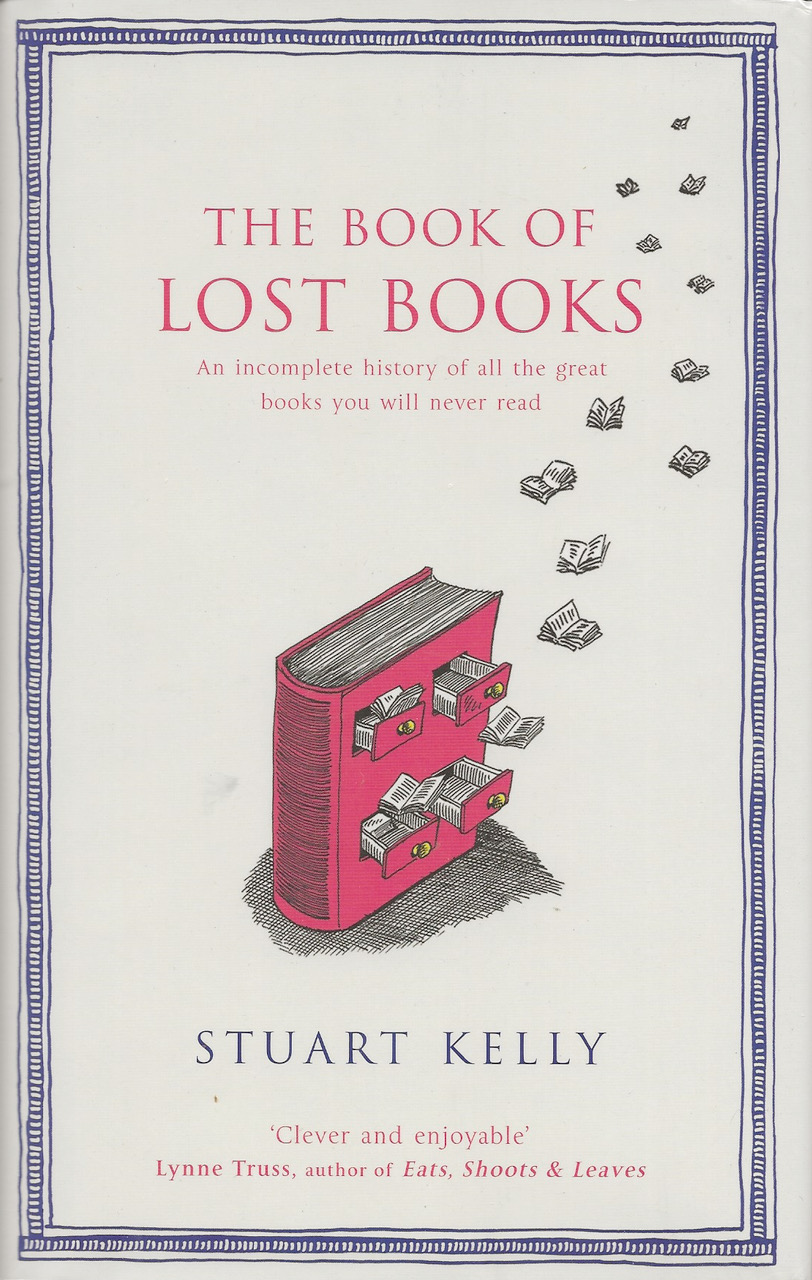
The Book of Lost Books

Kelly, Stuart.  The Book of Lost Books: An Incomplete History of All the Great Books You'll Never Read.  New York: Viking Press, 2005.  In this collection of 81 short essays, Kelly traces the stories of works of poetry and prose which have been completely lost, authored by some of history's most famous writers.  From the classic philosophers to the modern novelists, many of their works have been destroyed, misplaced, burned, left incomplete (often when the author died), or in some cases were simply never begun.

While most readers assess the history of literature through the books which have survived, Kelly considers the history of the loss of literature.  At age 15, he began compiling a list of lost books.  "From Shakespeare to Sylvia Plath, Homer to Hemingway, Dante to Ezra Pound, great writers had written works I could not possess," Kelly laments.  In The Book of Lost Books, he recounts the stories he has collected since his youth.


Fiction

The Shadow of the Wind

Zafón, Carlos Ruiz.  The Shadow of the Wind.  New York: The Penguin Press, 2001.  On a cold morning in 1945, an antiquarian book dealer takes his ten-year-old son, Daniel, to the Cemetery of Lost Books, a library of obscure and forgotten titles long out of print.  Allowed to select one book, Daniel chooses The Shadow of the Wind by Julian Carax.  After reading the mysterious tome, Daniel sets out to find other works by Carax only to discover that someone is seeking out and destroying every copy of every book written by the author.  Daniel may now possess the last Carax book in existence, and a shadowy figure who resembles a character in the book is out to destroy it, too.


Wednesday, June 30, 2021

June 2021: Books Published in the 1920s

The June 2021 meeting featured books published in the 1920s.  The decade was selected randomly.  It does, however, correspond with what many collectors consider the beginning of the era of modern first editions.  The modern books era does not have a universally agreed-upon beginning date; some collectors generally say, "the beginning of the 20th Century" while others say, "beginning in the late 19th Century."  Biblio.com, an international online marketplace for rare and collectible books, marks the start of modern firsts as 1919, corresponding with the end of WWI.  Using this reference point, the 1920s represents the first decade of the modern books era.

Selected books published in the 1920s are shown here in chronological order.


Glimpses of Authors

Ticknor, Caroline.  Glimpses of Authors.  Boston: Houghton Mifflin Company, 1922.  Caroline Ticknor (1866 – 1937) was an author from Boston, best known for her biographies of American authors.  She was the granddaughter of William Ticknor, the founder of Ticknor & Fields publishing house.  She later became an editor of the International Library of Famous Literature. 

Sample page and illustration from Glimpses of Authors

Glimpses of Authors is a semi-autobiographical book as Ticknor used many of her own memories of authors visiting her grandparents and parents along with personal letters received from writers to weave together her own reflections with short biographies of authors such as William Makepeace Thackeray, Alfred Tennyson, Henry James, Eugene Field, Henry Wadsworth Longfellow, and Edward Bellamy.


Oxford Poetry 1923

Thompson, David Cleghorn and F. W. Bateson, eds.  Oxford Poetry 1923.  Oxford: Basil Blackwell, 1923.  First edition, in one printing of 1,500 copies.  An anthology of poetry written by students from the colleges of Oxford University.  This book is Graham Greene's first appearance in book form, published when he was nineteen years old.  Greene contributes two poems, "Stepping Stones" and "Apologia." 

Contributor signatures by Harold Acton, Graham Greene,
John Linnell, and David Cleghorn Thompson

This copy is singed on the front free end paper by three contributors—Harold Acton, Graham Greene, and John Linnell—and signed on the title page by co-editor and contributor David Cleghorn Thompson.  Acton, Greene, and Thompson all went on to have distinguished writing careers.  As this is Greene's first publication in book format, this would be his earliest author-signed book. 


Babbling April (dust jacket and cover)

Greene, Graham.  Babbling April.  Oxford: Basil Blackwell, 1925.  Greene's first book, a poetry collection, is scarce as only one printing of 500 copies was produced.  Of the 500 copies, only 300 quires (unbound individual copies) were bound and issued.  The book reviewed poorly, and only 62 copies sold in the first year.  In 1934, the remaining 200 quires were withdrawn from the publisher's stock and scrapped.  Of the 300 copies issued, even fewer survive; Greene claimed he later bought and destroyed copies he came across in bookshops but stopped buying them when the price exceeded £1.


An American Tragedy

Dreiser, Theodore.  An American Tragedy.  London: Constable & Co. Ltd., 1926.  First published by Boni & Liveright in 1925 in two volumes; published here by Constable in one volume.  An American Tragedy is based on an actual crime when, in 1906, Grace Brown's body was found under a boat on Big Moose Lake in the Adirondack Mountains; her boyfriend was arrested the next day and later convicted of premeditated murder.  Dreiser used the same initials of the convicted murderer, Chester Gillette, for his character Clyde Griffiths.  Dreiser's method for selecting the character's name is a nod to details of the true crime case.  Gillette checked into a lodge in the Adirondacks that fateful weekend under a pseudonym with the same initials because his monogram was on his suitcase, and he did not want the proprietor of the lodge to become suspicious.  Dreiser's fictional story has been adapted for stage and film multiple times since publication. 

Dreiser began his writing career as a journalist, but once a novelist he often fought censorship due to his novels containing sexual promiscuity, like Sister Carrie (1900) and Jennie Gerhardt (1911).  In 1930, Dreiser was nominated for the Nobel Prize in Literature by Swedish author Anders Österling; he was passed over in favor of Sinclair Lewis.


The Man Within (1st English edition and 1st American edition)

Greene, Graham.  The Man Within.  London: William Heinemann Ltd., 1929.  First English edition.  One of only 2,500 copies of the first printing.

Greene, Graham.  The Man Within.  Garden City, NY: Doubleday, Doran & Company, Inc., 1929.  First American edition.

The Man Within was Greene's first published novel.  Greene was 24 years old and a sub-editor at The Times when the book was published.  Greene began working on The Man Within in 1926 while in the hospital recuperating from an appendicitis operation.  The book was an immediate success and reviewed well.  Though it was his first published novel, The Man Within was his third in order of composition.  His first attempt, written while a student at Oxford, was rejected by Heinemann and never published.  His second attempt was also rejected by Heinemann; originally titled The Episode, it was later published by Heinemann as Rumour at Nightfall (1931).


The Book of Common Prayer

Book of Common Prayer.  The Book of Common Prayer and Administration of the Sacraments and Other Rites and Ceremonies of the Church According to the Use of the Protestant Episcopal Church in the United States of America.  Together with the Psalter or Psalms of David.  Boston: Daniel Berkeley Updike at the Merrymount Press, 1929.  Limited edition of 500 copies of the Standard Edition of the Book of Common Prayer, 1928.  In 1928, the Prayer Book Commission of the Protestant Episcopal Church in the United States of America asked Daniel Berkeley Updike, a typographer, printer, and graphic designer, to produce a new Prayer Book for the church.  The book was financed by J. Pierpont Morgan and completed in 1929.  In 1930, the 500 copies were distributed to the bishops and select leaders of the church.

Title page of The Book of Common Prayer

Daniel Berkeley Updike was an advertising manager and layout artist at Houghton, Mifflin, and Company and Riverside Press until 1892, when he began producing his own books.  His first freelance commission was the design of the 1892 Book of Common Prayer.  Updike used the proceeds to establish his own fine printing press, the Merrymount Press, in 1893.  The Merrymount Press produced a wide range of fine books for publishers, book clubs, churches, libraries, and institutions; its catalogue included printing the first edition of Edith Wharton's first book, The Greater Inclination (Scribner's, 1899), and eight titles for The Limited Editions Club between 1930 and 1942.  The 1929 Book of Common Prayer is considered Updike's finest work.


Monday, May 31, 2021

May 2021: Dreams

Dreams—and nightmares—captured the imagination of the May 2021 meeting.  Works of fiction and nonfiction were presented; titles ranged from the classics of literature to little-known dream diaries.


The Interpretation of Dreams

Freud, Sigmund.  The Interpretation of Dreams.  Birmingham, Alabama: Gryphon Editions, Inc., 1988.  This special edition has been privately printed for the members of The Classics of Medicine Library.  Facsimile of the English translation by A. A. Brill, published by The Macmillan Company in 1913.

Freud, Sigmund.  The Interpretation of Dreams.  Birmingham, Alabama: Gryphon Editions, Inc., 1988.  This special edition has been privately printed for the members of The Classics of Psychiatry & Behavioral Sciences Library.  Facsimile of the English translation by A. A. Brill, published by The Macmillan Company in 1913.

The Interpretation of Dreams is arguably the most recognizable title in the field of dream theory.  Freud theorized that dreams were driven by an unconscious wish fulfillment; he saw dreams as the "royal road to the unconscious" and often explored the dreams of his patients during psychoanalysis.  Freud's dream theory has since been discredited and his "dream-work" interpretation strategies have not been found empirically valid; nevertheless, The Interpretation of Dreams remains popular.

The Interpretation of Dreams was first published in 1899, though Freud revised and expanded it at least eight times.  It was first translated from German to English in 1913 by Abraham Brill, an Austrian-born psychiatrist and the first psychoanalyst to practice in the United States.  Brill's translation of the third edition remains the authoritative English text and is the one used in these facsimile editions.


A Christmas Carol (first edition)

Dickens, Charles.  A Christmas Carol. In Prose. Being a Ghost Story of Christmas.  London: Chapman & Hall, 1843.  First edition.  With illustrations by John Leech.

A Christmas Carol (facsimile edition)

Dickens, Charles.  A Christmas Carol. In Prose. Being a Ghost Story of Christmas.  Boston: Little, Brown, and Company, 1920.  Facsimile of the 1843 Chapman & Hall edition.  With revised illustrations by John Leech, and an introduction by A. Edward Newton.

A Christmas Carol often springs to mind when asked to recall dreams in literature; the ghost of Jacob Marley visits Scrooge in a dream, followed by visits from the Ghost of Christmas Past, the Ghost of Christmas Present, and the Ghost of Christmas Yet to Come.  Only, Dickens does not portray the ghosts' visits as a dream; he sets the scene, however, for Marley's ghostly visit with:

Thus secured against surprise, he took off his cravat; put on his dressing gown and slippers, and his nightcap; and sat down before the fire to take his gruel.

After having a warm meal in one's pajamas beside the fireplace, who wouldn't nod off and begin to dream?  Shaken by Marley's ghost, even Scrooge questions whether it was a dream:

Marley’s ghost bothered him exceedingly. Every time he resolved within himself, after mature inquiry that it was all a dream, his mind flew back again, like a strong spring released, to its first position, and presented the same problem to be worked all through, “Was it a dream or not?”


Looking Backward: 2000 – 1887

Bellamy, Edward.  Looking Backward: 2000 – 1887.  Norwalk, CT: Easton Press, 1980.  First published in 1888, Bellamy's Utopian fiction avoids use of the term socialism but espouses "the elimination of social classes and the ills of society."  The story's main character, Julian West, is an insomniac.  He has himself mesmerized to an induced sleep inside of a tomb-like room in his home's cellar.  The house burns down, and he stays in this induced sleep for 113 years until discovered by the new owners of his now-rebuilt home.  West awakens in the same location but to a totally changed world in which the United States has been transformed into a socialist Utopia.  Through the eyes of West and the explanations of Doctor Leete, a resident of Boston in the year 2000, Bellamy extols a utopian future in which society is ordered for the smooth production and distribution of commodities to a regimented labor force.  In this society, "there would be no poverty, crime or taxes. Citizens would volunteer to work from the age of 21 to 45 and then retire."  (Now, that's the dream!)


A Connecticut Yankee in King Arthur's Court

Twain, Mark.  A Connecticut Yankee in King Arthur's Court.  New York: Harper & Brothers Publishers, 1898.  First published as A Yankee in King Arthur's Court by Charles L. Webster and Co. in 1889.  Twain uses a frame structure to tell a medieval story within a contemporary story.  Twain's main character Hank Morgan, an engineer in Hartford, Connecticut, receives a severe blow to the head and awakens in England during the reign of King Arthur.  He is initially confused but soon realizes he is living nearly 1300 years in the past.  Hank uses his 19th Century knowledge to make people believe he is a powerful magician.  He initially uses his knowledge of astronomy to outsmart Arthur, then later uses his engineering skills to help him.  Ultimately, Hank reawakens in his own time and place, and cries out for the family and friends he left behind in King Arthur's court.

Twain first conceived the story in December 1884, inspired by a dream in which he was a knight who found himself inconvenienced by the cumbersome, weighty armor he wore.  He started writing the story in 1885 and completed it in 1889 in Hartford, Connecticut.


Vivien Greene's copy of The Man Within

Greene, Graham.  The Man Within.  London: William Heinemann Ltd., 1952.  First volume of the 14-volume Uniform Edition of the works of Graham Greene.

Graham Greene's first novel, The Man Within, has nothing to do with dreams, but this particular copy certainly does.  It is Vivien Greene's copy, bearing an autograph inscription to the front free end paper.

Vivien Greene's inscription

1952

This arrived on morning of September 23 Tuesday. On Monday (ie last) night I had dreamed G. appeared, very ill & in great distress saying he had only a week to live.

The Man Within was first published in 1929, two years after Graham and Vivien married; the novel is dedicated to her.  Graham left his family in 1947, though Vivien refused to grant him a divorce; they remained married until Graham's death.  From 1946, before he and Vivien separated, Graham had carried on a very public affair with Catherine Walston.  Walston's husband demanded Catherine and Graham cease their adulterous relation in 1951, after the publication of Greene's The End of the Affair, which is dedicated to Catherine.  They did not end the relationship at that time, though they did tone down their appearances in public, causing many to speculate that the relationship had ended.  It is in this context in 1952 in which Vivien receives and inscribes this copy of The Man Within.


A World of My Own: A Dream Diary

Greene, Graham.  A World of My Own: A Dream Diary.  New York: Viking Press, 1994.  Selected entries from Greene's dream diary, posthumously published.

Greene began keeping a dream diary as a teenager while undergoing psychoanalysis.  He continued the practice throughout his life.  In the final months before he died, he returned to his diaries and selected and arranged entries for publication.  Shortly before he died, Greene gave the annotated diary entries to this then-mistress, Yvonne Cloetta, entrusting her to see it published.

Greene distinguishes between his dream world, a place which only he knows—which he calls "A World of My Own"—and the world he shares and experiences with others—what he calls the "Common World."  The entries, which span a lifetime, are arranged thematically; unfortunately, they are not dated.

Beyond the entries in his dream journals, Greene spoke often about how dreams were part of his writing process.  In her Foreword, Yvonne Cloetta writes:

It is well known that Graham was always very interested in dreams, and that he relied a great deal on the role played by the subconscious in writing.  He would sit down to work straightaway after breakfast, writing until he had five hundred words (which in the last while he reduced to approximately two hundred).  He was in the habit of then rereading, every evening before going to bed, the section of the novel or story he had written in the morning, leaving his subconscious to work during the night.  Some dreams enabled him to overcome a "blockage"; others provided him on occasion with material for short stories or even an idea for a new novel (as with It's a Battlefield and The Honorary Consul).  Sometimes, as he wrote, "identification with a character goes so far that one may dream his dream and not one's own"—as happened during the writing of A Burnt-Out Case, so that he was able to attribute his own dream to his character Querry and so extricate himself from an impasse in the narrative.


Friday, April 30, 2021

March & April 2021: Typography & Book Cover Design

The topic for March 2021 was Typeface, Fonts, and Lettering.  Due to some technical difficulties during the online meeting, the group continued the subject during the April meeting and added Dust Jacket and Book Cover Design for the April topic.  These topics worked well together as typography often plays a role in dust jacket and cover design.

Typography

The Ship that Sailed to Mars

Timlin, William M.  The Ship that Sailed to Mars: A Fantasy.  New York: Frederick A. Stokes Company, 1923.  Architect and artist William Timlin wrote and illustrated the fantasy story of an old man who sails to Mars on a ship he designed himself as he had told it to his son.  The first publisher he approached, George G. Harrap and Company, was enchanted not only by the story but also with Timlin's elegant handwritten manuscript and agreed to publish it on the spot.  The book was published exactly as it was presented to them, with Timlin's alternating water-color images and hand-lettered text.

Text and image from The Ship that Went to Mars

Harrap & Co. printed only 2000 copies of The Ship that Sailed to Mars, of which 250 numbered copies were prepared for distribution in America under the Frederick Stokes imprint.  The Dictionary of 20th Century British Book Illustrators describes it as "the most original and beautiful children's book of the 1920s."  The story has been reproduced several times, usually in fine bindings or limited editions, while copies of the original Stokes edition remain scarce on the collectors' market.


The Honorary Consul

Greene, Graham.  The Honorary Consul.  London: The Bodley Head, 1973.  First edition.  Dust jacket design by Michael Harvey.  This copy is signed by Michael Harvey on the front flap of the dust jacket.

Michael Harvey was a typographer, letter artist, and type designer.  For 25 years, from the late 1960s to the early 1990s, he designed dust jackets for several English publishers.  In that time, he designed and hand-lettered approximately 1500 jackets, including 12 Graham Greene books from 1971 to 1990, using a different font for each title.  Shortly after Greene's death in 1991, Harvey was commissioned by Nicholas Dennys, Greene's nephew, to design a "From the Library of Graham Greene" bookplate to go into the books in Greene's library which were bound for auction.  Harvey created the bookplate, but it was not used for two reasons.  First, Greene wrote heavily in the blank end papers and preliminary pages of his books, and there was no standard location to adhere a bookplate which did not cover his handwritten notes.  Second, Greene's library never went to auction; the entire collection was acquired by Boston University's library, so the bookplates were not needed.  Harvey's bookplate design was used instead to illustrate the cover of From the Library of Graham Greene, an essay on Greene's library by the woman who catalogued it for auction, with a selection of the manuscript annotations of Graham Greene discovered in the books.

From the Library of Graham Greene

McNeil, Jean.  From the Library of Graham Greene.  London: The Gloucester Road Bookshop, 1993.  Limited edition of 500 copies.  This copy was Michael Harvey's copy, bearing a presentation inscription from Nicholas Dennys thanking him for the design of the bookplate, now used for the cover of this book:

To Michael in thanks

for your design of

Graham's beautiful

bookplate and with

very good wishes

Nick   31 March 1993


Book Cover Design

From the Earth to the Moon

Verne, Jules.  From the Earth to the Moon: Direct in Ninety-Seven Hours and Twenty Minutes: And a Trip Round It.  New York: Scriber, Armstrong & Company, 1874.  Translated from the French by Louis Mercier and Eleanor E. King.  With eighty full page illustrations.  This edition bears a striking book cover design of gilt on red boards with a depiction of the projectile shooting toward the moon.  Other early editions used different color schemes of the same image, but the iconic red cover strongly evokes the ethos of the story.


An Antarctic Mystery

Verne, Jules.  An Antarctic Mystery.  Philadelphia: J. B. Lippincott Company, 1899.  Translated from the French by Mrs. [Frances] Cashel Hoey.  Illustrated.  The blue, white, and silver book cover conjures the frigid atmosphere of the sub-Antarctic setting of Verne's response to Edgar Allan Poe's 1838 novel The Narrative of Arthur Gordon Pym of Nantucket.


Saurus

Phillpotts, Eden.  Saurus.  London: John Murray, 1938.  Phillpotts, a prolific author, dramatist, and poet, began writing fantasy and science fiction later in his career, including Saurus about an alien reptilian observing human life on Earth.  Phillpotts wondered how our customs and culture might be interpreted by outsiders.  He described the story, "If Earth were to receive a visitor from another world, that visitor might not particularly resemble mankind, and might find our customs curious."  D. W. Rees's dust jacket whimsically yet eerily illustrates Phillpotts's notion.


Brideshead Revisited

Waugh, Evelyn.  Brideshead Revisited.  Boston: Little Brown, and Company. 1945. First US edition.  Waugh's masterpiece follows the romantic life of its main character from the 1920s to the early 1940s and explores the theme of nostalgia for the age of English aristocracy.  The dust jacket drawing by Lester M. Peterson depicts the "glittering and seductive world of English aristocracy in the waning days of the empire."


Something Wicked This Way Comes

Bradbury, Ray.  Something Wicked This Way Comes.  New York: Simon & Schuster, 1962. The dust jacket art by American artist Gray Foy sets the mood for Bradbury's dark fantasy which analyses the conflicting natures of good and evil which exist within all individuals.  Most known for his figurative Surrealist paintings, Foy supplemented his income by designing and illustrating magazine features and book jackets.  His two most recognizable dust jackets are for the first editions of J. R. Salamanca's Lilith (1961) and Bradbury's Something Wicked This Way Comes (1962).


Friday, February 26, 2021

February 2021: Anniversary & Commemorative Editions

The February 2021 meeting highlighted anniversary editions.  Members presented an array of classic and favorite books which have proved popular and successful enough to be reprinted in anniversary editions.  While these special editions mark an anniversary of the original publication, commemorative editions honor historic events or celebrate milestones of their subject matter.  A combination of both anniversary and commemorative editions were shown during the online meeting.

The anniversary edition books are arranged in order of appearance of the first edition.  The commemorative edition books are similarly chronologically ordered.


Anniversary Editions


Adventures of Huckleberry Finn

Twain, Mark.  Adventures of Huckleberry Finn.  Berkeley, CA: University of California Press, 1985.  100th anniversary edition, with a foreword by Henry Nash Smith and woodcut illustrations by Barry Moser.

First published in the United Kingdom in 1884 by Chatto & Windus and in the United States in 1885 by Charles L. Webster & Company.


The Hobbit

Tolkien, J. R. R.  The Hobbit, or There and Back Again.  Boston: Houghton Mifflin, 1987.  50th anniversary edition, with a foreword by Christopher Tolkien and maps, illustrations, and drawings by J. R. R. Tolkien.  Bound in gold leatherette with green and red foil stamping and housed in a paper gold slipcase.

First published in 1937 by Allen & Unwin.


The Power and the Glory

Greene, Graham.  The Power and the Glory.  New York: Viking Press, 1990.  50th anniversary edition with an introduction by John Updike.  This copy is signed by Updike on the first preliminary page.

First published in 1940 by William Heinemann.


Fahrenheit 451

Bradbury, Ray.  Fahrenheit 451.  New York: Simon & Schuster, 1993.  40th anniversary edition, with a new foreword by the author.

First published in 1951 in Galaxy Science Fiction magazine as "The Firemen," and in book form in 1953 as Fahrenheit 451 by Ballantine Books.


The Lord of the Rings

Tolkien, J. R. R.  The Lord of the Rings.  Boston: Houghton Mifflin, 1981.  25th anniversary edition.  Boxed 3 volume set, bound in silver leatherette.  Issued on the 25th anniversary of the first publication of The Return of the King, the final book in the trilogy, in the United States in 1956.

First published 1954-1955 by Allen & Unwin.  First published in the United States 1954-1956 by Houghton Mifflin.


The Owl Service

Garner, Alan.  The Owl Service.  London: HarperCollins, 2017.  50th anniversary edition, with a new introduction by Philip Pullman.

First published in 1967 by William Collins & Sons, Co.


The Front Runner

Warren, Patricia Nell.  The Front Runner.  Beverly Hills: Wildcat Press, 1996.  20th anniversary edition.  The book was first published in hardcover in 1975 and paperback in 1976.  Wildcat Press similarly released the anniversary edition in hardback in 1995 and paperback in 1996.

First published in 1975 by William Morrow & Company.


The Polar Express

Van Allsburg, Chris.  The Polar Express.  Boston: Houghton Mifflin, 1995.  10th anniversary edition, with a note from the author.

First published in 1985 by Houghton Mifflin.


The Alchemist

Coelho, Paulo.  The Alchemist.  New York: HarperOne, 2014.  25th anniversary edition, signed by the author on an anniversary edition signature page.

First published as O Alquimista in Portuguese in 1988.  First published in English in 1993 by HarperTorch.


American Gods

Gaiman, Neil.  American Gods.  New York: HarperCollins, 2011.  10th anniversary edition, using the author's preferred text and with a special introduction by the author.

First published in 2001 by William Morrow.


Commemorative Editions


Oz: The Hundreth Anniversary Celebration

Glassman, Peter, ed.  Oz: The Hundreth Anniversary Celebration.  New York: HarperCollins, 2000.  Thirty children's book authors and illustrators pay tribute to L. Frank Baum's The Wizard of Oz on the 100th anniversary of the first Oz book.

The Wonderful Wizard of Oz was first published in 1900 by George M. Hill Company.


I Have a Dream

King, Martin Luther, Jr.  I Have a Dream.  San Francisco: Harper San Francisco, 1993.  30th anniversary edition of Dr. King's August 28, 1963, "I Have a Dream" speech delivered at the March on Washington for Jobs and Freedom.  This copy is signed on the half title page by Coretta Scott King.


Apollo 13

Lovell, Jim and Jeffrey Kluger.  Apollo 13.  Boston: Houghton Mifflin Company, 2000.  Previously published as Lost Moon, with a new preface.  Commemorative edition on the 30th anniversary of the Apollo 13 mission, April 11, 1970.  This copy is signed by Jim Lovell on the title page.

First published as Lost Moon in 1994 by Houghton Mifflin.


The First Twenty-Five Years of the Beehive Press

Beehive Press.  The First Twenty-Five Years of the Beehive Press.  Savannah, GA: Beehive Foundation, 1995.  Published in collaboration with the Boston Public Library, the University of Georgia Libraries, and the Beehive Foundation.  Includes a complete catalogue of books published by the press from its 1970 inception through 1995.


July 2025: US Presidents

One member's unintentionally assembled collection of signed presidential books Getting an early start on the Fourth of July festivitie...