Wednesday, June 30, 2021

June 2021: Books Published in the 1920s

The June 2021 meeting featured books published in the 1920s.  The decade was selected randomly.  It does, however, correspond with what many collectors consider the beginning of the era of modern first editions.  The modern books era does not have a universally agreed-upon beginning date; some collectors generally say, "the beginning of the 20th Century" while others say, "beginning in the late 19th Century."  Biblio.com, an international online marketplace for rare and collectible books, marks the start of modern firsts as 1919, corresponding with the end of WWI.  Using this reference point, the 1920s represents the first decade of the modern books era.

Selected books published in the 1920s are shown here in chronological order.


Glimpses of Authors

Ticknor, Caroline.  Glimpses of Authors.  Boston: Houghton Mifflin Company, 1922.  Caroline Ticknor (1866 – 1937) was an author from Boston, best known for her biographies of American authors.  She was the granddaughter of William Ticknor, the founder of Ticknor & Fields publishing house.  She later became an editor of the International Library of Famous Literature. 

Sample page and illustration from Glimpses of Authors

Glimpses of Authors is a semi-autobiographical book as Ticknor used many of her own memories of authors visiting her grandparents and parents along with personal letters received from writers to weave together her own reflections with short biographies of authors such as William Makepeace Thackeray, Alfred Tennyson, Henry James, Eugene Field, Henry Wadsworth Longfellow, and Edward Bellamy.


Oxford Poetry 1923

Thompson, David Cleghorn and F. W. Bateson, eds.  Oxford Poetry 1923.  Oxford: Basil Blackwell, 1923.  First edition, in one printing of 1,500 copies.  An anthology of poetry written by students from the colleges of Oxford University.  This book is Graham Greene's first appearance in book form, published when he was nineteen years old.  Greene contributes two poems, "Stepping Stones" and "Apologia." 

Contributor signatures by Harold Acton, Graham Greene,
John Linnell, and David Cleghorn Thompson

This copy is singed on the front free end paper by three contributors—Harold Acton, Graham Greene, and John Linnell—and signed on the title page by co-editor and contributor David Cleghorn Thompson.  Acton, Greene, and Thompson all went on to have distinguished writing careers.  As this is Greene's first publication in book format, this would be his earliest author-signed book. 


Babbling April (dust jacket and cover)

Greene, Graham.  Babbling April.  Oxford: Basil Blackwell, 1925.  Greene's first book, a poetry collection, is scarce as only one printing of 500 copies was produced.  Of the 500 copies, only 300 quires (unbound individual copies) were bound and issued.  The book reviewed poorly, and only 62 copies sold in the first year.  In 1934, the remaining 200 quires were withdrawn from the publisher's stock and scrapped.  Of the 300 copies issued, even fewer survive; Greene claimed he later bought and destroyed copies he came across in bookshops but stopped buying them when the price exceeded £1.


An American Tragedy

Dreiser, Theodore.  An American Tragedy.  London: Constable & Co. Ltd., 1926.  First published by Boni & Liveright in 1925 in two volumes; published here by Constable in one volume.  An American Tragedy is based on an actual crime when, in 1906, Grace Brown's body was found under a boat on Big Moose Lake in the Adirondack Mountains; her boyfriend was arrested the next day and later convicted of premeditated murder.  Dreiser used the same initials of the convicted murderer, Chester Gillette, for his character Clyde Griffiths.  Dreiser's method for selecting the character's name is a nod to details of the true crime case.  Gillette checked into a lodge in the Adirondacks that fateful weekend under a pseudonym with the same initials because his monogram was on his suitcase, and he did not want the proprietor of the lodge to become suspicious.  Dreiser's fictional story has been adapted for stage and film multiple times since publication. 

Dreiser began his writing career as a journalist, but once a novelist he often fought censorship due to his novels containing sexual promiscuity, like Sister Carrie (1900) and Jennie Gerhardt (1911).  In 1930, Dreiser was nominated for the Nobel Prize in Literature by Swedish author Anders Ă–sterling; he was passed over in favor of Sinclair Lewis.


The Man Within (1st English edition and 1st American edition)

Greene, Graham.  The Man Within.  London: William Heinemann Ltd., 1929.  First English edition.  One of only 2,500 copies of the first printing.

Greene, Graham.  The Man Within.  Garden City, NY: Doubleday, Doran & Company, Inc., 1929.  First American edition.

The Man Within was Greene's first published novel.  Greene was 24 years old and a sub-editor at The Times when the book was published.  Greene began working on The Man Within in 1926 while in the hospital recuperating from an appendicitis operation.  The book was an immediate success and reviewed well.  Though it was his first published novel, The Man Within was his third in order of composition.  His first attempt, written while a student at Oxford, was rejected by Heinemann and never published.  His second attempt was also rejected by Heinemann; originally titled The Episode, it was later published by Heinemann as Rumour at Nightfall (1931).


The Book of Common Prayer

Book of Common Prayer.  The Book of Common Prayer and Administration of the Sacraments and Other Rites and Ceremonies of the Church According to the Use of the Protestant Episcopal Church in the United States of America.  Together with the Psalter or Psalms of David.  Boston: Daniel Berkeley Updike at the Merrymount Press, 1929.  Limited edition of 500 copies of the Standard Edition of the Book of Common Prayer, 1928.  In 1928, the Prayer Book Commission of the Protestant Episcopal Church in the United States of America asked Daniel Berkeley Updike, a typographer, printer, and graphic designer, to produce a new Prayer Book for the church.  The book was financed by J. Pierpont Morgan and completed in 1929.  In 1930, the 500 copies were distributed to the bishops and select leaders of the church.

Title page of The Book of Common Prayer

Daniel Berkeley Updike was an advertising manager and layout artist at Houghton, Mifflin, and Company and Riverside Press until 1892, when he began producing his own books.  His first freelance commission was the design of the 1892 Book of Common Prayer.  Updike used the proceeds to establish his own fine printing press, the Merrymount Press, in 1893.  The Merrymount Press produced a wide range of fine books for publishers, book clubs, churches, libraries, and institutions; its catalogue included printing the first edition of Edith Wharton's first book, The Greater Inclination (Scribner's, 1899), and eight titles for The Limited Editions Club between 1930 and 1942.  The 1929 Book of Common Prayer is considered Updike's finest work.


Monday, May 31, 2021

May 2021: Dreams

Dreams—and nightmares—captured the imagination of the May 2021 meeting.  Works of fiction and nonfiction were presented; titles ranged from the classics of literature to little-known dream diaries.


The Interpretation of Dreams

Freud, Sigmund.  The Interpretation of Dreams.  Birmingham, Alabama: Gryphon Editions, Inc., 1988.  This special edition has been privately printed for the members of The Classics of Medicine Library.  Facsimile of the English translation by A. A. Brill, published by The Macmillan Company in 1913.

Freud, Sigmund.  The Interpretation of Dreams.  Birmingham, Alabama: Gryphon Editions, Inc., 1988.  This special edition has been privately printed for the members of The Classics of Psychiatry & Behavioral Sciences Library.  Facsimile of the English translation by A. A. Brill, published by The Macmillan Company in 1913.

The Interpretation of Dreams is arguably the most recognizable title in the field of dream theory.  Freud theorized that dreams were driven by an unconscious wish fulfillment; he saw dreams as the "royal road to the unconscious" and often explored the dreams of his patients during psychoanalysis.  Freud's dream theory has since been discredited and his "dream-work" interpretation strategies have not been found empirically valid; nevertheless, The Interpretation of Dreams remains popular.

The Interpretation of Dreams was first published in 1899, though Freud revised and expanded it at least eight times.  It was first translated from German to English in 1913 by Abraham Brill, an Austrian-born psychiatrist and the first psychoanalyst to practice in the United States.  Brill's translation of the third edition remains the authoritative English text and is the one used in these facsimile editions.


A Christmas Carol (first edition)

Dickens, Charles.  A Christmas Carol. In Prose. Being a Ghost Story of Christmas.  London: Chapman & Hall, 1843.  First edition.  With illustrations by John Leech.

A Christmas Carol (facsimile edition)

Dickens, Charles.  A Christmas Carol. In Prose. Being a Ghost Story of Christmas.  Boston: Little, Brown, and Company, 1920.  Facsimile of the 1843 Chapman & Hall edition.  With revised illustrations by John Leech, and an introduction by A. Edward Newton.

A Christmas Carol often springs to mind when asked to recall dreams in literature; the ghost of Jacob Marley visits Scrooge in a dream, followed by visits from the Ghost of Christmas Past, the Ghost of Christmas Present, and the Ghost of Christmas Yet to Come.  Only, Dickens does not portray the ghosts' visits as a dream; he sets the scene, however, for Marley's ghostly visit with:

Thus secured against surprise, he took off his cravat; put on his dressing gown and slippers, and his nightcap; and sat down before the fire to take his gruel.

After having a warm meal in one's pajamas beside the fireplace, who wouldn't nod off and begin to dream?  Shaken by Marley's ghost, even Scrooge questions whether it was a dream:

Marley’s ghost bothered him exceedingly. Every time he resolved within himself, after mature inquiry that it was all a dream, his mind flew back again, like a strong spring released, to its first position, and presented the same problem to be worked all through, “Was it a dream or not?”


Looking Backward: 2000 – 1887

Bellamy, Edward.  Looking Backward: 2000 – 1887.  Norwalk, CT: Easton Press, 1980.  First published in 1888, Bellamy's Utopian fiction avoids use of the term socialism but espouses "the elimination of social classes and the ills of society."  The story's main character, Julian West, is an insomniac.  He has himself mesmerized to an induced sleep inside of a tomb-like room in his home's cellar.  The house burns down, and he stays in this induced sleep for 113 years until discovered by the new owners of his now-rebuilt home.  West awakens in the same location but to a totally changed world in which the United States has been transformed into a socialist Utopia.  Through the eyes of West and the explanations of Doctor Leete, a resident of Boston in the year 2000, Bellamy extols a utopian future in which society is ordered for the smooth production and distribution of commodities to a regimented labor force.  In this society, "there would be no poverty, crime or taxes. Citizens would volunteer to work from the age of 21 to 45 and then retire."  (Now, that's the dream!)


A Connecticut Yankee in King Arthur's Court

Twain, Mark.  A Connecticut Yankee in King Arthur's Court.  New York: Harper & Brothers Publishers, 1898.  First published as A Yankee in King Arthur's Court by Charles L. Webster and Co. in 1889.  Twain uses a frame structure to tell a medieval story within a contemporary story.  Twain's main character Hank Morgan, an engineer in Hartford, Connecticut, receives a severe blow to the head and awakens in England during the reign of King Arthur.  He is initially confused but soon realizes he is living nearly 1300 years in the past.  Hank uses his 19th Century knowledge to make people believe he is a powerful magician.  He initially uses his knowledge of astronomy to outsmart Arthur, then later uses his engineering skills to help him.  Ultimately, Hank reawakens in his own time and place, and cries out for the family and friends he left behind in King Arthur's court.

Twain first conceived the story in December 1884, inspired by a dream in which he was a knight who found himself inconvenienced by the cumbersome, weighty armor he wore.  He started writing the story in 1885 and completed it in 1889 in Hartford, Connecticut.


Vivien Greene's copy of The Man Within

Greene, Graham.  The Man Within.  London: William Heinemann Ltd., 1952.  First volume of the 14-volume Uniform Edition of the works of Graham Greene.

Graham Greene's first novel, The Man Within, has nothing to do with dreams, but this particular copy certainly does.  It is Vivien Greene's copy, bearing an autograph inscription to the front free end paper.

Vivien Greene's inscription

1952

This arrived on morning of September 23 Tuesday. On Monday (ie last) night I had dreamed G. appeared, very ill & in great distress saying he had only a week to live.

The Man Within was first published in 1929, two years after Graham and Vivien married; the novel is dedicated to her.  Graham left his family in 1947, though Vivien refused to grant him a divorce; they remained married until Graham's death.  From 1946, before he and Vivien separated, Graham had carried on a very public affair with Catherine Walston.  Walston's husband demanded Catherine and Graham cease their adulterous relation in 1951, after the publication of Greene's The End of the Affair, which is dedicated to Catherine.  They did not end the relationship at that time, though they did tone down their appearances in public, causing many to speculate that the relationship had ended.  It is in this context in 1952 in which Vivien receives and inscribes this copy of The Man Within.


A World of My Own: A Dream Diary

Greene, Graham.  A World of My Own: A Dream Diary.  New York: Viking Press, 1994.  Selected entries from Greene's dream diary, posthumously published.

Greene began keeping a dream diary as a teenager while undergoing psychoanalysis.  He continued the practice throughout his life.  In the final months before he died, he returned to his diaries and selected and arranged entries for publication.  Shortly before he died, Greene gave the annotated diary entries to this then-mistress, Yvonne Cloetta, entrusting her to see it published.

Greene distinguishes between his dream world, a place which only he knows—which he calls "A World of My Own"—and the world he shares and experiences with others—what he calls the "Common World."  The entries, which span a lifetime, are arranged thematically; unfortunately, they are not dated.

Beyond the entries in his dream journals, Greene spoke often about how dreams were part of his writing process.  In her Foreword, Yvonne Cloetta writes:

It is well known that Graham was always very interested in dreams, and that he relied a great deal on the role played by the subconscious in writing.  He would sit down to work straightaway after breakfast, writing until he had five hundred words (which in the last while he reduced to approximately two hundred).  He was in the habit of then rereading, every evening before going to bed, the section of the novel or story he had written in the morning, leaving his subconscious to work during the night.  Some dreams enabled him to overcome a "blockage"; others provided him on occasion with material for short stories or even an idea for a new novel (as with It's a Battlefield and The Honorary Consul).  Sometimes, as he wrote, "identification with a character goes so far that one may dream his dream and not one's own"—as happened during the writing of A Burnt-Out Case, so that he was able to attribute his own dream to his character Querry and so extricate himself from an impasse in the narrative.


Friday, April 30, 2021

March & April 2021: Typography & Book Cover Design

The topic for March 2021 was Typeface, Fonts, and Lettering.  Due to some technical difficulties during the online meeting, the group continued the subject during the April meeting and added Dust Jacket and Book Cover Design for the April topic.  These topics worked well together as typography often plays a role in dust jacket and cover design.

Typography

The Ship that Sailed to Mars

Timlin, William M.  The Ship that Sailed to Mars: A Fantasy.  New York: Frederick A. Stokes Company, 1923.  Architect and artist William Timlin wrote and illustrated the fantasy story of an old man who sails to Mars on a ship he designed himself as he had told it to his son.  The first publisher he approached, George G. Harrap and Company, was enchanted not only by the story but also with Timlin's elegant handwritten manuscript and agreed to publish it on the spot.  The book was published exactly as it was presented to them, with Timlin's alternating water-color images and hand-lettered text.

Text and image from The Ship that Went to Mars

Harrap & Co. printed only 2000 copies of The Ship that Sailed to Mars, of which 250 numbered copies were prepared for distribution in America under the Frederick Stokes imprint.  The Dictionary of 20th Century British Book Illustrators describes it as "the most original and beautiful children's book of the 1920s."  The story has been reproduced several times, usually in fine bindings or limited editions, while copies of the original Stokes edition remain scarce on the collectors' market.


The Honorary Consul

Greene, Graham.  The Honorary Consul.  London: The Bodley Head, 1973.  First edition.  Dust jacket design by Michael Harvey.  This copy is signed by Michael Harvey on the front flap of the dust jacket.

Michael Harvey was a typographer, letter artist, and type designer.  For 25 years, from the late 1960s to the early 1990s, he designed dust jackets for several English publishers.  In that time, he designed and hand-lettered approximately 1500 jackets, including 12 Graham Greene books from 1971 to 1990, using a different font for each title.  Shortly after Greene's death in 1991, Harvey was commissioned by Nicholas Dennys, Greene's nephew, to design a "From the Library of Graham Greene" bookplate to go into the books in Greene's library which were bound for auction.  Harvey created the bookplate, but it was not used for two reasons.  First, Greene wrote heavily in the blank end papers and preliminary pages of his books, and there was no standard location to adhere a bookplate which did not cover his handwritten notes.  Second, Greene's library never went to auction; the entire collection was acquired by Boston University's library, so the bookplates were not needed.  Harvey's bookplate design was used instead to illustrate the cover of From the Library of Graham Greene, an essay on Greene's library by the woman who catalogued it for auction, with a selection of the manuscript annotations of Graham Greene discovered in the books.

From the Library of Graham Greene

McNeil, Jean.  From the Library of Graham Greene.  London: The Gloucester Road Bookshop, 1993.  Limited edition of 500 copies.  This copy was Michael Harvey's copy, bearing a presentation inscription from Nicholas Dennys thanking him for the design of the bookplate, now used for the cover of this book:

To Michael in thanks

for your design of

Graham's beautiful

bookplate and with

very good wishes

Nick   31 March 1993


Book Cover Design

From the Earth to the Moon

Verne, Jules.  From the Earth to the Moon: Direct in Ninety-Seven Hours and Twenty Minutes: And a Trip Round It.  New York: Scriber, Armstrong & Company, 1874.  Translated from the French by Louis Mercier and Eleanor E. King.  With eighty full page illustrations.  This edition bears a striking book cover design of gilt on red boards with a depiction of the projectile shooting toward the moon.  Other early editions used different color schemes of the same image, but the iconic red cover strongly evokes the ethos of the story.


An Antarctic Mystery

Verne, Jules.  An Antarctic Mystery.  Philadelphia: J. B. Lippincott Company, 1899.  Translated from the French by Mrs. [Frances] Cashel Hoey.  Illustrated.  The blue, white, and silver book cover conjures the frigid atmosphere of the sub-Antarctic setting of Verne's response to Edgar Allan Poe's 1838 novel The Narrative of Arthur Gordon Pym of Nantucket.


Saurus

Phillpotts, Eden.  Saurus.  London: John Murray, 1938.  Phillpotts, a prolific author, dramatist, and poet, began writing fantasy and science fiction later in his career, including Saurus about an alien reptilian observing human life on Earth.  Phillpotts wondered how our customs and culture might be interpreted by outsiders.  He described the story, "If Earth were to receive a visitor from another world, that visitor might not particularly resemble mankind, and might find our customs curious."  D. W. Rees's dust jacket whimsically yet eerily illustrates Phillpotts's notion.


Brideshead Revisited

Waugh, Evelyn.  Brideshead Revisited.  Boston: Little Brown, and Company. 1945. First US edition.  Waugh's masterpiece follows the romantic life of its main character from the 1920s to the early 1940s and explores the theme of nostalgia for the age of English aristocracy.  The dust jacket drawing by Lester M. Peterson depicts the "glittering and seductive world of English aristocracy in the waning days of the empire."


Something Wicked This Way Comes

Bradbury, Ray.  Something Wicked This Way Comes.  New York: Simon & Schuster, 1962. The dust jacket art by American artist Gray Foy sets the mood for Bradbury's dark fantasy which analyses the conflicting natures of good and evil which exist within all individuals.  Most known for his figurative Surrealist paintings, Foy supplemented his income by designing and illustrating magazine features and book jackets.  His two most recognizable dust jackets are for the first editions of J. R. Salamanca's Lilith (1961) and Bradbury's Something Wicked This Way Comes (1962).


Friday, February 26, 2021

February 2021: Anniversary & Commemorative Editions

The February 2021 meeting highlighted anniversary editions.  Members presented an array of classic and favorite books which have proved popular and successful enough to be reprinted in anniversary editions.  While these special editions mark an anniversary of the original publication, commemorative editions honor historic events or celebrate milestones of their subject matter.  A combination of both anniversary and commemorative editions were shown during the online meeting.

The anniversary edition books are arranged in order of appearance of the first edition.  The commemorative edition books are similarly chronologically ordered.


Anniversary Editions


Adventures of Huckleberry Finn

Twain, Mark.  Adventures of Huckleberry Finn.  Berkeley, CA: University of California Press, 1985.  100th anniversary edition, with a foreword by Henry Nash Smith and woodcut illustrations by Barry Moser.
First published in the United Kingdom in 1884 by Chatto & Windus and in the United States in 1885 by Charles L. Webster & Company.


The Hobbit

Tolkien, J. R. R.  The Hobbit, or There and Back Again.  Boston: Houghton Mifflin, 1987.  50th anniversary edition, with a foreword by Christopher Tolkien and maps, illustrations, and drawings by J. R. R. Tolkien.  Bound in gold leatherette with green and red foil stamping and housed in a paper gold slipcase.

First published in 1937 by Allen & Unwin.


The Power and the Glory

Greene, Graham.  The Power and the Glory.  New York: Viking Press, 1990.  50th anniversary edition with an introduction by John Updike.  This copy is signed by Updike on the first preliminary page.

First published in 1940 by William Heinemann.


Fahrenheit 451

Bradbury, Ray.  Fahrenheit 451.  New York: Simon & Schuster, 1993.  40th anniversary edition, with a new foreword by the author.

First published in 1951 in Galaxy Science Fiction magazine as "The Firemen," and in book form in 1953 as Fahrenheit 451 by Ballantine Books.


The Lord of the Rings

Tolkien, J. R. R.  The Lord of the Rings.  Boston: Houghton Mifflin, 1981.  25th anniversary edition.  Boxed 3 volume set, bound in silver leatherette.  Issued on the 25th anniversary of the first publication of The Return of the King, the final book in the trilogy, in the United States in 1956.

First published 1954-1955 by Allen & Unwin.  First published in the United States 1954-1956 by Houghton Mifflin.


The Owl Service

Garner, Alan.  The Owl Service.  London: HarperCollins, 2017.  50th anniversary edition, with a new introduction by Philip Pullman.

First published in 1967 by William Collins & Sons, Co.


The Front Runner

Warren, Patricia Nell.  The Front Runner.  Beverly Hills: Wildcat Press, 1996.  20th anniversary edition.  The book was first published in hardcover in 1975 and paperback in 1976.  Wildcat Press similarly released the anniversary edition in hardback in 1995 and paperback in 1996.

First published in 1975 by William Morrow & Company.


The Polar Express

Van Allsburg, Chris.  The Polar Express.  Boston: Houghton Mifflin, 1995.  10th anniversary edition, with a note from the author.

First published in 1985 by Houghton Mifflin.


The Alchemist

Coelho, Paulo.  The Alchemist.  New York: HarperOne, 2014.  25th anniversary edition, signed by the author on an anniversary edition signature page.

First published as O Alquimista in Portuguese in 1988.  First published in English in 1993 by HarperTorch.


American Gods

Gaiman, Neil.  American Gods.  New York: HarperCollins, 2011.  10th anniversary edition, using the author's preferred text and with a special introduction by the author.

First published in 2001 by William Morrow.


Commemorative Editions


Oz: The Hundreth Anniversary Celebration

Glassman, Peter, ed.  Oz: The Hundreth Anniversary Celebration.  New York: HarperCollins, 2000.  Thirty children's book authors and illustrators pay tribute to L. Frank Baum's The Wizard of Oz on the 100th anniversary of the first Oz book.

The Wonderful Wizard of Oz was first published in 1900 by George M. Hill Company.


I Have a Dream

King, Martin Luther, Jr.  I Have a Dream.  San Francisco: Harper San Francisco, 1993.  30th anniversary edition of Dr. King's August 28, 1963, "I Have a Dream" speech delivered at the March on Washington for Jobs and Freedom.  This copy is signed on the half title page by Coretta Scott King.


Apollo 13

Lovell, Jim and Jeffrey Kluger.  Apollo 13.  Boston: Houghton Mifflin Company, 2000.  Previously published as Lost Moon, with a new preface.  Commemorative edition on the 30th anniversary of the Apollo 13 mission, April 11, 1970.  This copy is signed by Jim Lovell on the title page.

First published as Lost Moon in 1994 by Houghton Mifflin.


The First Twenty-Five Years of the Beehive Press

Beehive Press.  The First Twenty-Five Years of the Beehive Press.  Savannah, GA: Beehive Foundation, 1995.  Published in collaboration with the Boston Public Library, the University of Georgia Libraries, and the Beehive Foundation.  Includes a complete catalogue of books published by the press from its 1970 inception through 1995.


Saturday, January 30, 2021

January 2021: Childhood

Childhood inspired the January 2021 meeting.  Collectors presented books ranging from poetry to prose and from children's books to elementary school curriculum.  Many of the books were intended for children while some cross-generational books help bring out the inner child in adults.  Classic and favorite books for young readers often evoke images of our own childhood, yet most books shown during the meeting were from the late 1800s to early 1900s.  With only one exception, the books submitted for this blog were published between 1869 and 1913, so they were clearly not personal childhood keepsakes of the collectors.

Sadly, most adults do not still possess the books from their childhood; for collectors it is a constant lament.  For some, it is a motivation to procure the same edition of a favorite title from one's childhood.  In a similar vein, one collector found a copy by a favorite author with a delightful, apposite inscription.  Another collector obtained a copy of a book once owned by his favorite author as a child.  These exciting acquisitions lead off our exploration of childhood.


Floor Games

Wells, H. G.  Floor Games.  Boston: Small, Maynard and Company, 1912.  With photographs by the author and marginal drawings by J. R. Sinclair.  First American edition.  Wells begins Floor Games: “The jolliest indoor games for boys and girls demand a floor, and a home that has no floor upon which games may be played falls so short of happiness.”  Wells was a proponent of playing with one’s children; he adored his children and was intentional in spending time with them, especially his two sons (pictured on the cover).  He sets out in this book to provide the reader with both a checklist of items needed and a framework for a spectrum of games to be played in large rooms designed for play.  He describes a variety of games he and his children play with a basic set of “bricks” (cut wood), boards and planks, clockwork railway rolling stock and rails, and toy soldiers and other figures.  Using these essentials, Wells provides accounts and photos of some of the games he and his sons have played, with a single game taking days, if not weeks, to set up and play.  Wells concludes Floor Games with only the briefest description of a type of floor game, war games; this inclusion sets up Well’s companion book, Little Wars, published the following year.


Little Wars

Wells, H. G.  Little Wars: A Game for Boys from Twelve Years of Age to One Hundred and Fifty and for That More Intelligent Sort of Girls Who Like Boys’ Games and Books.  London: Frank Palmer, 1913.  With photographs by the author and marginal drawings by J. R. Sinclair.  First edition.  War games were not new for either boys or men; an adult Robert Louis Stevenson, for example, kept detailed diaries of his war games written as his army general’s field journal.  The invention of a working 4.7” naval gun that fired projectiles revolutionized the game, and Wells put pen to paper to create a set of rules of war and standardize the engagement of infantry and cavalry soldiers.  As the subtitle of Little Wars suggests, Wells intended the game to be enjoyed by both children and adults.  Photographs in the book show him and Jerome K. Jerome, a fellow author, setting up and playing war games. 

H. G. Wells and Jerome K. Jerome playing war games


Provenance

Graham Greene, in his memoir A Sort of Life, recounts playing war games as a child:

My favorite toys in those days were a clockwork train and lead soldiers.  When the soldiers had lost too many limbs to stand up we melted them down in a frying pan over the nursery fire and dropped them into cold water as people do now in Sweden on New Year’s night, seeking omens of the future… When I was a bit older (about twelve) I would play with Hugh, who was six, an elaborate war game based on H. G. Wells’s book Little Wars.  In the holidays we were able to use the big tables in the School House dining-hall.  We would push two tables together and lay out a whole countryside.  There were roads marked in chalk and cottages and forests of twigs and rivers which had to be crossed.  One game might last a week, with perhaps two hundred men on either side, quick raids by cavalry and slow advances by infantry, measured on lengths of string, melees which led to the capture of prisoners, and bombardments with the two 4.2 [sic] naval guns.  It was 1916, but war was still glamorous to a child.

Graham Greene's childhood ownership signature

This book is Graham Greene’s childhood copy of Little Wars.  He was nine years old when the book was first published.  His boyhood ownership signature appears in pencil on the front inside cover (three times) and he has penciled game scores and annotated field notes in his own hand on the rear blank pages.  Several stick figures, likely drawn by his younger brother Hugh, appear on several pages throughout.

Scores and field notes recorded by Graham

Despite Wells’s simple yet detailed rules, they were apparently insufficient for Graham and Hugh.  Graham added two rules pertaining to the firing of the naval gun and the carrying of sandbags by soldiers.  The additional rules are written in ink in Graham’s hand in the bottom margin of the text covering rules.

Additional rules written by Graham

The copy appears to have been well used by Graham.  The binding is loose at the spine, with several pages completely detached and some pages holding on by a single thread.  Despite being well worn and in fragile condition, it is complete with all pages and tipped-in photos present.


Snoopy and His Sopwith Camel

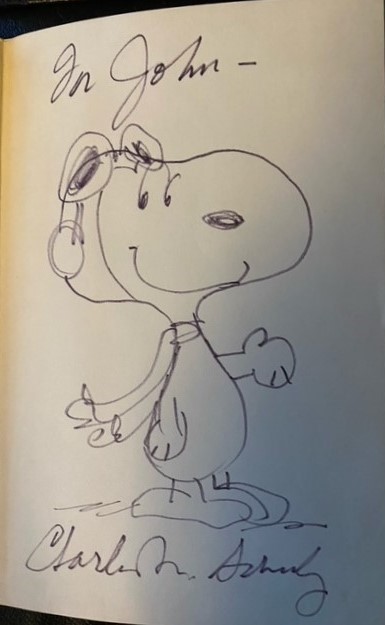
Schulz, Charles M.  Snoopy and His Sopwith Camel.  New York: Holt, Rinehart and Winston, 1969.  First Edition.  A sequel to Snoopy and the Red Baron, tales of Snoopy’s World War I flying ace adventures.  This copy is inscribed, “For John - Charles M. Schulz,” and with an original full-page hand-drawn portrait by Charles Schulz of Snoopy smiling and wearing goggles, a scarf, and a flight cap.

Charles Schulz inscription with drawing

The collector was fortunate to acquire the book inscribed to “John” even though Charles Schulz passed away in 1999.  The collector’s first name is John!


Noah Webster and Charles Pooler spellers

Spelling matches became popular in the United States in the 1800s, with the first documented spelling match occurring in 1808.  By 1850, the contests became known as spelling bees and were held in schools and towns throughout the country.  Their advent coincided with the publication of spelling books introduced a few years earlier.  Noah Webster’s first spelling book was published in 1786.  Webster’s spellers quickly became the standard for both spelling bees and elementary classroom instruction, though other spelling books such as Pooler’s Test Speller were widely available.  The first national spelling bee was held by the National Education Association during its annual conference in Cleveland, Ohio, in 1908, the same year Webster’s then-newest edition speller was published.

Webster, Noah.  The Elementary Spelling Book, Being an Improvement on the American Spelling Book.  New York: American Book Company, 1908.  First published in 1786 as The American Spelling Book, Webster’s speller was colloquially known as “the Blue-backed speller” and was an essential part of the curriculum for elementary school children.  Because the nickname stuck, later editions such as this copy of The Elementary Spelling Book were also bound in a blue cover, even as the name of the book changed with new editions.  The publication of this 1908 edition coincided with the first national spelling bee.

Pooler, Charles Thomas.  Pooler’s Test Speller for the Use of Teachers’ Institutes and Other Spelling Classes.  New York: American Book Company, 1875.  At only 79 pages, Pooler’s Test Speller—compared to Webster’s 174-page The Elementary Spelling Book—was a less comprehensive spelling list, focusing on words which are harder to spell correctly.


Poems of Childhood and A Child's Garden of Verses

Field, Eugene.  Poems of Childhood.  New York: Charles Scribner’s Sons, 1904.  Illustrated by Maxfield Parrish.  First American Edition.  Bound in 3/4 leather with raised bands and gilt tooling on the spine, matching the following title.

Stevenson, Robert Louis.  A Child’s Garden of Verses.  New York: Charles Scribner’s Sons, 1905.  Illustrated by Jessie Willcox Smith.  First American Edition.  Binding matching the above title.


Our Soldier Boy

Fenn, George Manville.  Our Soldier Boy.  Philadelphia: Henry Altemus Company, 1900.  With original dust jacket, bearing advertising for other titles by the publisher.  Fenn was a prolific English writer, authoring 161 children’s books as well as several short stories, biographies, plays, and other works.  His most notable children’s books are Young Robin Hood (1899) and The Bag of Diamonds (1887).  His last published book was George Alfred Henty, a biography of a fellow juvenile writer, published in 1907.


Kardoo, the Hindoo Girl, and Other Stories

Brittan, Harriet G., et. al.  Kardoo, the Hindoo Girl, and Other Stories.  Philadelphia: Presbyterian Board of Publication, 1869.  From the publisher’s Series for Youth, eight stories on the social life and customs of Hindu children for the purpose of educating children with the hope that “American children will pity and pray for heathens in other lands.”  The title story, “Kardoo, the Hindoo Girl” by Harriet G. Brittan was republished from the London Religious Tract Society.  Brittan was a British-born American missionary to Liberia, India, and Japan; in India, she served with the Zenana missionaries.  Zenana missionaries were female missionaries sent to British India to convert women to Christianity, beginning in 1854.  The missionaries would meet with the Indian women in the zenana, a private part of the house where men were not allowed.  Tracts such as these were written to inspire girls and encourage them to become missionaries themselves.


July 2025: US Presidents

One member's unintentionally assembled collection of signed presidential books Getting an early start on the Fourth of July festivitie...