Book collectors and bibliophiles tend to enjoy books about
books, and not just bibliographies. Nonfiction
books about books may also include booksellers’ memoirs, collectors’ acquisition
adventures, or librarians’ funny or cringe-worthy encounters, for example;
bibliononfiction covers a spectrum of books about books. Bibliofiction might encompass even more
genres. If a story takes place in a
bookshop or a library, it likely counts.
If the central character is a bookseller, librarian, book collector, or
even a publisher or editor, the story is likely bibliofiction. And if a purloined manuscript or a rare first
edition is a MacGuffin—an object, device, or event which serves as a trigger
for the plot—then the story is definitely bibliofiction. These stories, more often than not, tend to
be mysteries; writers seem to enjoy making readers squirm when a book is stolen
or a manuscript is believed to be destroyed in a fire. Bibliomysteries range from gumshoe whodunits to
decades- or centuries-old origin stories.
With all these options for bibliomystery, bibliofiction, and
bibliononfiction—terms not found in any dictionary but perfectly recognizable
by bibliophiles (which is in the dictionary)—they were a fun subject for the
November 2020 meeting.
Bibliomystery
 |
| Ex-Libris |
King, Ross. Ex-Libris. New York: Walker & Company, 2001. Best known for his historical fiction, King
takes the reader back to the turmoil of Seventeenth Century Europe, when an
English bookseller is hired to track down a rare, missing manuscript in order
to restore a great library disassembled during the war. The story is told in two parallel narratives:
the bookseller’s quest in the late 1600’s to recover the manuscript, and the
destruction of Prague earlier in the century when books were taken from the
library of a castle in an effort to preserve them. The story traverses both time and geography
as it weaves together the bookseller’s present and the manuscript’s past, and
as it moves throughout Europe from Prague to London. This copy is a first edition, signed and
dated in the year of publication on the title page.
 |
| The Bookman's Promise |
Dunning, John. The
Bookman’s Promise: A Cliff Janeway Novel.
New York: Scribner, 2004. The
third of the Cliff Janeway series, The Bookman’s Promise finds Janeway,
a retired detective turned bookseller, the center of attention after he
purchases a rare first edition of a book by the explorer Sir Richard Francis
Burton. The publicity from the sale at
auction attracts an elder woman who claims the book was part of a collection
scammed from her family by an unprincipled bookseller. The old woman recounts her family’s
connection to Burton and the book, going back to the pre-Civil War United
States, where Burton and her grandfather explored the southern US. Janeway promises the woman, now on her
deathbed, he will find the rest of the family collection, missing now for
eighty years. This copy is a first
edition, signed by the author on the title page.
 |
| The Bookman's Tale and First Impressions |
Lovett, Charlie. The
Bookman’s Tale. New York: Viking,
2013. While reading up on
Shakespeare forgeries, an antiquarian bookseller discovers a Victoria watercolor
of a woman bearing an uncanny resemblance to his recently deceased wife. His obsession with the portrait leads him on
a search for the origin of the picture.
The clues lead him all the way back to Shakespeare’s time and
information which may reveal the true identity of the Bard himself.
Lovett, Charlie. First
Impressions. New York: Viking, 2014. While working at a rare books shop in London,
a Jane Austen enthusiast becomes intrigued when two customers in quick
succession seek the same rare edition of a book. Her curiosity leads her to the life of the
author of the book and his connection to Jane Austen; and what she learns could
ruin the reputation of her favorite writer.
 |
| Magpie Murders |
Horowitz, Anthony.
Magpie Murders. New York:
Harper, 2017. Editor Susan Ryland
curls up with a glass of wine to read the latest manuscript of her bestselling
author Alan Conway. She gets engrossed
in Conway’s detective Atticus Pünd mystery—which the reader gets to read along
with her—only to discover it is incomplete.
When she is unable to contact Conway, she goes to his house to retrieve
the remaining chapters only to discover Conway’s dead body. Conway’s death is suspicious, and Ryland must
solve the mystery of his murder in order to locate the missing ending of
Conway’s manuscript. Ryland must become
her own detective and solve a murder so that the fictional detective Atticus
Pünd can do the same.
Bibliofiction
 |
| Parnassus on Wheels and The Haunted Bookshop |
Morley, Christopher.
Parnassus on Wheels. New
York: J. B. Lippincott, 1955.
Illustrated by Douglas Gorsline.
First published in 1917. Morley’s
first novel follows a travelling bookstore-wagon, the Parnassus on Wheels. The Parnassus, named after Mount Parnassus,
the home of the Muses in Greek mythology, is pulled by a horse named Pegasus
and owned by bookseller Roger Mifflin.
In his travels, Mifflin meets brother and sister Andrew and Helen. Helen buys the travelling bookstore not only
to treat herself to what she believes to be an adventure but also to prevent
her novice author brother from buying it first.
Morley, Christopher.
The Haunted Bookshop. New
York: J. B. Lippincott, 1955.
Illustrated by Douglas Gorsline.
First published in 1919.
Bookstore proprietor Roger Mifflin returns, now owning The Haunted
Bookshop, a brick-and-mortar bookstore where strange—though not
supernatural—events begin to take place, such as the disappearance and
reappearance of a copy of Thomas Carlyle’s Letters and Speeches of Oliver
Cromwell. Aubrey Gilbert, an
acquaintance, becomes suspicious of Mifflin and the unusual events taking place
in and near the bookstore. Gilbert
confronts Mifflin and the two men become convinced that someone else is behind
the increasingly dangerous happenings and, together, they uncover an espionage
ring and assassination plot against President Woodrow Wilson. The story is full of allusions and references
to well-known authors at the time—including Emerson, Thoreau, Shaw, Chesterton,
Barrie, Conrad, Keats, and Dickinson—and their works. Humorously, among the many book titles named
by Morley in The Haunted Bookshop is his own Parnassus on Wheels.
 |
| The Forgers and The Forger's Daughter |
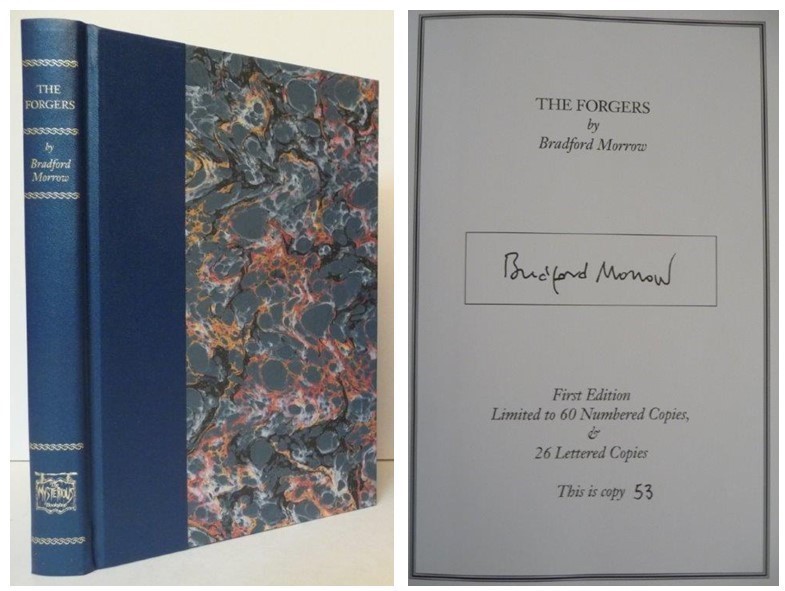
Morrow, Bradford. The
Forgers. New York: Mysterious Press,
2014. Will, a literary forger, finds
himself in an uncomfortable position following the death of a rare book
collector who happens to be the brother of his girlfriend, Meghan. After the police are unable to identify a
suspect and the case goes cold, Will begins receiving mysterious and
threatening letters written in the hand of deceased famous authors and
containing information about the book collector’s death. Fearing for their lives, Will and Meghan set
out to make a new life for themselves, but can they escape the letter writer? This copy is a signed limited edition of only
86 copies, signed by the author on the limitation page.
Morrow, Bradford. The
Forger’s Daughter. New York:
Mysterious Press, 2020. Set twenty
years after The Forger, Will, a now-reformed ex-forger, and his wife,
Meghan, find themselves in trouble when Will is threatened and forced back into
the dark world of literary forgery. A
former nemesis and fellow forger coerces Will into creating a forgery of Edgar
Allan Poe’s Tamerlane, the rarest book in American literature. To create the flawless forgery, Will must
enlist the help of his oldest daughter, a talented artist.
 |
| The Forgers, signed limited edition |
 |
| Autoboyography |
Lauren, Christina.
Autoboyography. New York:
Simon & Schuster, 2017.
Christina Lauren is the pen name for the writing duo Christina Hobbs and
Lauren Billings. Autoboyography
is a story told in first-person narration by Tanner, a high school senior who
takes a writing seminar in which the sole assignment is to write a full novel
by the end of the semester. The
instructor brings in Sebastian, a former student whose own seminar novel from
the previous year is now being published, as a mentor. The relationship between Tanner and Sebastian
grows beyond the classroom to the romantic, while Tanner is unable to put pen
to paper and begin his novel. He
ultimately writes a thinly disguised story about his relationship with Sebastian,
but as the semester draws to a close decides he would rather fail the course
than turn in the book because it would out Sebastian and harm his debut book
tour. He gives a copy to Sebastian,
however, who in turn hands in the assignment on his behalf. Christina Lauren breaks the first-person
narrative in the final chapters to reveal the story the reader has been reading
thus far is, in fact, Tanner’s seminar novel, and to conclude the boys’
post-seminar story.
Bibliononfiction
 |
| Dukedom Large Enough |
Randall, David A. Dukedom
Large Enough: Reminiscences of a Rare Book Dealer, 1929-1956. New York: Random House, 1969. As a book collector, bookseller, and
librarian, Randall spent most of his life surrounded by books. From 1935 to 1956, he was the head of Scribner’s
rare book department. He then became the
Lilly Librarian at Indiana University when Josiah Lilly donated his collection
to the university. Randall also served
as a professor of Bibliography at the university. In Dukedom Large Enough, Randall
reflects mostly on his time at Scribner’s rare book department, chronicling
some of the fantastic material which passed through his hands, including the re-discovery
and sale of the Schuckburgh copy of the Gutenberg Bible.
 |
| Can You Ever Forgive Me? |
Israel, Lee. Can
You Ever Forgive Me?: Memoirs of a Literary Forger. New York: Simon & Schuster, 2008. In this unapologetic memoir, Israel tells how
she went from a published biographer to a forger of letters by literary giants
such as Dorothy Parker, Noel Coward, and Lillian Hellman. She describes how she “plummeted from
best-sellerdom to welfare,” where she found herself selling a letter from a
well-known author for much-needed cash.
The bookseller buying the letter commented that she would have paid more
if the content of the letter had been better.
This prompted Israel to begin forging letters with humorous, scandalous,
or consequential content. Booksellers
around the country soon grew suspicious of the Israel letters, and she was
arrested by the FBI. Israel does not
defend her actions, but she does defend the quality of her forgeries, claiming
they were the best writing she ever created.
 |
| Sample forged letters by Lee Israel |
Somewhere between Bibliofiction and Bibliononfiction… and
Bibliomystery?
 |
| Party: A Literary Nightmare |
Lambeck, Frederick.
Party: A Literary Nightmare.
Garden City, NY: Doubleday, Doran & Co., 1936. “This volume has been printed and bound at
the Country Life Press, Garden City, New York, especially for the New York
Times National Book Fair, Rockefeller Center, November, 1936.”
 |
| Party copyright and first page of story |
The book opens with the narrator—presumably, Frederick
Lambeck—recalling a dream in which he is invited to a party hosted by Doubleday
Doran in conjunction with the 1936 New York Times National Book Fair. The narrator attends the party and describes
the guests and the goings on of the event, dropping the names of 262 authors within
the 37-page short story. During the
party, the publisher’s colophon is stolen—it’s a dream so this doesn’t have to
make sense—and the guests panic and then begin to whisper at who they suspect the
culprit may be. The story ends abruptly
as the narrator awakens.
 |
| First pages of Doubleday Doran catalogue |
The short story is immediately followed by a list of the
“authors mentioned at the party and their books.” The list is Doubleday Doran’s complete 1936
catalogue of books in print. The
volume—the short story and the catalogue—is a hardback bound book which was
distributed from the Doubleday Doran booth to attendees of the 1936 New York
Times National Book Fair. The pastedown
label on the front of the book is an invitation to a party, hosted by Doubleday
Doran, at the Country Life Press in Garden City, Long Island, New York. The invitation serves not only as a graphic
for Lambeck’s name-dropping short story but also as an actual invitation to a
real party hosted by the publisher. It
begs the question: how many attendees of the New York Times National Book Fair received
the catalogue, figured it out, and attended the Doubleday Doran party?