Thursday, February 28, 2019

February 2019: Romance

Romance served as the topic for the February 2019 meeting.  The topic proved challenging as no one in the group collects Harlequin or Silhouette romance novels; but, using some creativity, members brought an array of books ranging from classic Romanticism to modern young adult fiction.  Many of these romantic poems and stories have been adapted into films, plays, and operas.

Facsimile of original manuscript of "Annabel Lee"
Poe, Edgar Allan.  "Annabel Lee."  1849.  A facsimile of the original manuscript in Edgar Allan Poe's handwriting of "Annabel Lee."  During our meeting we listened to a recording of the poem, read by Vincent Price, of the heart-rending loss of the beautiful Annabel Lee.

Lady of the Lake
Scott, Sir Walter.  Lady of the Lake.  London: T. Nelson and Sons, 1869.  Illustrated with early tipped in photos of different lochs and scenes around Scotland.  Sir Walter Scott's poetic version of the classic enchantress of the lake legend involves the contest among three men to win the love of Ellen Douglas.  The polished wood boards for this book are from the famous field of Bannockburn where the Scottish King, Robert the Bruce, defeated the English in the first war of Scottish independence.  The Lady of the Lake was adapted to silent film in 1928, starring Benita Humas as the Lady in the Lake.  The poem is also the basis for Rossini's opera La Donna del Lago.
Frontispiece and title page, Lady of the Lake

 
The Scarlet Letter
Hawthorne, Nathaniel.  The Scarlet Letter.  Boston: Houghton, Mifflin and Company, 1878.  Second edition.  All edges gilt.  Illustrated with an engraved frontis portrait, 29 black-and-white illustrations drawn by Mary Hallock Foote and engraved by A.V.S. Anthony, and ornamental head-pieces are by L.S. Ipsen.  A red line borders the text.  The Scarlet Letter has been adapted to film at least seven times, the first being in 1926 starring Lillian Gish as Hester Prynne.
Illustration from The Scarlet Letter

Jennie Gerhardt
Dreiser, Theodore.  Jennie Gerhardt.  New York: Harper & Brothers, 1911.  First edition, first state.  Bound in green cloth with gilt titles.  Dreiser's second novel, after Sister Carrie (1900).  Dreiser wrote it as a social realistic novel but after cutting it by 16,000 words, it became a love story.  Jennie Gerhardt was adapted to film in 1933, starring Sylvia Sidney as the eponymous Jennie.

Pearl Cleage novels
Cleage, Pearl.  Some Things I Never Thought I'd Do.  New York: Ballantine Books, 2003.  First edition.  Inscribed by the author on the title page.
Cleage, Pearl.  Seen It All and Done the Rest.  New York: Ballantine Books, 2008.  First edition.  Signed by the author on the title page.
Some Things I Never Thought I'd Do and Seen It All and Done the Rest are two of the first six novels in a succession of books—though not a series—in which Cleage tells stories mostly set in Atlanta with a black woman as the central character in each story.  Minor characters in one story become central characters in another story.  Each story focuses on the love interest and romance of its main character, who Cleage seeks to portray as a strong black woman.  But in most cases—betraying Cleage's own womanist perspective—the main character ends up in a perilous situation and ultimately has to be rescued by her man. 

Becky Albertalli novels
Albertalli, Becky.  Simon vs. the Homo Sapiens Agenda.  New York: Balzer + Bray, 2015.  First edition.  Signed by the author on the title page.
Albertalli, Becky.  The Upside of Unrequited.  New York: Balzer + Bray, 2017.  First edition.  Signed by the author on the title page.
Albertalli, Becky.  Leah on the Offbeat.  New York: Balzer + Bray, 2018.  First edition.  Signed by the author on the title page.
In what has become known as the "Simon-verse," Albertalli's first book, Simon vs the Homo Sapiens Agenda tells the story of Simon and his online relationship with "Blue," another student at his high school who has not yet revealed his identity.  In a climactic scene, Blue finally reveals himself as a known character throughout the story.  The second book in the trilogy, The Upside of Unrequited, follows 17-year-old Molly, a cousin of a Simon character and a self-described "prolific crusher," through her 26 unrequited loves of the summer.  The third book, Leah on the Offbeat, returns to Simon's high school and his best friend, Leah, as she finds first love in the midst of senior-year angst.  Albertalli announced at the 2018 Decatur Book Festival that Leah would conclude the Simon-verse, to the audible disapproval of the teens and young adults in the audience.  Simon vs. the Homo Sapiens Agenda was adapted to film as Love, Simon in 2018, starring Nick Robinson as Simon.

Saturday, January 19, 2019

January 2019: Private Press – Fine Press and Small Press Books


Private press books served as the topic for the January 2019 meeting, exploring the artistic and intrinsic quality of fine press books and the regional focus, narrow specialization, and niche genres of small press books.  While fine and small presses have different definitions, the two are not mutually exclusive as many fine books' publishers are also small press publishers.  Even though this blog uses the two categories for organizational purposes, several of the fine press books were produced by small press publishers.
Fine press books often describe the typography and printing methods used in the production of its books and may even detail the paper and other materials used in printing and binding the books.  This information is common in most limited-edition books.  Examples of such typography detail are shown in several of the limited editions shown this month, as indicated on either a limitation or copyright page.

Fine Press Books


Title Page, The Song of Songs
Authorized Version.  The Song of Songs, Called by Many the Canticle of Canticles, Printed and Published at the Golden Cockerel Press at Waltham St. Lawrence in Berkshire in the Year MCMXXV.  Waltham St. Lawrence, England: Golden Cockerel Press, 1925.  The colophon reads: “This book was printed by Robert Gibbings at the Golden Cockerel Press and Completed on the XVII. day of October MCMXXV.  The illustrations have been designed and engraved on wood by Eric Gill.  Compositors: F. Young and A. H. Gibbs.  Pressman: A. C. Cooper.  The Edition is limited to seven hundred and fifty numbered copies, of which this is No. 548.”  The Golden Cockerel Press was one of the greatest fine presses of the twentieth century.  In 1925, the press had just been taken over by Robert Gibbings (1889-1958), and Song of Songs was one of the first books published by him.  Eric Gill (1882-1940) is one of the twentieth century’s greatest typographers and illustrators, be it via stone carving or wood engraving.  He provided specially designed typefaces for Golden Cockerel Press and also illustrated a number of their books.
First illustration and first page, The Song of Songs
Chris Adamson, posted on BooksAndVines.com, January 11, 2012:
One quick look through the Golden Cockerel Press edition of The Song of Songs is all it takes to understand both the illustrative genius of Eric Gill and why copies of it were seized and destroyed by New York Customs when imported into the United States early last century.  Given the Song of Songs is a book of the Hebrew Bible, Gill’s emphasis on the erotic nature of the story would cause consternation among some even today.  While some may more politely use the word ‘romantic’ rather than ‘erotic’ in describing the illustrations, it certainly pushes the envelope considering its place in the Bible.  In any case, there is no denying the artistic magnificence of the work.


Front cover, Antiquities
Crowley, John.  Antiquities: Seven Stories.  Seattle: Incunabula, 1993.  Trade edition.  Limited to 1,000 trade edition copies and 77 copies of a signed and numbered limited edition.  A collection of short stories by a writer better known for long form, collected in one volume for the first time.  The seven stories span every period of the writer's twenty-year writing career. 


Front cover, prospectus, and limitation page, Reflections on Travels With My Aunt
Greene, Graham.  Reflections on Travels With My Aunt.  New York: Firsts and Company, 1989.  A limited edition of 250 signed and numbered copies, of which this copy is No. 110, together with an original prospectus for the book.  Contains both a facsimile holograph of Greene's manuscript and printed text.  A fine binding reprint of Greene's new introduction to Travels with My Aunt for the 1980 Bodley Head/ Heinemann Collected Edition in 1980.  The holographic manuscript was printed offset by the Allethaire Press, and the text was printed letterset by The Grenfell Press.  The fine books publisher Firsts & Company was founded in 1989 and Reflections on Travels With My Aunt is the only book it ever produced.


Front cover, title page, copyright/limitation page, Dear David, Dear Graham
Greene, Graham and David Low.  Dear David, Dear Graham: A Bibliophilic Correspondence.  Oxford: The Alembic Press, 1989.  Published jointly with The Amate Press, Oxford.  A limited edition of 250 numbered copies, of which this copy is No. 236.  A collection of correspondence between author Graham Greene and bookseller David Low from 1971 though 1984, on matters related to books, bookselling, and publishing.  The Alembic Press, founded in 1972, is a fine press which, through 2016, printed 148 fine and limited-edition books.  This title is published jointly with The Amate Press, to which David Low was deeply connected; the Amate Press published only a dozen books between 1973 and 1992, not counting jointly-published books printed by other printers.


Front cover, Gilgamesh: King of Erech
Lucas, F. L.  Gilgamesh: King of Erech.  London: Golden Cockerel Press, 1948.  With twelve engravings by Dorothea Braby.  This is a hardback book (no dust jacket) published in a limited edition of 500 numbered copies of which this is No. 270.


Cover and limitation page, A Leaf from the Kelmscott Chaucer
Windle, John.  A Leaf from the Kelmscott Chaucer with an Essay on Its Commercial History.  San Francisco: Arion Press, 1994.  Folio size.  Produced in a limited edition of 100 numbered copies of which this is No. 22.  Each of the 100 leaf books contains one page from a broken copy of an original 1896 edition of the Works of Geoffrey Chaucer, published by William Morris at the Kelmscott Press, with designs by Sir Edward Burne-Jones, of which only 438 were printed.  Leaf books are normally produced from damaged copies in order to save some of the undamaged pages so collectors can enjoy them at a much-reduced cost.  The original complete book itself can cost over $100,000 when one rarely comes on the market. 
Recto and Verso, Leaf page from the Kelmscott Chaucer
The Kelmscott Chaucer is considered the first of the modern private presses to be concerned with the fine details of typography and with the book as an art form.  It is often regarded as the most beautiful printed book in the English Language.  The true bibliophile delights in the superb quality of the wood-engraved illustrations, the fine large decorated borders, the special Chaucer type, all impressed with rich, dark ink upon large folio-size paper. 


Cover and title page, Fine Printing in Georgia
Zachert, Martha Jane K.  Fine Printing in Georgia, 1950s–1990: Six Prize-Winning Private Presses.  Athens, Georgia: The Press of the Nightowl, 1994.  This copy being No. 14 of 40 bound in quarter leather and signed by the author and printer.  A very good bibliography of small and fine private presses in Georgia. 
Limitation page and Table of Contents, Fine Printing in Georgia


Small Press Books


Title Page, The Book of Common Prayer
Book of Common Prayer.  The Book of the Common Prayer.  London: William Pickering at the Chiswick Press, 1844.  The Chiswick Press was founded in 1811 by Charles Whittingham and later taken over by his nephew, also Charles Whittingham, and later by William Pickering, who in 1844 produced his first work at the Press.  This was a beautiful set of 8 folio facsimiles of the Book of Common Prayer from Henry the Eighth through Queen Victoria, which have been regarded as “the outstanding achievement of nineteenth century printing” before the Kelmscott Press was created in 1891.  This first volume in the set represents in facsimile the first Prayer Book of King Edward the Sixth, published in 1549.  The woodcut facsimile titles and wood-engraved initials and ornaments were done by Mary Byfield.
Sample pages, The Book of Common Prayer


Front cover, Atlanta Illustrated
Clarke, E. Y.  Atlanta Illustrated.  Atlanta: Jas. P. Harrison & Co. Publishers and Printers, 1881.  Third Edition.  A book about the history of Atlanta that is rare.  Includes many drawings of post-Civil War Atlanta landmarks, giving a glimpse of the beautiful old buildings that used to be throughout the city.  A former library copy, but in good condition with minimal markings.  According to information on the internet, the publisher was in business for less than twenty years.
Title page and sample illustration, Atlanta Illustrated


Title page and printer's postscript, signed, The Poetical Books of the Bible
Davie, James.  The Poetical Books of the Bible.  Edinburgh: James Davie, 1891.  This very rare translation of the books of Job, the Song of Songs, Ecclesiastes, Lamentations, Isaiah, Proverbs, the Psalms, miscellaneous pieces from Joel, Micah, Nahum, Habakkuk, the Last Song of Moses, the Song of Deborah, the Song of Hannah, and Lamech’s Lament, was privately typeset and printed by the author, and limited to 25 copies. This copy is No. 4 and was presented by the author to his son. There is a note at the end of the Preface where the author/printer states: “Besides the many imperfections in this work, of all kinds, an apology is due for the unworkmanlike printing of it. The excuse for this is that the type-setting and printing, page by page, have been done solely by myself, under numerous difficulties, at odd and sometimes wide apart intervals, and its production has consequently been spread over more years than I care to say. The faulty appearance of the workmanship, however, may probably be considered to be quite as good as the contents deserve!”


Cover, frontispiece, and title page, The Field Diary of a Confederate Soldier
Haynes, Draughton Stith.  The Field Diary of a Confederate Soldier.  Darien, Georgia: The Ashantilly Press, 1963.  Includes the original dust jacket.  Inscribed on the front free end paper by the publisher of the Ashantilly Press.  One of an edition of only 400 copies which now has become quite scarce on the market.  This title is listed in Fine Printing in Georgia, 1950s–1990 (above).
Limitation page and first page, The Field Diary of a Confederate Soldier


Cover and title page, Father Damien
Stevenson, Robert Louis.  Father Damien: An Open Letter to the Reverend Dr. Hyde of Honolulu from Robert Louis Stevenson, with a Statement by Mrs. Stevenson.  Notre Dame, Indiana: Ave Maria Press, n.d.  Father Damien was originally issued in 1890; the Ave Maria Press special edition has no publication date, but the Preface is dated 1911.  The title has been reprinted numerous times over the years, but the Ave Marie Press issue was small, making it a bit hard to find.  Ave Marie Press was started by the Rev. E. Sorin, a Holy Cross priest, in 1865.  Rev. Sorin had earlier founded the University of Notre Dame.  The press was created to publish a Catholic magazine, but also printed books by select authors.


Book and slipcases, Hitherto Unpublished Prose Writings
Stevenson, Robert Louis.  Hitherto Unpublished Prose Writings.  Boston: The Bibliophile Society, 1921.  Edited by Henry H. Harper.  Limited edition of 450 copies, printed for members only.  Double-Boxed/Slip-cased.  Illustrated with facsimiles of Stevenson's manuscripts.  The Bibliophile Society of Boston, founded in 1901, was one of many bibliographic societies common across America in the late 1800s and early 1900s, though one of the few to print its own books.  The Bibliophile Society had its own printing press, which was occasionally made available to its members to print their own volumes.  The Bibliophile Society preceded Stevenson's Hitherto Unpublished Prose Writings with its 1916 and 1921 editions of Stevenson's Poems Hitherto Unpublished.
Title page and bookplate, Hitherto Unpublished Prose Writings


A History of Southern Football, 3 volumes
Woodruff, Fuzzy.  A History of Southern Football, 1890–1928, In Three Volumes.  Atlanta: Georgia Southern Publishing Company, 1928.  This three-volume set tells about the origins of southern college football.  Written by Lorenzo Ferguson "Fuzzy" Woodruff, one of the great sportswriters of the early twentieth century, it goes into detail documenting famous games complete with team rosters.  A scare set in good condition. First acquired by the owner because he coached high school football.
Title page (Vol. 1) and sample pages, A History of Southern Football

Wednesday, November 28, 2018

November 2018: Military History


Inspired by Veterans Day, Military History served as the topic for the November 2018 meeting.  The theme produced an array of books ranging from biographies of significant figures in different wars to books and Bibles carried by soldiers in battle.  Booklets and pamphlets ranged from a military-issued handbook for US forces in Vietnam to propaganda literature intended to bolster support the war effort during WWII.  The theme even inspired a copy of the 1636 Book of Common Prayer that helped fuel the English/Scottish Civil War.  A selection of the books presented are offered in a chronological order of the wars they represent.

British Civil Wars (Wars of the Three Kingdoms)


Scottish Prayer Book
Scottish Prayer Book.  The Booke of Common Prayer.  Edinburgh: Printed by Robert Young, 1637.  Bound with The Psalmes of King David: Translated by King James.  London: Printed by Thomas Harper, 1636.  In 1637, King Charles the First and William Laud, Archbishop of Canterbury, imposed an Anglican Book of Common Prayer on the Church of Scotland, which strongly opposed the use of a prescribed liturgy. They requested William Alexander, the Earl of Stirling, to compose a new paraphrase of the Psalms to supplement the work, which they ascribed to King James himself in the hope that since the former king had served as the King of Scotland before unifying Scotland and England, it would make the whole effort more acceptable. The day the Prayer Book was used in Edinburgh a riot ensued, when the Bishop had to be escorted under guard from the cathedral. Its imposition became one of the final straws which led to the English/Scottish Civil War, the execution of King Charles, and the establishment of the Commonwealth under Oliver Cromwell. This is the first printing of the Scottish Prayer Book, bound with the Psalms attributed to King James.

Lord Fairfax’s Paraphrase of the Psalms
Fairfax, Thomas.  "The Psalms of King David Paraphrased into Verse Which May Be Sung According to the Tunes Used in Churches, by the Right Honorable Thomas, Lord Fairfax, 1669."  Manuscript.  Held in private collection, Atlanta.  Thomas, Lord Fairfax, served as Commander-in-Chief of the British Military under King Charles the First, and it was he who argued before Parliament that the King should not be put to death. When Oliver Cromwell established the Commonwealth, Lord Fairfax was named Commander-in-Chief of the Commonwealth Military. After a disagreement with Cromwell regarding an aggressive move on a Scottish village, Lord Fairfax resigned his post and retired to his family’s country estate, where he devoted much of his time to composing a new paraphrase of the Psalms and other poetry. His rough draft is housed in the Bodleian Library at Oxford University. In 1669, he wrote out by hand what he thought were his best versions as a gift to his family, and he died two years later. His poetry has never been published. This is his manuscript left with the family. Since he wrote only on one side of each page, a relative after his death copied all of his other poetry on the reverse side. The book was purchased from a shop in Manchester, England, which specialized in military memorabilia.
Lord Fairfax's Psalm 23 and Psalm 103

American Revolution


The History of the American Revolution
Ramsay, David.  The History of the American Revolution: In Two Volumes.  Philadelphia: Aitken & Son, 1789.  This copy has both volumes bound together in contemporary leather with a more recent re-backed spine and the original title label laid down.  The 1789 first edition of his book is now quite rare.  Ramsay's account was one of the first and most accomplished histories to appear in the aftermath of that event.  David Ramsay (1749–1815) was an American physician, public official, and historian who participated in many of the events during the Revolution.  He wrote with firsthand knowledge and access to many of the participants and documents having been a member of the South Carolina legislature, a delegate to the Continental Congress, and a member of the South Carolina militia as a field surgeon.
Title pages and Preface to Ramsay's The History of the American Revolution

American Civil War


Confederate New Testament
Authorized Version (King James Version).  New Testament.  Augusta, GA: Confederate States Bible Society, 1862.  The First Confederate Printing of the New Testament. At the beginning of the Civil War, most of the American editions of the Bible were published by the American Bible Society in New York. As the war progressed, the Northern forces did not want to sell copies to the Southern states, and the Southern states did not want to make purchases from the North. They began to buy copies of the Bible imported from England, but these were too expensive for many of the ordinary people to afford. The Confederate States Bible Society, based in Augusta, Georgia, issued a New Testament under their name in 1862, which was printed by private printers in Atlanta. This is the first printing by the Confederate States Bible Society, in the original paper boards so it could easily be carried by soldiers in battle.

Stonewall Jackson: A Military Biography
Cooke, John Esten.  Stonewall Jackson: A Military History.  New York: D. Appleton & Company, 1866.  Illustrated with maps and frontispiece. 470 pages.  Original brown pebbled cloth.  During the Civil War, Cooke served as a staff officer for Major Gen. J.E.B. Stuart in the Confederate States Army cavalry and later served under Brig. Gen. William N. Pendleton.  His biography of Jackson is divided into three parts: Part I – Childhood to the Battle of Manassas; Part II – The Campaign of the Valley; Part III – From Port Republic to Chancellorsville.

Annual Report of the Adjutant-General of the State of New York For the Year of 1895
State of New York.  Annual Report of the Adjutant-General of the State of New York For the Year of 1895: Registers of the First and Second Veteran Cavalry, First and Second Mounted Rifles, in the War of the Rebellion.  New York: Wynkoop Hallenbeck Crawford Co., 1896.  Volume II, a supplement to the 1895 full annual report of the military department of the state, by E. A. McAlpin, Adjutant-General.  1,059 pages.  This volume lists the names, ages, dates of enlistments, ranks and home states of Union soldiers from these four army regiments, and includes the "mustering out" (discharge from service) or deaths of soldiers.  The title refers to the Civil War as "the War of Rebellion," which is consistent with official war records at the time.  During and immediately after the war, U.S. officials, Union states, southern Unionists, and pro-Union writers often referred to Confederates as "rebels," and the earliest histories published in northern U.S. states commonly refer to the American Civil War as "the Great Rebellion" or "the War of the Rebellion."  The official war records of the United States refer to this war as "the War of the Rebellion."
Sample roster from the Annual Report

World War Two


Paris or The Future of War
Hart, B. H. Liddell.  Paris or The Future of War.  London: Kegan Paul, Trench, Trubner & Co., Ltd., 1925.  First edition.  Hart, a British soldier in WWI and a military historian and theorist, articulates that the "indirect approach" to warfare is more effective than direct combat; he argues, for example, that air power and strategic bombings are faster and more efficient than ground battles, which he describes as prolonged bloodbaths.  His exemplar of the indirect approach is Paris, featured in the title; Paris does not refer to the capital of France but to the Trojan prince in Homer's Iliad who slays Achilles by shooting him with an arrow, attacking his weakness rather than his strength.  This book helped the Germans devise their blitzkrieg military strategy that was so successful in the first part of WWII.

The Man Who Never Was and Operation Mincemeat
Montagu, Ewen.  The Man Who Never Was.  Philadelphia: Lippincott, 1954.  First edition.

Macintyre, Ben.  Operation Mincemeat: How a Dead Man and a Bizarre Plan Fooled the Nazis and Assured an Allied Victory.  New York: Harmony Books, 2010.  First edition.

The Man Who Never Was and Operation Mincemeat both tell the story of a British deception operation during WWII to disguise the Allied invasion of Sicily in 1943, by disguising a corpse (a homeless man who died from eating rat poison) as a Royal Marine captain and planting falsified intelligence information on the body about a planned Allied invasion of Greece and Sardinia.  The rouse proved successful when the body was discovered and the documents were shared with German military intelligence, who sent reinforcements to the wrong locations.  Sicily was liberated quicker than expected and with fewer casualties than predicted.  The Man Who Never Was tells the story of Operation Mincemeat from the perspective of one of the participants, while Operation Mincemeat is more of a historical narrative using new material, previously unreleased by MI5 and Naval Intelligence, to tell the same story, but at a remove of almost 70 years.

When Books Went to War and two Armed Services Editions books
Manning, Molly Guptill.  When Books Went to War: The Stories that Helped Us Win World War II.  New York: Houghton Mifflin Harcourt, 2014.  Advancing the concept that books are weapons in the war on ideas, Manning documents the roles books played in the lives of US soldiers during WWII.  The book traces this history of the Victory Book Campaign (VBC), the formation of the Council on Books in Wartime, and the production and distribution of the Armed Services Editions (ASEs) and how they not only provided respite and entertainment for the soldiers but also helped combat the Nazi ideology that embraced censorship and the banning and burning of books.

Examples of the Armed Services Editions books included Graham Greene's The Ministry of Fear (Series #A-22), one of the first 30 ASEs issued in September 1943 in the larger size intended for soldiers' cargo pants pockets, and The Confidential Agent (Series #873), issued in October 1945 in the smaller size intended for carry in shirt pockets.

They Burned the Books and I, James Blunt
Benét, Stephen Vincent.  They Burned the Books.  New York: Farrar & Rinehart, Inc., 1942.  A radio play first broadcast on May 11, 1942, supported by the Council on Books in Wartime and the Writers War Board, the play commemorated the May 10, 1933, book burning in a public square in Berlin, Germany, by rallying Americans to support the war effort lest Germany win the war and impose similar censorship on the world.  Benet's characters in the play are authors, both living and dead, whose works have been banned by the Nazis.  The popularity of the production compelled the Writers War Board to publish the play quickly and disseminate it to libraries across the country.  Unbound copies were printed for use by nonprofit organizations supporting the war effort.  The unbound copy shown was distributed by one such organization, Citizens for Victory.

Morton, H. V.  I, James Blunt.  London: Methuen, 1942.  A future history (alternative history) short story set two years in the future, a post-war period in which Germany has won the war.  It depicts life in Nazi-occupied Great Britain and shows a world of martial law, paranoia, and revenge against those who resist the "complete Germanization" of the country.  The story takes the form of a diary kept by James Blunt, an English tradesman, who writes of fearing for his safety.  Morton was one of several popular British authors commissioned by the UK's Ministry of Information to write stories to help reinvigorate British citizens' support of the war.

Vietnam War


Handbook for U. S. Forces in Vietnam
United States Department of Defense.  Handbook for US Forces in Vietnam.  Washington DC: Armed Forces Information and Education, 1966.  June 10, 1966, edition; forward by General W. C. Westmoreland.  Official Department of Defense publication for use by personnel in the military services.  The handbook offers "basic techniques and procedures" for combatting "regular and guerilla forces" in South Vietnam.  The pocket-size handbook was given to all combat personnel.  It provided information and drawings of guerilla tactics used by the enemy, including pits, traps, and underground sniper holes.  The handbooks often contained photographs of models of enemy aircraft for identification purposes.  The handbook was intended to keep soldiers alert and up-to-date in order to "increase the effectiveness of our forces and preclude a repetition of past mistakes."
Forward and sample pages from Handbook for U. S. Forces in Vietnam

Sunday, October 28, 2018

October 2018: Catalogues, Bibliographies, and Resource Guides

The topic for the October 2018 meeting was Catalogues, Bibliographies, and Resource Guides.  The theme was inspired by John Payne's Great Catalogues by Master Booksellers (Austin: Roger Beacham, 2018).  Bookseller and auction house catalogues serve as a trove of valuable information for collectors.  Attendees brought exemplary copies of bookseller catalogues (Peter Harrington Antiquarian Bookseller, William Reese Co., Blackwell Rare Books, etc.) and auction catalogues (Sotheby's, Christie's, etc.) they have held onto over the years because of the material they contain.

Bibliographies

Members also brought annotated bibliographies of specific authors and genres which are helpful for their respective collections.


Bibliographia Oziana

Hanff, Peter E. and Douglas E. Greene.  Bibliographia Oziana: A Concise Blbliographical Checklist of the Oz Books by L. Frank Baum and His Successors.  Berkley, MI: The International Wizard of Oz Club, 1976.  First edition.  Contains photographs of all first-state covers and many of the later covers of the books in this checklist; also contains points of issue for identifying first editions.  Revised and expanded editions of Bibliographia Oziana were published in 1988 and 2002.


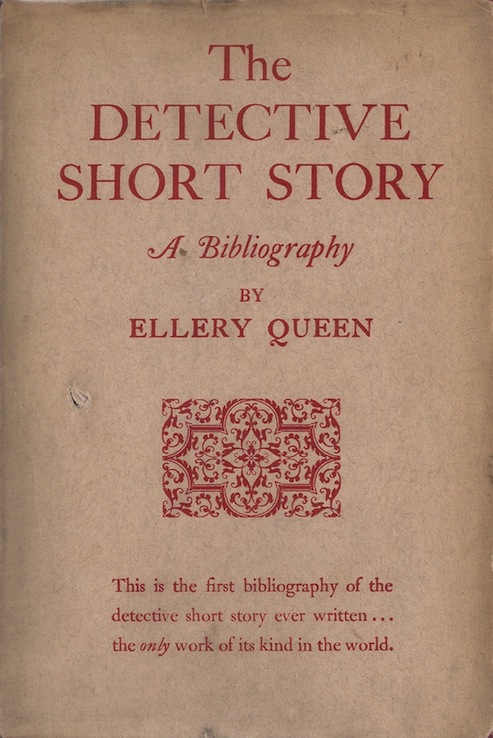
The Detective Short Story

Queen, Ellery.  The Detective Short Story: A Bibliography.  Boston: Little, Brown & Co., 1942.  First edition.  The first bibliography of detective short stories ever written.


Graham Greene bibliographies

Wobbe, R. A.  Graham Greene: A Bibliography and Guide to Research.  New York: Garland Publishing, 1979.  First edition.  Contains detailed descriptions of Greene's published works through 1978, including collation, pagination, and printing information for each book.

Wise, Jon and Mike Hill.  The Works of Graham Greene: A Reader's Bibliography and Guide.  New York: Continuum, 2012.  First edition.  Contains limited publishing information and information about each title as it relates to Greene's life and writing career.  Also includes Greene's contributions to others' works, periodicals, letters written by Greene, published interviews, films, and unpublished works.  Exhaustive, though incomplete, it spans the entirety of Greene's life and posthumously-published works.

Resource Guides

The group also discussed the value of resource guides for identifying first editions and points of issue, especially the handiness of McBride's pocket guides.

McBride's pocket guides

McBride, Bill.  A Pocket Guide to the Identification of First Editions, 7th revised ed.  Hartford, CT: McBride/Publisher, 2012.  List the methods that English-language publishers use to identify first editions of their books.

McBride, Bill.  Points of Issue: A Compendium of Points of Issue of Books by 19th-20th Century Authors, 3rd ed.  Hartford, CT: McBride/Publisher, 1996.  Identifies points of issue (changes made in a book during the production of the first printing of the first edition without that change being noted as a change elsewhere in the book) in books and dust jackets.

Thursday, September 20, 2018

September 2018: Charles Dickens


The topic for the September 2018 meeting was Charles Dickens and 19th Century Literature.  Attendees focused mainly on the works of Charles Dickens, who is known not only for his novels but also for his Christmas stories and religious writings (most notably The Life of Our Lord).  Fine examples of all three literary areas were shown during the meeting.


Novels

Several finely bound novels were presented, including Little Dorrit and David Copperfield.  Many nineteenth century collectors sent their new clothbound books off to their binder to be dressed up in attractive leather bindings to grace their library walls. 


David Copperfield
Dickens, Charles.  The Personal History of David Copperfield.  London: Bradbury & Evans, 1850.  First Edition.  Illustrated by H. K. Browne.  Re-bound in nineteenth century full brown calf with raised bands and gilt lines and title.  Originally issued in 1849-1850 in 20 parts as 19 individual volumes in green pictorial wraps (parts 19 and 20 combined in one final volume).  This is the first complete book edition with all 20 parts, originally bound in dark green cloth.  David Copperfield is considered one of the most beloved novels of the nineteenth century.
David Copperfield, front illustration and title page


Christmas Stories

Various editions of Dickens's Christmas stories were shared, including an omnibus edition of the Christmas Books together with a fine facsimile of the first edition of A Christmas Carol.

Christmas Books and A Christmas Carol
Dickens, Charles.  Christmas Books.  London: Chapman and Hall, 1866.  Three-quarter leather with marbled boards and closed page edges. All five Christmas books in one volume, printed with double columns, including: "A Christmas Carol"; "The Chimes"; "The Cricket on the Hearth"; "The Battle of Life"; and, "The Haunted Man".  Only illustration is the black-and-white frontispiece. Volume is showing wear at extremities, but still a lovely copy.

Dickens, Charles.  A Christmas Carol, in Prose: Being a Ghost Story of Christmas.  London: The Atlantic Monthly Press, 1920.  A facsimile of the first edition published in 1843 by Chapman and Hall.  Includes four-color and black-and-white illustrations by John Leach.  For the facsimile edition, the following statement is opposite title page: "By special arrangement with Mr. H. S, Nichols, of New York, The Atlantic Monthly Press issues this reproduction of the first edition of 'A Christmas Carol.'  When it was brought out by Mr. Nichols in 1914, it bore the following 'Endorsement,' signed by him: This is a genuine copy of my fac-simile edition of the excessively rare and almost unobtainable earliest issue of the original edition, to which has been prefixed an introduction and bibliographical data."
A Christmas Carol and Christmas Books

  
The Life of Our Lord

The religious writing of Charles Dickens is exemplified in The Life of Our Lord.  Dickens never wanted his manuscript published.  It was written for his children, to whom he read it aloud every Christmas.  It was a sacredly guarded precious family secret.  Upon the death of his last child, the remaining family decided to have it published.  It was first published, in serial form, in March 1934.  Later that year, it first appeared in book form, published concurrently in the UK and US by Associated Newspapers Ltd. and Simon and Schuster, respectively.  Several editions were shown, including first printings of both the first British and American editions.

The Life of Our Lord, first UK edition

Dickens, Charles.  The Life of Our Lord: Written Expressly for His Children by Charles Dickens.  London: Associated Newspapers Ltd., 1934.  First British Edition.  With a frontispiece of Charles Dickens.  In the original dust jacket. 
Frontispiece and title page, UK edition


The Life of Our Lord, first US edition
Dickens, Charles.  The Life of Our Lord: Written for His Children During the Years 1846 to 1849.  New York: Simon and Schuster, 1934.  First American Edition.  With a frontispiece of Charles Dickens.  In the original rather scarce dust jacket. 
Frontispiece and title page, US edition


July 2025: US Presidents

One member's unintentionally assembled collection of signed presidential books Getting an early start on the Fourth of July festivitie...