Thursday, March 31, 2022

March 2022: Pioneers

Pioneers was the topic for the March 2022 meeting.  The topic was originally "pioneers in their respective fields" but most of the books presented focused on a conventional understanding of pioneers as settlers and explorers.  Colonial venture, westward expansion, and space exploration led the topic in works of both fiction and nonfiction.

Colonial Venture and Westward Expansion

Nonfiction

Bradford's History "Of Plimoth Plantation"

Bradford, William.  Bradford's History "Of Plimoth Plantation": From the Original Manuscript, With a Report of the Proceedings Incident to the Return of the Manuscript to Massachusetts.  Boston: Wright & Potter Printing Co., 1898.  555 pages.  Originally known as The Log of the Mayflower, Bradford's logs and accounts of the Mayflower voyage and the early settlement of the Plymouth Colony were written between 1620 and 1651.  The manuscript vanished from the Old South Meeting House in Boston during the American Revolutionary War and reappeared at Fulham Palace in the Bishop of London's library in the 1840s.  After a lengthy custody battle, the manuscript was returned to Massachusetts and presented to the governor of the Commonwealth of Massachusetts during a joint session of the legislature on May 26, 1897.

Facsimile page of Bradford's journal (verso)

Bradford's journal was first published in America in June 1897.  This early edition, printed in 1898 by Wright & Potter, the State Printers, predates the "final authorized version of the text" published by the Massachusetts Historical Society in 1912.  Bradford's journal documents the story of the Pilgrims beginning in 1608, when they settled in the Dutch Republic, through the 1620 Mayflower voyage to the New World.  It includes a log of the Mayflower passengers as well as a brief history of what happened to each of them through the year 1647.  Bradford himself served as the 2nd Governor of the Plymouth Colony (as well as its 5th, 7th, 9th, and 11th governor).  The editions of Bradford's journal published in the United States include facsimile pages of the journal and Mayflower log as well as a report of the history of the original manuscript and its eventual return to Massachusetts.

Facsimile page of the Mayflower log (verso)


The Pioneers

McCullough, David.  The Pioneers: The Heroic Story of the Settlers Who Brought the American Ideal West.  New York: Simon & Schuster, 2019.  352 pages.  McCullough recounts the settling of the Northwest Territory through the stories of six men who were part of the first band of pioneers to set out from New England led by Revolutionary War veteran General Rufus Putnam.  Settlement in the Northwest Territory—a vast wilderness northwest of the Ohio River (modern day Ohio, Indiana, Illinois, Michigan, and Wisconsin)—was initially offered to veterans of the Revolutionary War who committed to three conditions of the Northwest Ordinance's "American Ideal": freedom of religion, free universal education, and the prohibition of slavery.  Much of McCullough's account is drawn from a collection of primary documents including diaries and letters from Putman and the other key figures followed in the book.


Fiction

The Pioneers

Cooper, James Fenimore.  The Pioneers, or the Sources of the Susquehanna; a Descriptive Tale.  2 vol.  New York: Charles Wiley, 1823.  First Edition.  Two volumes in early contemporary calf.  This is the first of five novels published which became known as the Leatherstocking Tales.  In The Pioneers, Cooper explores naturalist ideas and shows his concern for how the first American pioneers are mistreating the new frontier and how one, his protagonist Natty Bumpo, respects the land and wants to coexist with nature using only what he needs for his mere survival.  Cooper's tone is highly critical, if not outright mocking, of the carelessness and recklessness towards the wilderness exhibited by the settlers and the notion of established society.

Title pages of The Pioneers, Volumes One and Two


My Ántonia

Cather, Willa.  My Ántonia.  Boston: Houghton Mifflin Co., 1977.  419 pages.  First Edition Library facsimile. 

Cather, Willa.  My Ántonia.  Franklin Center, PA: The Franklin Library, 1978.  280 pages.  Illustrated by Liam Roberts. 

In what is considered to be Cather's best work, My Ántonia tells the story of Jim Burden, an orphaned boy from Virginia, and Ántonia Shimerda, the daughter of Bohemian immigrants.  They are each brought to Nebraska near the end of the 19th century as children of pioneers.  The story is told by Jim, who recounts meeting Ántonia in a place that is new to both of them and the strong impressions formed during their first year there.  Cather's original manuscript was rejected multiple times before her magazine editor read it and suggested she rewrite the story from Jim's point of view. 


Space Exploration

Footprints

MacKinnon, Douglas and Joseph Baldanza.  Footprints: The 12 Men Who Walked on the Moon Reflect on Their Flights, Their Lives, and the Future.  Washington, DC: Acropolis Books Ltd., 1989.  First Edition.  Published on the twentieth anniversary of the first lunar landing in 1969, the authors of Footprints conduct interviews with the twelve astronauts who walked on the lunar surface during the Apollo missions between 1968 and 1972.  These astronauts were true pioneers in the exploration of space and in Footprints they reflect on their missions, the space program, and the future of space exploration.  This copy is signed by six of the twelve astronauts who walked on the moon, one astronaut from each of the six Apollo moon landings: Buzz Aldrin, David Scott, Eugene Cernan, Alan Bean, Charles Duke, and Edgar Mitchell. 

Signatures of six of the Apollo astronauts interviewed in Footprints


Sunday, February 27, 2022

February 2022: Greatest Find or Buy

Collectors shared their Greatest Find and Greatest Buy during the February 2022 meeting.  Greatest Find was subjective and interpreted differently by each collector.  For some, their greatest find was a title, edition, or a particular copy which somehow anchored their collection or a sub-collection.  For others, it was a significant work in its respective genre or history, or a title which carried a sentimental attachment.  And for others, it was a truly rare, elusive book which few are fortunate enough to ever own.

Greatest Buy was that favorite "heist" or "steal" where the collector acquired a book at a ridiculously low price (or even at no cost).  On this blog, we generally avoid writing about prices and values of individual books in our collections.  For this topic, however, prices paid and values appraised were kind of the point.  So, we proudly boasted about some of our best steals.

In several cases, great finds were also great buys, and the line between the two topics was often blurred.  For the organization of this blog, the books are grouped by how the collector principally introduced the work.


Greatest Finds

 
The History of the Decline and Fall of the Roman Empire

Gibbon, Edward.  The History of the Decline and Fall of the Roman Empire.  7 vol.  New York: AMS Press, 1974.  Bound in quarter leather with truncated title on the spine.  All volumes in fine condition.

The collector recalls: "Really, it was the very inexpensive price that made it a great find.  I paid $20 for the set at a yard sale several years ago.  The condition was as new. I don't think the volumes had ever been opened, they were so tight. There was no bumping, scratching, bent pages, etc.  Prices online for the same set in inferior condition run several hundred dollars, with one set on Amazon today priced at $773."


The Ridiculously Expensive MAD

Gaines, William M. and Albert B. Feldstein.  The Ridiculously Expensive MAD: A Collection of the Worst from 17 Years of MAD.  New York: World Publishing Co., 1969.  First edition.  A compilation of reprinted material from the first 17 years of the magazine's publication, original content, and numerous inserts.

Title page of The Ridiculously Expensive MAD

The collector remembers: "My neighbor was moving and offered me a choice of any of her books.  I asked for it over other titles, as the original MAD magazines were always special to me.  The volume is a delightful fun-filled reminder of going to the local corner 'newspaper' store to buy the latest MAD magazine as a teenager.  This is a superior copy in fine condition with the dust jacket (price intact) and all the 'extras' in place (uncut mobile, facsimile dust jackets, a record, bumper stickers, stencils, and more).  Most copies lack most of the extras.  Later, I was surprised to learn its value."

A MAD Record, one of many inserts

When the book came out in 1969, it retailed for $9.95.  Presently, there are only 3 copies for sale which include the dust jacket and are complete with all of the inserts; they range from $1,300 to $1,750. 


Oliver Wiswell frontispiece and title page

Roberts, Kenneth.  Oliver Wiswell.  2 vol.  Garden City: Doubleday Doran, 1940.  Signed limited edition with map end papers, top edge gilt and deckled fore edge.  This set is #852 of 1,050 copies; 1,000 copies were for sale and 50 copies were reserved for use by the author.

Roberts mostly wrote historical novels and specialized in regionalist historical fiction, often writing about Maine and upper New England states.  Oliver Wiswell, the main character of the eponymous novel, was from Milton, Massachusetts; the novel recounts the American Revolution from the perspective of Wiswell, a Loyalist, at the Siege of Boston.

Signed limitation page

The collector explains: "Kenneth Roberts novels seem to be lost to modern readers of American history.  His historical novels were my very first introduction to American Revolutionary history.  Since this set is in near-perfect condition and limited, I was thrilled to finally come across it."


Greatest Buys

The Long, Lonely Leap

Kittinger, Joseph W.  The Long, Lonely Leap.  New York: E. P. Dutton, 1961.  Written with Martin Caidin, Captain Kittinger describes his United States Air Force work with high altitude balloon flight projects in the pre-Space Age era.  The Long, Lonely Leap focuses on his world record-setting skydive from a balloon at 102,800 feet on August 16, 1960, testing an early version of a pressure suit which ultimately lead to the space suits for NASA's Mercury, Gemini, and Apollo missions.

The collector recounts: "I discovered this book lurking on the shelves of the Newnan Good Will store back in 2016.  The price was $1.10 (I think).  The condition is near fine, which is unbelievable considering it is over 60-years old.  The book was obviously part of a private collection where the collector passed away, or something. This book is hard to find, and prices range from $395 to $850 depending on condition."

Author's inscription

The collector adds: "I had a friend who knew Captain Kittinger personally and lived very close to him.  I mailed the book to my friend, and he got Captain Kittinger to inscribe the book for me."


Nineteen Stories and The End of the Affair

Greene, Graham.  Nineteen Stories.  London: William Heinemann Ltd., 1947.  First edition.  This copy is signed by the author on the title page.

Greene, Graham.  The End of the Affair.  London: William Heinemann Ltd., 1951.  First edition.  This copy is signed by the author on the title page.

The collector boasts: "My 'greatest buy' consists of two books which came up for auction on eBay at the same time, by the same seller.  I recognized these copies instantly and was suspicious of the eBay listings.  I had seen these books listed online with a reputable bookseller; Nineteen Stories was listed for £1,900 ($2,508 at the time) and The End of the Affair was listed for £3,000 ($3,960).  Now, these exact same copies were up for auction with a starting bid of £10 each; the eBay seller used the same photographs and descriptions as those used on the bookseller's website.  I worried the books may have been stolen, so I carefully inquired about the books with the bookseller and determined the books were still in his possession.  I also worried the listings may have been fake, but after some digging around, I confirmed that the eBay seller was, in fact, the reputable bookseller and rightful owner of the books.

The End of the Affair signed title page

"Because of the popularity of The End of the Affair and its importance in the author's body of work, signed first editions are quite expensive; the bookseller's asking price of £3,000 was a good deal.  Nineteen Stories is a very difficult title to find signed, so £1,900 was also a reasonable price.  I knew the winning bids would far exceed the starting price of £10, but I remained hopeful I might be able to get one of them for a sensible rate below the original asking price.  The End of the Affair came up first; it was the title I was more interested in acquiring.  I placed my bid in the final seconds of the auction and won the book for a whopping $216.32.  The price was so surprisingly low that minutes later I was able to bid on the copy of Nineteen Stories, too; I got it for $171.63.  These prices include sales tax and shipping, by the way!

Nineteen Stories signed title page

"In the end, I got both signed first editions for a grand total of $387.95, or 6% of the bookseller's original asking price.  Presently, there is only one signed copy of Nineteen Stories available, an inscribed copy for £2,500 ($3,500); and there are two signed copies of The End of the Affair listed for $4,500 and $5,000.  I never asked the bookseller why he parted with the books for such low prices; I'm just glad he did."


Tuesday, January 25, 2022

January 2022: Libraries and Ex-Library Copies

The January 2022 meeting checked out Libraries as its topic.  Collectors selected books about libraries and librarians from both fiction and nonfiction works.  Several nonfiction books focused on well-known libraries started as private collections, such as the Morgan, the Huntington, and the Lilly libraries.  Librarians, such as Bella Greene, David Randall, and Abdel Kader Haidara were highlighted for their work curating and preserving library collections.  Some infamous and tragic library stories were also shared.  In fiction, mysterious libraries raised more questions than they answered.

The collectors also considered Ex-Library Copies.  While some collectors eschew ex-library copies—primarily because of the damage done by library stamps and labels—and won't acquire them, others are willing to accept these flaws in order to have a copy of the title or edition in question… at least until a better copy becomes available.  A couple of ex-library copies—which the respective collectors are quite pleased to have in their personal libraries—lead off this month's selections of books.


Ex-Library Copies

 
Explanatory Notes upon the New Testament

Wesley, John.  Explanatory Notes upon the New Testament.  London: William Bowyer, 1755.  This is the first edition of Wesley's translation of the New Testament, especially made for "plain, unlettered men who understand only their Mother Tongue, and yet reverence and love the word of God and have a desire to save their souls."  The biblical text, considerably revised from the King James Version, is printed at the top of the page, with notes printed below.  Wesley began his translation in 1729 but moved slowly because of his lack of confidence in his ability to complete the work.  In the early 1750s he became very ill and was not sure that he would live to complete the work, so he made a promise to God that if his life were spared, he would diligently strive to complete his translation.  He did survive and soon published his complete New Testament in 1755.

Frontispiece and title page with ex-library stamp

The collector describes the acquisition of the ex-library copy: "This copy of the first printing was purchased from a bookseller in Oxford, England, whom I had dealt with in the past.  It was very reasonably priced, and in his description he stated that the only "flaw" was a library stamp on the title page.  I wouldn't let that stand in my way of purchasing it, and when it arrived a few weeks later, I saw that the library stamp was from Emory University School of Theology (now Candler School of Theology), about 3 miles from where I worked at Columbia Seminary.  When I emailed the seller to tell him the Testament had arrived, I mentioned that we could have saved a lot of postage if I could have just picked up the book at Emory!  A few weeks later, the Director of the Pitts Theology Library at Candler and a couple of his rare book associates were coming to have lunch at my house and visit my library.  I was a bit uncomfortable about showing the book to him, since I didn't know how it got released from Candler.  I told him the story, and he said the library had a duplicate copy and sold this one to the dealer in Oxford.  When my Bible collection eventually goes to the Pitts Library, this copy of Wesley's Testament will find its way back into its earlier home!"
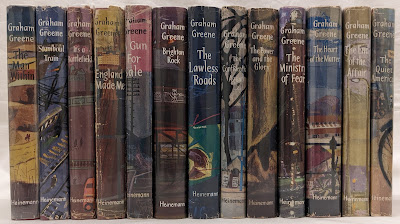

The Library Edition of the Works of Graham Greene

The Library Edition of the Works of Graham Greene is a uniform series issued by William Heinemann Ltd. in 1959 and 1960.  The series consists of 13 titles—12 novels and 1 nonfiction travel book—marketed exclusively to libraries and schools.  The 13 titles issued in series order include:

L1: The Power and the Glory (1959)

L8: The Ministry of Fear (1960)

L2: Brighton Rock (1959)

L9: The Man Within (1959)

L3: Stamboul Train (1959)

L10: A Gun for Sale (1959)

L4: The End of the Affair (1959)

L11: The Confidential Agent (1960)

L5: The Heart of the Matter (1959)

L12: The Lawless Roads (1960)

L6: It's a Battlefield (1959)

L13: The Quiet American (1960)

L7: England Made Me (1960)


Somehow, the last two titles printed in 1959 were leapfrogged by the first two titles printed in 1960 in the order in which they were released.  The series remained in print until 1963.

Select dust jackets by Peter Edwards

The books are desirable because of the dustjackets, illustrated by Peter Edwards.  The wrap-around illustrations poignantly capture the ethos, setting, or a key moment in the book.  Because of the ways libraries often discard or damage dust jackets—including labels, permanently affixing them to the books, and trimming them—copies with intact dust jackets are difficult to locate. 

Many of the copies in this collection are ex-library copies with the usual stamps and markings.  A few copies, instead, were awarded to children for spelling bees or essay contests, and bear school award labels.  It took the collector 15 months to assemble the full set; one title, with a damaged dust jacket from a label on the spine, was upgraded three years later.


The Morgan Library & Bella Greene

 
Twenty-first Report to the Fellows of the Pierpont Morgan Library, 1984-1986

Ryskamp, Charles, ed.  Twenty-first Report to the Fellows of The Pierpont Morgan Library, 1984 – 1986.  New York: The Pierpont Morgan Library, 1989.  Annual reports of the Morgan Library detail the year's acquisitions.  Each report includes a comprehensive list of new acquisitions and essays highlighting some of the significant works, including medieval manuscripts, printed books, music manuscripts, and autograph letters.  The reports are generally published biennially and limited to 1,000 to 1,200 copies.  The 1984-1986 report was limited to 1,000 copies; it was edited by Charles Ryskamp, the third director of the Morgan library from 1969 to 1987.


An Illuminated Life

Ardizzone, Heidi.  An Illuminated Life: Belle da Costa Greene's Journey from Prejudice to Privilege.  New York: W. W. Norton & Company, 2007.  514 pages.  Bella Greene was initially hired by John Pierpont Morgan to organize his personal library; she went on to curate his personal collection.  See was a self-taught expert on illuminated manuscripts and built J.P. Morgan an impressive library of incunabula, rare manuscripts, and bindings.  She traveled all over the world for him, buying individual items and entire libraries.  As a light-skinned African American woman who passed as white, she gained access to collectors and booksellers whom she might not have otherwise been able to approach, even on behalf of Morgan.  Ms. Greene eventually became the first director of the newly public Morgan Library in 1924.


The Personal Librarian

Benedict, Marie and Victoria Christopher Murray.  The Personal Librarian.  New York: Berkley, 2021.  352 pages.  A novelized story of Bella Greene and her role as the curator of J. P. Morgan's library.  The authors seem to focus more on Ms. Greene's Black heritage than her intellect.  The book flap states ''she was forced to hide her true identity and pass as white....to protect herself from racial persecution."  The overarching theme of the narrative is that "Belle has a secret, one she must protect at all costs."


The Huntington Library

 
Henry E. Huntington's Library of Libraries

Dickinson, Henry C.  Henry E. Huntington’s Library of Libraries.  San Marino: Huntington Library Press, 1995.  286 pages.  Henry Huntington did not fool around buying one or two rare books at a time; he purchased other collectors' whole rare book libraries.  He had the assets to accomplish this time and again.  Huntington made his fortune in the railroad industry before setting out to build a rare book and manuscript library by gathering unequaled collections from private collectors.  From 1911 to 1927, he dominated the book markets of New York and London.  He formally founded the Huntington Library in 1919 and in 1928, shortly after his death in 1927, the library and art museum based on his own collection opened to the public.


The Lilly Library

 
Dukedom Large Enough

Randall, David A.  Dukedom Large Enough.  New York: Random House, 1969.  368 pages.  First Edition.  In 1955, Josiah K. Lilly, Jr. donated his book collection to Indiana University, forming the basis for the Lilly Library, which opened in 1960.  In 1956, David Randall became the Lilly Librarian, then director of the library once it opened.  His memoir highlights some of the rare books, high-priced manuscripts, and entire collections he was able to acquire for the Lilly Library, including Ian Fleming's collection of important books.


Libraries: Nonfiction

 
Cataloging the World

Wright, Alex.  Cataloging the World: Paul Otlet and the Birth of the Information Age.  New York: Oxford University Press, 2014.  360 pages.  In the 1930's, Paul Otlet, a librarian, envisioned a network of "electronic telescopes" which would allow anyone to search printed materials not just in his native Belgium but anywhere in the world.  He sought to expand the potential of the catalog card system to link libraries together, providing access to books, newspapers, and other sources of information anywhere.  He envisioned a worldwide web fifty years before it would become a reality.  His work was cut short in 1940 by the Nazis, who raided his collection and confiscated his work, while pilfering and destroying libraries throughout Europe.  Wright's biography seeks to restore Otlet to his rightful place on the timeline of thinkers and visionaries in the field of classifying and organizing knowledge.


Improbable Libraries

Johnson, Alex.  Improbable Libraries: A Visual Journey to the World's Most Unusual Libraries.  Chicago: University of Chicago Press. 2015.  240 pages.  In 250 color photographs, Johnson highlights a wide range of unusual libraries around the world.  From the tiniest of spaces to large open-air gardens, the author shows how librarians are changing the face of library architecture; and from mobile libraries moved about by camel, donkey, or elephant, librarians are changing the way books get to the people who want to read them.  Phone booths are not very common anymore, but next time you see one you might want to take a second look; it might be a library.


The Bad-Ass Librarians of Timbuktu

Hammer, Joshua.  The Bad-Ass Librarians of Timbuktu: And Their Race to Save the World's Most Precious Manuscripts.  New York: Simon & Schuster, 2016.  288 pages.  In the 1980s, as Al Qaeda established a stronghold in Mali, Abdel Kader Haidara, an archivist for the government library, and a band of librarians and other volunteers began smuggling tens of thousands of ancient Islamic and secular manuscripts out of Timbuktu and to the safety of southern Mali.  They also tracked down and salvaged more manuscripts throughout the Sahara Desert region.  Using any means of deception and transport at their disposal, Haidara and his team preserved fragile manuscripts and saved them from sure destruction by Al Qaeda.


Torn from Their Bindings

McDade, Travis.  Torn From Their Bindings: A Story of Art, Science, and the Pillaging of American University Libraries.  Lawrence, KS: University Press of Kansas, 2018.  240 pages.  Robert Kindred was an antiquarian print dealer struggling to keep his business afloat.  The print market was competitive, and the supply of desirable prints was becoming scarce, when Kindred realized a solution to his problem.  Kindred identified university libraries as a treasure trove of the types of prints, maps, and plates he brokered; and the libraries were easily accessible and rarely well-guarded.  He damaged and destroyed countless priceless and irreplaceable books as he deftly removed their prints and then sold them to collectors.  McDade chronicles Kindred's crime spree and the clues and paper trail which led to his capture.


The Library Book

Orlean, Susan.  The Library Book.  New York: Simon & Schuster, 2018.  336 pages.  Orlean chronicles the April 28, 1986, fire which tore through the Los Angeles Public Library, destroying 400,000 books and damaging 700,000 more.  The fire investigation could not determine whether the fire had been purposefully set; and, if it was an act of arson, who set it?  Orlean delves into the investigation and reexamines the case of an actor suspected of setting the fire.  The book is part "whodunit" and part social analysis; as the author examines the Los Angeles Public Library fire, she also reflects on the roles libraries play in American society.  Detailing the aftermath of the 1986 fire and its impact on the Los Angeles community, Orlean also broadly considers the past, present, and future of public libraries.


Libraries: Fiction

 
The House of Paper

Domínguez, Carlos María.  The House of Paper.  New York: Harcourt, 2005.  103 pages.  Translated by Nick Caistor and illustrated by Peter Sis.  When a professor of Latin American literature at Cambridge receives a package containing a Conrad novel encrusted in cement and bearing a mysterious inscription, she sets off to Buenos Aires, Argentina, to find the mysterious sender, who has built a house out of his books.  The novel offers an examination of bibliomania and the relationship between people and their books.


The Caxton Private Lending Library & Book Depository

Connolly, John.  The Caxton Private Lending Library & Book Depository.  New York: The Mysterious Bookshop, 2013.  82 pages.  An avid reader who prefers books to people witnesses a shocking incident which seemingly recreates the climactic scene of Anna Karenina.  Seeking to unravel this mystery, the man is led to the Caxton Private Lending Library & Book Depository, where he discovers some of the world's best-known literary characters, alive and well.  Reality and fiction become blurred as the reader tries to comprehend his discovery.


The Library of the Dead

Huchu, T. L.  The Library of the Dead.  New York: Tor Books, 2021.  336 pages.  Ropa earns her living as a ghostalker, transmitting messages from the dead to those they left behind.  The dead begin to communicate a warning directly to Ropa, however, that someone is bewitching children.  Seeking to solve the mystery, Ropa discovers the world of underground Edinburgh, including an occult library which may provide the answers she seeks and more.  The Library of the Dead is the first book of an intended series, Edinburgh Nights.


Wednesday, December 15, 2021

December 2021: Mountains

Mountains piqued the interest of the group as the topic for the December 2021 meeting.  The group surveyed mountains in works of fiction and nonfiction.  The titles presented included memoirs of record-setting expeditions and life-changing encounters, beautifully illustrated books, and award-winning fiction.

Nonfiction

Seven Years in Tibet

Harrer, Heinrich.  Seven Years in Tibet.  Translated by Richard Graves.  New York: E. P. Dutton and Company, 1954.  314 pages, with 40 pages of photographs.  First edition.  Heinrich Harrer was a noted Austrian mountain climber.  He and a friend took nearly two years to walk from India through rugged Himalayan passes to the Forbidden City of Lhasa, the home of the Dalai Lama.  Once there, Heinrich met the then-11-year-old 14th Dalai Lama.  Harrer became a confidant to the youthful Dalai Lama and tutored him about the world outside Lhasa.  Harrer and the Dalai Lama remained friends until Harrer's death in 2006.

Pictorial title page


High Adventure

Hillary, Edmund.  High Adventure.  Norwalk, CT: Easton Press, 2003.  245 pages.  Illustrated by George Djurkovic.  Bound in full leather.  Signed by the author on a Collector's Edition signature page.  High Adventure was first published in 1955 by Hodder & Stoughton, and the Easton Press signed collector's edition was released in 2003 on the 50th anniversary of Hillary's Mount Everest climb.

Signed limitation page

In 1953, the ninth British expedition of Everest was led by John Hunt.  Hunt planned three assaults of two climbers each once they reached Camp VII at an elevation of 24,000 feet.  The first team set out for the summit on May 26th; they made the first ascent and came within 300 vertical feet of the final summit but were forced to turn back after repeated troubles with their supplemental oxygen supply equipment.  The next day Edmund Hillary, an Australian climber, and Tenzing Norgay, a Nepali-Indian Sherpa mountaineer, launched the second assault.  Snow and wind held them partway up for two days, but they reached the summit (elevation 29,028 ft.) at 11:30 am on May 29, 1953.  They spent only about fifteen minutes at the summit, taking photos to document the ascent, before making their way back down.

Frontispiece and title page

An interesting aside: Hillary's son, Peter, joined Norgay's son, Jamling, in climbing Everest in 2003 on the 50th anniversary of their fathers' famous climb.


Moments of Being

Greene, Raymond.  Moments of Being: The Random Recollections of Raymond Greene.  London: William Heinemann Ltd., 1974.  196 pages with 8 pages of photographs.  This copy is inscribed by the author to a fellow mountaineer: "For Ernest from Raymond because of many memorable moments of being in the High Alps long ago."  There are marginal notes in the text by the recipient.  When Greene writes about spending three weeks in Switzerland climbing with the Oxford Mountaineering Club, Ernest pencils in the margin, "I was there."

Author's inscription and recipient's marginal note

Greene was a physician and avid mountaineer; his memoir extensively covers the intersection of these two aspects of his life.  He completed medical school in 1927 and in 1931 was invited to join Frank Smythe's British expedition of Kamet.  Their successful climb to Kamet's summit was, at the time, the highest mountain ever to have been climbed (elevation 25,446 ft.).  Greene's medical skills were required several times on that climb.  Two years later in 1933, Greene served as a climber and chief medical officer for the fourth British expedition of Mount Everest, led by Hugh Ruttledge.  While the expedition did not make the summit, it achieved the highest elevation of Everest (28,200 ft.) until Tenzing Norgay and Edmund Hillary's summit ascent in 1953.  Greene covered the 1953 summit and made the announcement for BBC Radio. 

Beyond his two record-breaking climbs, Raymond Greene made other contributions to mountaineering.  He engineered an experimental smaller, lighter-weight device for carrying supplementary oxygen at high altitude; and, during the Everest climb, he successfully conducted field research on alveolar air, taking breath samples at varying altitudes to later analyze and determine the effects of altitude on alveolar gas (the mixture of oxygen, water vapor, and carbon dioxide expired by the lungs).  He became a leading expert on physiology and the effects of high altitude and cold on the human body.  During World War II, he used his expertise as a physician and mountaineer to advise Allied forces' mountain troops and special operations.  For his contributions to the mountain troops during the war, Greene was awarded the Legion of Honor in France; the rank of Chevalier was bestowed to Greene by President Charles de Gaulle.


Fiction

The Hobbit

Tolkien, J. R. R.  The Hobbit.  Boston: Houghton Mifflin Company, 1997.  289 pages.  Illustrated by Alan Lee.  The Hobbit, or There and Back Again was first published in the UK by George Allen & Unwin in 1937 and in the US by Houghton Mifflin Company in 1938.  The Hobbit tells the story of Bilbo Baggins’s journey, along with Gandalf the wizard and 13 dwarves, to the Misty Mountains on an unexpected adventure.  This copy is signed by the illustrator, Alan Lee.


Drakulya

Doherty, P. C.  Drakulya.  Suffolk: Post Mortem Books, 1997.  365 pages.  Limited edition.  Drakulya was originally published as two titles in 1986, The Prince Drakulya and The Lord Count Drakulya; this edition combines those two titles as the author originally intended.  The binding mimics the original binding and color of the first edition of Bram Stoker's DraculaDrakulya is a novel about the historical figure Vlad Drakulya, or Vlad the Impaler.  The first book culminates in Vlad's invasion alongside the Turks of Wallachia, his homeland.  Wallachia is a historical and geographical region of Romania, which includes the Southern Carpathians mountain range, also known as the Transylvanian Alps.  It is here that Vlad Drakulya retakes the throne of his father, Vlad Dracul, prince of Wallachia.

Signed limitation page

This copy is from a limited edition run of 350 copies of which this is copy 252, and is signed by the author on the limitation page.  


Boots and the Glass Mountain

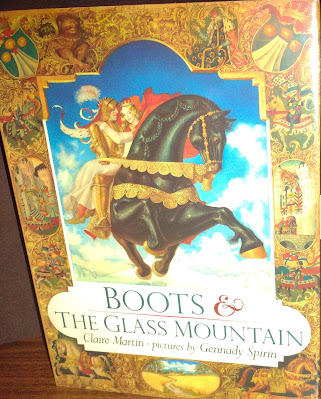
Martin, Claire.  Boots and the Glass Mountain.  New York: Dial Press, 1992.  320 pages.  Illustrated by Gennady Spirin.  In this retelling of a Norwegian folk tale—with parallels to the Cinderella fairy tale—Boots, the youngest of three sons always tasked with the dirtiest chores, must protect his father's field from the trolls' wild stallions.  Boots steadily tames the magical horses, then uses one to ride up a glass mountain—a supposedly impossible feat—to fetch the king's daughter and win her hand.

Sample illustration

The tale is elegantly illustrated by Gennady Spirin, a Russian painter and children's book illustrator noted for his delicate watercolor illustrations reminiscent of the great masters of the Renaissance.  Spirin immigrated to the United States in 1992, following the dissolution of the Soviet Union.  He has won multiple awards for his illustrations including four gold medals from the Society of Illustrators.  He has also appeared on The New York Times Best Illustrated Books of the Year list four times.  Spirin may be most recognized for his illustration of Julie Andrews's Simeon's Gift (2003) and Madonna's Yakov and the Seven Thieves (2004).


Brokeback Mountain
First UK edition (left) and first US edition (right)

Proulx, Annie.  Brokeback Mountain.  London: Fourth Estate, 1998.  58 pages.  First separate appearance in book form.  Softcover edition with French flaps.

Proulx, Annie.  Brokeback Mountain.  New York: Scribner, 2005.  55 pages.  First American separate appearance.  Softcover edition.

"Brokeback Mountain" first appeared in the October 13, 1997, issue of The New Yorker.  The magazine inadvertently omitted the two-paragraph prologue which opens the short story; subsequent publications were often described as revised or expanded when, in fact, they were simply complete.  The story first appeared in book form in 1998 as a stand-alone story published in the United Kingdom by Fourth Estate.  It was next published in the United States in Proulx's 1999 short story collection Close Range: Wyoming Stories.  Its first appearance as a separate book in the United States came in 2005, the same year the film adaptation was released.  Also in 2005, an edition was published containing the short story, the screenplay, and three essays by Proulx and screenwriters Larry McMurtry and Diana Ossana.

Order of publication (left to right)

"Brokeback Mountain" won the 1998 National Magazine Award for Fiction and took third place for the 1998 O. Henry Award for short stories of exceptional merit.


Cold Mountain

Frazier, Charles.  Cold Mountain.  New York: Atlantic Monthly Press, 1997.  356 pages.  Drawing comparisons to Homer's Odyssey, Cold Mountain follows a wounded deserter from the Confederate army, W. P. Inman, who walks for months to return to his rural mountain community home near Cold Mountain, North Carolina, in search of the love of his life.  Frazier's novel won the 1997 National Book Award for Fiction.  This copy is signed by the author.


Gods of Howl Mountain

Brown, Taylor.  Gods of Howl Mountain.  New York: St. Martin’s Press, 2018.  294 pages.  Advance uncorrected proof.

Brown, Taylor.  Gods of Howl Mountain.  New York: St. Martin’s Press, 2018.  294 pages.  First edition.

Set in the North Carolina high country in the 1950s, Gods of Howl Mountain follows Rory, a bootleg whiskey runner, and "Granny Mae," his folk healer grandmother.  When Rory's life is in danger Granny Mae, who knows many of the secrets of the mill town at the foot of the perilous Howl Mountain, must decide between revealing secrets and protecting her grandson from the past.


July 2025: US Presidents

One member's unintentionally assembled collection of signed presidential books Getting an early start on the Fourth of July festivitie...