Tuesday, January 25, 2022

January 2022: Libraries and Ex-Library Copies

The January 2022 meeting checked out Libraries as its topic.  Collectors selected books about libraries and librarians from both fiction and nonfiction works.  Several nonfiction books focused on well-known libraries started as private collections, such as the Morgan, the Huntington, and the Lilly libraries.  Librarians, such as Bella Greene, David Randall, and Abdel Kader Haidara were highlighted for their work curating and preserving library collections.  Some infamous and tragic library stories were also shared.  In fiction, mysterious libraries raised more questions than they answered.

The collectors also considered Ex-Library Copies.  While some collectors eschew ex-library copies—primarily because of the damage done by library stamps and labels—and won't acquire them, others are willing to accept these flaws in order to have a copy of the title or edition in question… at least until a better copy becomes available.  A couple of ex-library copies—which the respective collectors are quite pleased to have in their personal libraries—lead off this month's selections of books.


Ex-Library Copies

 
Explanatory Notes upon the New Testament

Wesley, John.  Explanatory Notes upon the New Testament.  London: William Bowyer, 1755.  This is the first edition of Wesley's translation of the New Testament, especially made for "plain, unlettered men who understand only their Mother Tongue, and yet reverence and love the word of God and have a desire to save their souls."  The biblical text, considerably revised from the King James Version, is printed at the top of the page, with notes printed below.  Wesley began his translation in 1729 but moved slowly because of his lack of confidence in his ability to complete the work.  In the early 1750s he became very ill and was not sure that he would live to complete the work, so he made a promise to God that if his life were spared, he would diligently strive to complete his translation.  He did survive and soon published his complete New Testament in 1755.

Frontispiece and title page with ex-library stamp

The collector describes the acquisition of the ex-library copy: "This copy of the first printing was purchased from a bookseller in Oxford, England, whom I had dealt with in the past.  It was very reasonably priced, and in his description he stated that the only "flaw" was a library stamp on the title page.  I wouldn't let that stand in my way of purchasing it, and when it arrived a few weeks later, I saw that the library stamp was from Emory University School of Theology (now Candler School of Theology), about 3 miles from where I worked at Columbia Seminary.  When I emailed the seller to tell him the Testament had arrived, I mentioned that we could have saved a lot of postage if I could have just picked up the book at Emory!  A few weeks later, the Director of the Pitts Theology Library at Candler and a couple of his rare book associates were coming to have lunch at my house and visit my library.  I was a bit uncomfortable about showing the book to him, since I didn't know how it got released from Candler.  I told him the story, and he said the library had a duplicate copy and sold this one to the dealer in Oxford.  When my Bible collection eventually goes to the Pitts Library, this copy of Wesley's Testament will find its way back into its earlier home!"
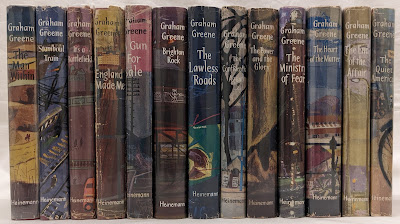

The Library Edition of the Works of Graham Greene

The Library Edition of the Works of Graham Greene is a uniform series issued by William Heinemann Ltd. in 1959 and 1960.  The series consists of 13 titles—12 novels and 1 nonfiction travel book—marketed exclusively to libraries and schools.  The 13 titles issued in series order include:

L1: The Power and the Glory (1959)

L8: The Ministry of Fear (1960)

L2: Brighton Rock (1959)

L9: The Man Within (1959)

L3: Stamboul Train (1959)

L10: A Gun for Sale (1959)

L4: The End of the Affair (1959)

L11: The Confidential Agent (1960)

L5: The Heart of the Matter (1959)

L12: The Lawless Roads (1960)

L6: It's a Battlefield (1959)

L13: The Quiet American (1960)

L7: England Made Me (1960)


Somehow, the last two titles printed in 1959 were leapfrogged by the first two titles printed in 1960 in the order in which they were released.  The series remained in print until 1963.

Select dust jackets by Peter Edwards

The books are desirable because of the dustjackets, illustrated by Peter Edwards.  The wrap-around illustrations poignantly capture the ethos, setting, or a key moment in the book.  Because of the ways libraries often discard or damage dust jackets—including labels, permanently affixing them to the books, and trimming them—copies with intact dust jackets are difficult to locate. 

Many of the copies in this collection are ex-library copies with the usual stamps and markings.  A few copies, instead, were awarded to children for spelling bees or essay contests, and bear school award labels.  It took the collector 15 months to assemble the full set; one title, with a damaged dust jacket from a label on the spine, was upgraded three years later.


The Morgan Library & Bella Greene

 
Twenty-first Report to the Fellows of the Pierpont Morgan Library, 1984-1986

Ryskamp, Charles, ed.  Twenty-first Report to the Fellows of The Pierpont Morgan Library, 1984 – 1986.  New York: The Pierpont Morgan Library, 1989.  Annual reports of the Morgan Library detail the year's acquisitions.  Each report includes a comprehensive list of new acquisitions and essays highlighting some of the significant works, including medieval manuscripts, printed books, music manuscripts, and autograph letters.  The reports are generally published biennially and limited to 1,000 to 1,200 copies.  The 1984-1986 report was limited to 1,000 copies; it was edited by Charles Ryskamp, the third director of the Morgan library from 1969 to 1987.


An Illuminated Life

Ardizzone, Heidi.  An Illuminated Life: Belle da Costa Greene's Journey from Prejudice to Privilege.  New York: W. W. Norton & Company, 2007.  514 pages.  Bella Greene was initially hired by John Pierpont Morgan to organize his personal library; she went on to curate his personal collection.  See was a self-taught expert on illuminated manuscripts and built J.P. Morgan an impressive library of incunabula, rare manuscripts, and bindings.  She traveled all over the world for him, buying individual items and entire libraries.  As a light-skinned African American woman who passed as white, she gained access to collectors and booksellers whom she might not have otherwise been able to approach, even on behalf of Morgan.  Ms. Greene eventually became the first director of the newly public Morgan Library in 1924.


The Personal Librarian

Benedict, Marie and Victoria Christopher Murray.  The Personal Librarian.  New York: Berkley, 2021.  352 pages.  A novelized story of Bella Greene and her role as the curator of J. P. Morgan's library.  The authors seem to focus more on Ms. Greene's Black heritage than her intellect.  The book flap states ''she was forced to hide her true identity and pass as white....to protect herself from racial persecution."  The overarching theme of the narrative is that "Belle has a secret, one she must protect at all costs."


The Huntington Library

 
Henry E. Huntington's Library of Libraries

Dickinson, Henry C.  Henry E. Huntington’s Library of Libraries.  San Marino: Huntington Library Press, 1995.  286 pages.  Henry Huntington did not fool around buying one or two rare books at a time; he purchased other collectors' whole rare book libraries.  He had the assets to accomplish this time and again.  Huntington made his fortune in the railroad industry before setting out to build a rare book and manuscript library by gathering unequaled collections from private collectors.  From 1911 to 1927, he dominated the book markets of New York and London.  He formally founded the Huntington Library in 1919 and in 1928, shortly after his death in 1927, the library and art museum based on his own collection opened to the public.


The Lilly Library

 
Dukedom Large Enough

Randall, David A.  Dukedom Large Enough.  New York: Random House, 1969.  368 pages.  First Edition.  In 1955, Josiah K. Lilly, Jr. donated his book collection to Indiana University, forming the basis for the Lilly Library, which opened in 1960.  In 1956, David Randall became the Lilly Librarian, then director of the library once it opened.  His memoir highlights some of the rare books, high-priced manuscripts, and entire collections he was able to acquire for the Lilly Library, including Ian Fleming's collection of important books.


Libraries: Nonfiction

 
Cataloging the World

Wright, Alex.  Cataloging the World: Paul Otlet and the Birth of the Information Age.  New York: Oxford University Press, 2014.  360 pages.  In the 1930's, Paul Otlet, a librarian, envisioned a network of "electronic telescopes" which would allow anyone to search printed materials not just in his native Belgium but anywhere in the world.  He sought to expand the potential of the catalog card system to link libraries together, providing access to books, newspapers, and other sources of information anywhere.  He envisioned a worldwide web fifty years before it would become a reality.  His work was cut short in 1940 by the Nazis, who raided his collection and confiscated his work, while pilfering and destroying libraries throughout Europe.  Wright's biography seeks to restore Otlet to his rightful place on the timeline of thinkers and visionaries in the field of classifying and organizing knowledge.


Improbable Libraries

Johnson, Alex.  Improbable Libraries: A Visual Journey to the World's Most Unusual Libraries.  Chicago: University of Chicago Press. 2015.  240 pages.  In 250 color photographs, Johnson highlights a wide range of unusual libraries around the world.  From the tiniest of spaces to large open-air gardens, the author shows how librarians are changing the face of library architecture; and from mobile libraries moved about by camel, donkey, or elephant, librarians are changing the way books get to the people who want to read them.  Phone booths are not very common anymore, but next time you see one you might want to take a second look; it might be a library.


The Bad-Ass Librarians of Timbuktu

Hammer, Joshua.  The Bad-Ass Librarians of Timbuktu: And Their Race to Save the World's Most Precious Manuscripts.  New York: Simon & Schuster, 2016.  288 pages.  In the 1980s, as Al Qaeda established a stronghold in Mali, Abdel Kader Haidara, an archivist for the government library, and a band of librarians and other volunteers began smuggling tens of thousands of ancient Islamic and secular manuscripts out of Timbuktu and to the safety of southern Mali.  They also tracked down and salvaged more manuscripts throughout the Sahara Desert region.  Using any means of deception and transport at their disposal, Haidara and his team preserved fragile manuscripts and saved them from sure destruction by Al Qaeda.


Torn from Their Bindings

McDade, Travis.  Torn From Their Bindings: A Story of Art, Science, and the Pillaging of American University Libraries.  Lawrence, KS: University Press of Kansas, 2018.  240 pages.  Robert Kindred was an antiquarian print dealer struggling to keep his business afloat.  The print market was competitive, and the supply of desirable prints was becoming scarce, when Kindred realized a solution to his problem.  Kindred identified university libraries as a treasure trove of the types of prints, maps, and plates he brokered; and the libraries were easily accessible and rarely well-guarded.  He damaged and destroyed countless priceless and irreplaceable books as he deftly removed their prints and then sold them to collectors.  McDade chronicles Kindred's crime spree and the clues and paper trail which led to his capture.


The Library Book

Orlean, Susan.  The Library Book.  New York: Simon & Schuster, 2018.  336 pages.  Orlean chronicles the April 28, 1986, fire which tore through the Los Angeles Public Library, destroying 400,000 books and damaging 700,000 more.  The fire investigation could not determine whether the fire had been purposefully set; and, if it was an act of arson, who set it?  Orlean delves into the investigation and reexamines the case of an actor suspected of setting the fire.  The book is part "whodunit" and part social analysis; as the author examines the Los Angeles Public Library fire, she also reflects on the roles libraries play in American society.  Detailing the aftermath of the 1986 fire and its impact on the Los Angeles community, Orlean also broadly considers the past, present, and future of public libraries.


Libraries: Fiction

 
The House of Paper

Domínguez, Carlos María.  The House of Paper.  New York: Harcourt, 2005.  103 pages.  Translated by Nick Caistor and illustrated by Peter Sis.  When a professor of Latin American literature at Cambridge receives a package containing a Conrad novel encrusted in cement and bearing a mysterious inscription, she sets off to Buenos Aires, Argentina, to find the mysterious sender, who has built a house out of his books.  The novel offers an examination of bibliomania and the relationship between people and their books.


The Caxton Private Lending Library & Book Depository

Connolly, John.  The Caxton Private Lending Library & Book Depository.  New York: The Mysterious Bookshop, 2013.  82 pages.  An avid reader who prefers books to people witnesses a shocking incident which seemingly recreates the climactic scene of Anna Karenina.  Seeking to unravel this mystery, the man is led to the Caxton Private Lending Library & Book Depository, where he discovers some of the world's best-known literary characters, alive and well.  Reality and fiction become blurred as the reader tries to comprehend his discovery.


The Library of the Dead

Huchu, T. L.  The Library of the Dead.  New York: Tor Books, 2021.  336 pages.  Ropa earns her living as a ghostalker, transmitting messages from the dead to those they left behind.  The dead begin to communicate a warning directly to Ropa, however, that someone is bewitching children.  Seeking to solve the mystery, Ropa discovers the world of underground Edinburgh, including an occult library which may provide the answers she seeks and more.  The Library of the Dead is the first book of an intended series, Edinburgh Nights.


Wednesday, December 15, 2021

December 2021: Mountains

Mountains piqued the interest of the group as the topic for the December 2021 meeting.  The group surveyed mountains in works of fiction and nonfiction.  The titles presented included memoirs of record-setting expeditions and life-changing encounters, beautifully illustrated books, and award-winning fiction.

Nonfiction

Seven Years in Tibet

Harrer, Heinrich.  Seven Years in Tibet.  Translated by Richard Graves.  New York: E. P. Dutton and Company, 1954.  314 pages, with 40 pages of photographs.  First edition.  Heinrich Harrer was a noted Austrian mountain climber.  He and a friend took nearly two years to walk from India through rugged Himalayan passes to the Forbidden City of Lhasa, the home of the Dalai Lama.  Once there, Heinrich met the then-11-year-old 14th Dalai Lama.  Harrer became a confidant to the youthful Dalai Lama and tutored him about the world outside Lhasa.  Harrer and the Dalai Lama remained friends until Harrer's death in 2006.

Pictorial title page


High Adventure

Hillary, Edmund.  High Adventure.  Norwalk, CT: Easton Press, 2003.  245 pages.  Illustrated by George Djurkovic.  Bound in full leather.  Signed by the author on a Collector's Edition signature page.  High Adventure was first published in 1955 by Hodder & Stoughton, and the Easton Press signed collector's edition was released in 2003 on the 50th anniversary of Hillary's Mount Everest climb.

Signed limitation page

In 1953, the ninth British expedition of Everest was led by John Hunt.  Hunt planned three assaults of two climbers each once they reached Camp VII at an elevation of 24,000 feet.  The first team set out for the summit on May 26th; they made the first ascent and came within 300 vertical feet of the final summit but were forced to turn back after repeated troubles with their supplemental oxygen supply equipment.  The next day Edmund Hillary, an Australian climber, and Tenzing Norgay, a Nepali-Indian Sherpa mountaineer, launched the second assault.  Snow and wind held them partway up for two days, but they reached the summit (elevation 29,028 ft.) at 11:30 am on May 29, 1953.  They spent only about fifteen minutes at the summit, taking photos to document the ascent, before making their way back down.

Frontispiece and title page

An interesting aside: Hillary's son, Peter, joined Norgay's son, Jamling, in climbing Everest in 2003 on the 50th anniversary of their fathers' famous climb.


Moments of Being

Greene, Raymond.  Moments of Being: The Random Recollections of Raymond Greene.  London: William Heinemann Ltd., 1974.  196 pages with 8 pages of photographs.  This copy is inscribed by the author to a fellow mountaineer: "For Ernest from Raymond because of many memorable moments of being in the High Alps long ago."  There are marginal notes in the text by the recipient.  When Greene writes about spending three weeks in Switzerland climbing with the Oxford Mountaineering Club, Ernest pencils in the margin, "I was there."

Author's inscription and recipient's marginal note

Greene was a physician and avid mountaineer; his memoir extensively covers the intersection of these two aspects of his life.  He completed medical school in 1927 and in 1931 was invited to join Frank Smythe's British expedition of Kamet.  Their successful climb to Kamet's summit was, at the time, the highest mountain ever to have been climbed (elevation 25,446 ft.).  Greene's medical skills were required several times on that climb.  Two years later in 1933, Greene served as a climber and chief medical officer for the fourth British expedition of Mount Everest, led by Hugh Ruttledge.  While the expedition did not make the summit, it achieved the highest elevation of Everest (28,200 ft.) until Tenzing Norgay and Edmund Hillary's summit ascent in 1953.  Greene covered the 1953 summit and made the announcement for BBC Radio. 

Beyond his two record-breaking climbs, Raymond Greene made other contributions to mountaineering.  He engineered an experimental smaller, lighter-weight device for carrying supplementary oxygen at high altitude; and, during the Everest climb, he successfully conducted field research on alveolar air, taking breath samples at varying altitudes to later analyze and determine the effects of altitude on alveolar gas (the mixture of oxygen, water vapor, and carbon dioxide expired by the lungs).  He became a leading expert on physiology and the effects of high altitude and cold on the human body.  During World War II, he used his expertise as a physician and mountaineer to advise Allied forces' mountain troops and special operations.  For his contributions to the mountain troops during the war, Greene was awarded the Legion of Honor in France; the rank of Chevalier was bestowed to Greene by President Charles de Gaulle.


Fiction

The Hobbit

Tolkien, J. R. R.  The Hobbit.  Boston: Houghton Mifflin Company, 1997.  289 pages.  Illustrated by Alan Lee.  The Hobbit, or There and Back Again was first published in the UK by George Allen & Unwin in 1937 and in the US by Houghton Mifflin Company in 1938.  The Hobbit tells the story of Bilbo Baggins’s journey, along with Gandalf the wizard and 13 dwarves, to the Misty Mountains on an unexpected adventure.  This copy is signed by the illustrator, Alan Lee.


Drakulya

Doherty, P. C.  Drakulya.  Suffolk: Post Mortem Books, 1997.  365 pages.  Limited edition.  Drakulya was originally published as two titles in 1986, The Prince Drakulya and The Lord Count Drakulya; this edition combines those two titles as the author originally intended.  The binding mimics the original binding and color of the first edition of Bram Stoker's DraculaDrakulya is a novel about the historical figure Vlad Drakulya, or Vlad the Impaler.  The first book culminates in Vlad's invasion alongside the Turks of Wallachia, his homeland.  Wallachia is a historical and geographical region of Romania, which includes the Southern Carpathians mountain range, also known as the Transylvanian Alps.  It is here that Vlad Drakulya retakes the throne of his father, Vlad Dracul, prince of Wallachia.

Signed limitation page

This copy is from a limited edition run of 350 copies of which this is copy 252, and is signed by the author on the limitation page.  


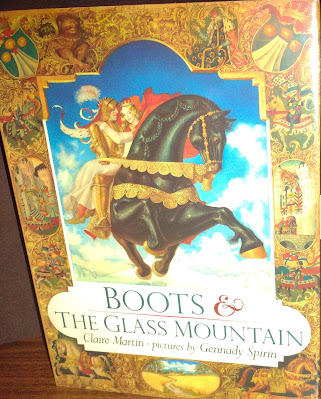
Boots and the Glass Mountain

Martin, Claire.  Boots and the Glass Mountain.  New York: Dial Press, 1992.  320 pages.  Illustrated by Gennady Spirin.  In this retelling of a Norwegian folk tale—with parallels to the Cinderella fairy tale—Boots, the youngest of three sons always tasked with the dirtiest chores, must protect his father's field from the trolls' wild stallions.  Boots steadily tames the magical horses, then uses one to ride up a glass mountain—a supposedly impossible feat—to fetch the king's daughter and win her hand.

Sample illustration

The tale is elegantly illustrated by Gennady Spirin, a Russian painter and children's book illustrator noted for his delicate watercolor illustrations reminiscent of the great masters of the Renaissance.  Spirin immigrated to the United States in 1992, following the dissolution of the Soviet Union.  He has won multiple awards for his illustrations including four gold medals from the Society of Illustrators.  He has also appeared on The New York Times Best Illustrated Books of the Year list four times.  Spirin may be most recognized for his illustration of Julie Andrews's Simeon's Gift (2003) and Madonna's Yakov and the Seven Thieves (2004).


Brokeback Mountain
First UK edition (left) and first US edition (right)

Proulx, Annie.  Brokeback Mountain.  London: Fourth Estate, 1998.  58 pages.  First separate appearance in book form.  Softcover edition with French flaps.

Proulx, Annie.  Brokeback Mountain.  New York: Scribner, 2005.  55 pages.  First American separate appearance.  Softcover edition.

"Brokeback Mountain" first appeared in the October 13, 1997, issue of The New Yorker.  The magazine inadvertently omitted the two-paragraph prologue which opens the short story; subsequent publications were often described as revised or expanded when, in fact, they were simply complete.  The story first appeared in book form in 1998 as a stand-alone story published in the United Kingdom by Fourth Estate.  It was next published in the United States in Proulx's 1999 short story collection Close Range: Wyoming Stories.  Its first appearance as a separate book in the United States came in 2005, the same year the film adaptation was released.  Also in 2005, an edition was published containing the short story, the screenplay, and three essays by Proulx and screenwriters Larry McMurtry and Diana Ossana.

Order of publication (left to right)

"Brokeback Mountain" won the 1998 National Magazine Award for Fiction and took third place for the 1998 O. Henry Award for short stories of exceptional merit.


Cold Mountain

Frazier, Charles.  Cold Mountain.  New York: Atlantic Monthly Press, 1997.  356 pages.  Drawing comparisons to Homer's Odyssey, Cold Mountain follows a wounded deserter from the Confederate army, W. P. Inman, who walks for months to return to his rural mountain community home near Cold Mountain, North Carolina, in search of the love of his life.  Frazier's novel won the 1997 National Book Award for Fiction.  This copy is signed by the author.


Gods of Howl Mountain

Brown, Taylor.  Gods of Howl Mountain.  New York: St. Martin’s Press, 2018.  294 pages.  Advance uncorrected proof.

Brown, Taylor.  Gods of Howl Mountain.  New York: St. Martin’s Press, 2018.  294 pages.  First edition.

Set in the North Carolina high country in the 1950s, Gods of Howl Mountain follows Rory, a bootleg whiskey runner, and "Granny Mae," his folk healer grandmother.  When Rory's life is in danger Granny Mae, who knows many of the secrets of the mill town at the foot of the perilous Howl Mountain, must decide between revealing secrets and protecting her grandson from the past.


Tuesday, November 30, 2021

November 2021: Travel Fiction

Travel Fiction took us all over the place as the topic for the November 2021 meeting.  Miguel de Cervantes launched our journeys with a tour of Spain, a route retraced by Graham Greene 377 years later.  Jules Verne guided us around the world and to the center of the Earth, while J. R. R. Tolkien took us only so far as Middle-earth.  Verne also took us under the seas, but Jonathan Swift, H. Bedford Jones, and Matthew Hodgart kept us above water on their nautical adventures.  H. G. Wells transported us through time into the far future, and Edward Wells (no relation) and William Stirling brought us back to biblical times.  Graham Greene hauled us across Europe aboard the Orient Express (twice!).  Both John Steinbeck and Neil Gaiman trekked us across the United States, while Forrest Carter made sure we didn't skip over Texas.

The books appear in the order of their original date of publication.


Don Quixote de La Mancha (1818)

Cervantes Saavedra, Miguel de.  Don Quixote de La Mancha.  4 volumes.  London: T. Cadell and W. Davies, 1818.  Translated by Mary Smirke.  Engravings by Robert Smirke (father of the translator).  Bound in the publisher's original quarter brown leather.

Don Quixote (1908)

Cervantes Saavedra, Miguel de.  The History of the Ingenious Gentleman Don Quixote of La Mancha.  4 volumes.  Edinburgh: John Grant, 1908.  Translated from the Spanish by Pierre Antoine Motteux.  Etchings by LaLauze.  Library edition, bound in brown cloth with paper labels affixed to the front and spine.

Frontispiece and sample illustration by LaLauze in Don Quixote (1908)

Don Quixote was originally published in two parts, in 1605 and 1615.  Fully titled The Ingenious Gentleman Don Quixote of La Mancha, the book is generally regarded as the first modern novel.  It is also considered one of the earliest works of travel fiction as it recounts the episodic quests and adventures of the noble Alonso Quixano and his squire, Sancho Panza.

Don Quixote also holds the distinction of being the second-most-translated book in the world, after the Bible.  It was first translated into English in 1612 and 1620 by Thomas Shelton.  It has since been translated into English about 20 more times.  In 1700, Pierre Antoine Motteux completed the third English translation.  Motteux's translation was regarded as "the most agreeable" of the time and remained the most popular until the 1940s, after it was selected for publication by the Modern Library in 1930.  Modern scholars and translators found fault with Motteux's treatment of Sancho Panzo.  Don Quixote has since been translated into English nine times since the 1940s.  Mary Smirke's 1818 translation was the first translation completed by a woman.


An Historical Geography of the New Testament

Wells, Edward.  An Historical Geography of the New Testament in Two Parts. Part I: The Journeyings of Our Lord and Saviour Jesus Christ. Part II: The Travels and Voyages of St. Paul, etc. Being a Geographical and Historical Account of all the Places Mention’d, or referr’d to, in the Books of the New Testament: Very useful for understanding the History of the said Books, and several Particular Texts. To which End there is also added a Chronological Table. Throughout is inserted the Present State of such Places, as have been lately visited by Persons of our own Nation, and of unquestionable Fidelity: whereby the Work is rendered very Useful and Entertaining. Illustrated and Adorned with Maps and several Copper Plates; wherein is represented the Present State of the Place now most Remarkable.  London: James Knapton, 1718.  379 pages.

Frontispiece and title page

As laid out in the lengthy full title of the work, Wells traces the travels of Jesus as described in the gospels (part one) and the missionary travels of the apostle Paul described in Acts and the Pauline epistles (part two).  This edition contains a fold-out map of Paul's missionary journeys, bound in before the title page to Part Two.  First published in 1708, An Historical Geography of the New Testament was followed by An Historical Geography of the Old Testament, published in 1711-12.

A Map of the Travels & Voyages of St. Paul

Edward Wells (1667-1727) is identified on the title page as being Rector of Cotesbach, in Leicestershire, at the time of publication.  He was the son of Edward Wells, vicar of Corsham, Wiltshire.  He was inducted to the rectory of Cotesbach, Leicestershire, on January 2, 1702.  Wells achieved distinction as a mathematician and geographer as well as a divine.  He was a strong advocate of the orthodox position of the Church of England and engaged in polemics against Separatists, Presbyterians, and Dissenters.  In 1713 he wrote a treatise defending the Church’s view of the Trinity against Arianism.  Later, while the Rector of Bletchley, from 1716 until his death, he turned to the task of publishing a complete correction of the Authorized Version of the Bible.


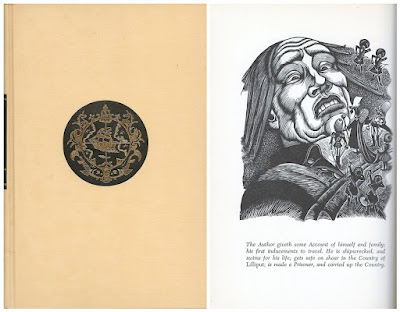
Gulliver's Travels

Swift, Jonathan.  Gulliver's Travels.  New York: Heritage Press, 1950.  343 pages.  Illustrations by Fritz Eichenberg.  First published in 1726, Travels into Several Remote Nations of the World. In Four Parts. By Lemuel Gulliver, First a Surgeon, and then a Captain of Several Ships was written as political satire.  It was published quickly (to avoid piracy), secretly (to avoid prosecution), and anonymously (again, prosecution).  The book was immediately popular even though—or maybe because—the true identity of the titular author Lemuel Gulliver was a mystery.  Authorship of the book was not publicly confirmed until 1735 when George Faulkner, an Irish publisher, printed a set of Swift's works, which included what by that point had become known simply as Gulliver's Travels.  The story has become Brobdingnagian—of gigantic proportion—in that it has outsized its original anti-Whig political satire and become an enduring classic of English literature.


Songs of the Holy Land

Stirling, William.  Songs of the Holy Land.  London: John Ollivier, 1848.  128 pages.  A manuscript note on the first preliminary page reads: “First published in Edinburgh in 1846, only 50 copies printed. Second series, London, 1847, limited to 12 copies.” According to John Martin's Bibliographic Catalogue of Privately Printed Books, only 10 copies of this combined edition were printed on large-paper.  Tipped in to this copy is an ALS presentation letter from the author dated 21 January 1848.

Presentation letter from the author

Stirling wrote the poems and paraphrases included in Songs of the Holy Land while traveling through the Middle East.  Numerous biblical passages are paraphrased, including several Psalms and a portion of the Song of Solomon.  In the preliminary pages Stirling writes:

The following Poems were for the most part written six years ago, during a journey through the countries to which they relate.  For those countries the Bible will ever remain the most fascinating of guide-books.  When read anew on the bosom of the river of Egypt or under the shade of the monuments which skirt its banks, in the deserts of Sinai or Edom, in the Holy Land itself, or within sight of the snowy peaks of Lebanon, the venerable page resumes all the freshness and charm, which neglect or too familiar use at home may perhaps have impaired.


A Journey to the Centre of the Earth

Verne, Jules.  A Journey to the Centre of the Earth.  London: Griffith and Farran, 1872.  384 pages.  Illustrations by Riou.  First English edition.  Verne's Voyage au centre de la Terre was first published in French in 1864.  It was reissued in a revised and expanded edition in 1867 and translated into English in 1871 by an unknown translator.

Frontispiece and title page

This copy is bound in full polished calf leather of the period with raised bands and gilt tooling on the spine.  The end papers and all edges are marbled.  This first edition title rarely shows up for sale today because when published it was quite expensive and few copies sold.  Original copies were bound in full pictorial cloth.  As was the custom in the late 19th century, many wealthy collectors upon purchase of a new book would immediately send it to their fine binder to have the book bound in leather with gilt tooling to match other books in their library.  This copy most likely followed that path.

The collector purchased this copy from the estate of a geology professor (interesting that he would have this title) about 40 years ago for $8.00.  When first editions appear on the market today prices can vary from $8,000 to $25,000.


Around the World in Eighty Days

Verne, Jules.  Around the World in Eighty Days.  New York: William Morrow (Books of Wonder), 1988.  242 pages.  Illustrated by Barry Moser.  Verne's Le tour du monde en quatre-vingts jours was first published in French in 1872 and translated into English in 1873.  The story follows Phileas Fogg, a wealthy English gentleman, who wagers £20,000—half of his personal net worth—with a fellow member of a private club that he can circumnavigate the world in 80 days. 


Twenty Thousand Leagues Under the Seas

Verne, Jules.  Twenty Thousand Leagues Under the Seas.  Boston: James R. Osgood and Company, 1875.  303 pages.  With full-page illustrations.  Author's edition, bound in the publisher's original decorative cloth.  Verne's Vingt mille lieues sous les mers was originally serialized in Magasin d'éducation et de récréation (The Education and Recreation Store), a French literary periodical intended for children, from March 1869 through June 1870.  It was first published in book form in 1870 and translated into English in 1873 by Lewis Page Mercier.

Sample illustrations


The Time Machine
Wells, H. G.  The Time Machine: An Invention.  London: William Heinemann, 1895.  152 pages.  Bound in original cloth covered boards.  First British edition.  The first version of the story appeared in 1888 in a college magazine founded by Wells.  With the final version appearance in 1895 in book form, Wells's future as a writer was secured.  The idea of time travel fascinated the reading public and to this day it is one of the most famous science fiction stories ever written.


The Opium Ship

Jones, H. Bedford.  The Opium Ship.  Rockville, MD: The Wildside Press, 2005.  128 pages.  Bedford's story was originally serialized in four parts in The Thrill Book, a popular pulp magazine, in 1919.  It was not printed again until 2005, when it was published in book form by Wildside Press as part of their Pulp Classics reprints.  The Opium Ship follows two Irishmen in the Philippines who have been shanghaied and forced to smuggle opium between the Philippines and Thailand.


Stamboul Train
First issue (left) and second issue (right)

Greene, Graham.  Stamboul Train.  London: William Heinemann, 1932.  307 pages.  First edition, first printing, first issue.  A rare copy of the title before textual alterations were made by the author at the publisher's behest.

Greene, Graham.  Stamboul Train.  London: William Heinemann, 1932.  307 pages.  First edition, first printing, second issue.  The first commercially available edition sold by the publisher.

A self-important popular novelist, a wealthy fruit merchant, an aging socialist leader, and a young chorus girl all board the luxurious Orient Express in Ostend.  A lesbian couple—a hard-drinking journalist and the daughter of a prominent businessman—and a fleeing murderer board the train along the way, and these seven strangers all interact and interfere in each other's lives as they travel to Constantinople.  Most of them arrive safely at their intended destination.

The self-important novelist character—Q. C. Savory—nearly derailed the publication of Stamboul Train.  The real-life popular author J. B. Priestley obtained a proof copy of Greene's forthcoming novel and interpreted the pompous, self-regarding, pipe smoking writer with "blunt fingers" as a vicious parody of himself and threatened Heinemann, his own publisher, with a libel action.  Heinemann forced Greene to make a number of minor changes to the character and his name—Q. C. Savory became Quin Savory—to mollify Priestley.

A modified page
First issue (left) and second issue (right)

Heinemann ordered an initial printing of 15,000 copies of Stamboul Train, and 13,000 copies were already bound when Priestley read the proof.  The bound copies were disbound and then rebound once twenty modified pages were printed and substituted.  Greene incurred most of the expense of the changes.  A small handful of originally-bound copies somehow escaped the publisher; while the exact number is unknown it may be fewer than a dozen copies, as they were not missed by the publisher when the alterations were made.  First issue copies of Stamboul Train, such as this one, are among the rarest of Greene collectibles.


The Hobbit

Tolkien, J. R. R.  The Hobbit.  London: HarperCollins, 2012.  320 pages.  5th edition (Special collector's edition).  First published in 1937, The Hobbit, or There and Back Again tells of Bilbo Baggins, a hobbit whose comfortable life is disturbed when a wizard and 13 dwarves whisk him away on an unexpected journey "there and back again."  This special collector's edition was released concurrently with the 2012 film adaptation The Hobbit: An Unexpected Journey and features illustrations inspired by the film.


The Grapes of Wrath

Steinbeck, John.  The Grapes of Wrath.  New York: The Viking Press, 1939.  464 pages.  First edition.  Set in the Great Depression, the story follows the Joad family, tenant farmers forced to leave their home in Oklahoma and head west to California in hope of a better life.  In his own estimation, Steinbeck said there were "five layers" to his novel, one of which was "allusions to the Israelite's Exodus from Egypt and the trials of Christian Life."  According to The New York Times, The Grapes of Wrath was the best-selling book of 1939.  It won the National Book Award for favorite fiction (1939) and the Pulitzer Prize for fiction (1940).  The Nobel Prize committee cited The Grapes of Wrath as one of the main reasons for granting Steinbeck the Nobel Prize for Literature in 1962.


The Lord of the Rings

Tolkien, J. R. R.  The Lord of the Rings: Illustrated Edition.  Boston: Houghton Mifflin Harcourt, 2021.  1,248 pages.  First edition thus.  The three books which make up The Lord of the Rings were first published in 1954 and 1955.  This new omnibus—based on the reset edition published in 2020—is the first edition to be illustrated with artwork by J. R. R. Tolkien which he created as he wrote the books.  The text is printed in two colors with full-color illustrations, with painted edges displaying Tolkien's runes.

The Lord of the Rings consists of three books—The Fellowship of the Ring, The Two Towers, and The Return of the King—and recounts the great quest undertaken by the hobbit Frodo and the Fellowship of the Ring—Gandalf the Wizard; the hobbits Merry, Pippin, and Sam; Gimli the Dwarf; Legolas the Elf; Boromir of Gondor; and, Strider, the stranger—as they perilously journey across Middle-earth to destroy the Ruling Ring by casting it into the Cracks of Doom.


Travels With My Aunt

Greene, Graham.  Travels With My Aunt.  New York: Bodley Head, 1969.  319 pages.  Corrected proof copy.  Thirty-seven years after Stamboul Train, Greene reboards the Orient Express during the travel adventures of Henry Pulling and his eccentric Aunt Augusta.  Henry first meets his aunt when leaving the crematorium after his mother's cremation service.  Drawn in by her persistence and her tales of adventure, Henry uproots his dull retirement life and sets out on a series of strange and sometimes perplexing escapades, including the long trip from Paris to Istanbul aboard the Orient Express.  Throughout their misadventures, Henry begins to believe Aunt Augusta is not who she claims to be and is, in fact, his birth mother.

This copy came from the library of George Cukor and bears his bookplate designed by Paul Landacre.  Cukor directed the 1972 film of the same name starring Maggie Smith as Aunt Augusta and Alec McCowen as Henry Pulling.  The film adaptation begins faithfully enough to the book, but once Augusta and Henry get off the Orient Express in Istanbul, the subsequent plot and antics of Augusta and Henry are completely unrecognizable.


A Voyage to the Country of the Houyhnhnms

Hodgart, Matthew.  A Voyage to the Country of the Houyhnhnms.  New York: G. P. Putnam's Sons, 1970.  91 pages.  Gulliver's Travels has inspired countless sequels, the first being published anonymously in 1727, only one year after Swift's original.  In 1970 Hodgart added his own work to the ever-growing list.  Written as "being the fifth part" of Gulliver's Travels, Hogdart's satire was poorly received.


Gone to Texas

Carter, Forrest.  Gone to Texas.  New York: Delacorte Press, 1973.  206 pages.  First edition thus.  Gone to Texas was written by Asa Earl Carter under the pen name Forrest Carter.  The book was first published in 1973 as The Rebel Outlaw: Josey Wales.  It was rereleased as Gone to Texas in 1975, the same year it was adapted to film as The Outlaw Josey Wales.  During the Civil War, Josey Wales, a farmer from Missouri, joins a group of Confederate guerillas to seek vengeance on a gang of Unionists who murdered his family.  Refusing to surrender after the war, Wales, now an outlaw, sets out to make a new life for himself while also evading capture.


Monsignor Quixote

Greene, Graham.  Monsignor Quixote.  New York: Simon and Schuster, 1982.  223 pages.  Advanced uncorrected proof.  Greene's pastiche of Don Quixote follows a Catholic priest and a communist ex-mayor as they crisscross Spain and explore the country while debating Catholicism and communism.  Both from a small town in La Mancha and both recently out of a job, Monsignor Quixote and his new friend, Sancho, cram into the priest's old SEAT 600—affectionately nicknamed Rocinante—and hit the road, finding their own contemporary equivalents of windmills and encountering both holy and unholy places and people along the way. 

This copy bears the ownership signature of Martha Updike, novelist John Updike's wife, on the preliminary page.  While no documentation is available, the copy was likely sent to John Updike in favor of a review or maybe a blurb.  Updike never wrote about or commented on this Greene title, but his wife appears to have claimed the proof copy as her own.


American Gods

Gaiman, Neil.  American Gods.  New York: William Morrow, 2001.  465 pages.  First edition.

Gaiman, Neil.  American Gods.  New York: William Morrow, 2011.  529 pages.  Tenth anniversary edition.  With a special introduction by the author.  Includes the "author's preferred text" and 12,000 additional words.

Gaiman's story follows Shadow across the country with his mysterious boss, Mr. Wednesday, who is recruiting American manifestations of the Old Gods to join him in battling the New American Gods.  The book has won numerous fantasy and science fiction awards including the Hugo and Nebula awards for Best Novel (2002).  The story has been adapted to a comic book series as well as a television series.  In addition to planned sequels by the author, the characters and story lines intersect with other Gaiman books.


July 2025: US Presidents

One member's unintentionally assembled collection of signed presidential books Getting an early start on the Fourth of July festivitie...