Saturday, October 31, 2020

October 2020: Books by Incarcerated and Institutionalized Authors

The October 2020 meeting showcased books by incarcerated, imprisoned, and institutionalized authors.  For some writers, their incarceration had nothing to do with their writing.  Some, however, were imprisoned for their writing, while others drew writing inspiration from their time behind bars.  Some wrote while they were incarcerated, while others penned memoirs after their release.  Persons who spent time confined to mental institutions were also included in this topic.

The authors whose works were presented included several famous and prolific writers; and, several members brought different titles by the same author.  Books by other not-so-famous writers of both fiction and nonfiction, including memoirs of their time of confinement, were also discussed.  In terms of being famous—or, in this case, infamous—Jack the Ripper appeared in our meeting.  If a prevailing theory as to the identity of Jack the Ripper is correct, then the man behind the murders printed a book shortly before his disappearance.  The subject matter makes the book all the more fascinating.  Jack’s rare book leads off our selections of books by incarcerated, imprisoned, and institutionalized authors.


Jack the Ripper [b. 1841]

The Patristic Gospels

D’Onston, Roslyn.  The Patristic Gospels: An English Version of the Holy Gospels as They Existed in the Second Century.  London: Grant Richards, 1904.  Roslyn D’Onston was the pen name for Robert Donston Stephenson (b. 1841), a military surgeon employed by the British government and living in the Whitechapel area of London in the 1880s. He was also a strong occult follower, though he developed an interest in the early versions of the Gospels in English and had his own translation, The Patristic Gospels, printed in a very limited edition in 1904. The last person ever to see Stephenson was the printer who personally delivered a copy of his book as soon as it came off the press.

Stephenson shared a home with Vittoria Cremers, who became more and more uncomfortable with their relationship over the years, becoming convinced that there was something evil about him. Around the year 1888 he contracted a venereal disease from a prostitute which caused him to be dismissed from his government position, and he combined his occult character with his rage and took out his revenge on five local prostitutes. Though he was arrested twice for the murders, he was never convicted.

In his book Jack the Ripper’s Black Magic Rituals (2002), Ivor Edwards presents substantial evidence that the killer was in truth Robert Donston Stephenson. The strongest evidence was the fact that the women had been virtually dissected by someone with remarkable surgical skills. After Stephenson had vanished in 1904, Cremers was cleaning out his room and found a chamber in the back of his closet where there were five scarves hidden which years before had become soaked in blood. The thought was that Stephenson wore the scarves when he committed the murders so that his shirts would not be ruined or bear evidence to his crimes.

Cover and title page of The Patristic Gospels

Since his Gospel translation was never published, copies of the original edition are exceedingly rare, but it has been reprinted in facsimile in recent years. This is a scarce copy of the 1904 first and only printing.

Jack the Ripper's Black Magic Rituals makes the case
for Robert Donston Stephenson being Jack the Ripper

Sir Thomas Malory [b. 1415]

Le Morte D'Authur in two volumes

Malory, Sir Thomas.  Le Morte D’Arthur.  2 vols.  Norwalk, CT: The Easton Press, 1983.  Illustrated by Robert Gibbings.  Edition based on the Limited Editions Society edition of 1955.

Malory’s identity is not fully confirmed, but he was often referred to as a “knight’s prisoner” to distinguish him from other persons named Thomas Malory during the Fifteenth Century.  The designation may refer to a criminal career or his prisoner-of-war status during the War of the Roses, in which he supported both sides at different times.  Accused of many, mostly politically motivated crimes, Malory ended up serving a year in prison. He was pardoned upon the accession of Edward IV, but later changed his allegiance and plotted against Edward IV for which he was again imprisoned.  Unique in English history, so far as is known, he was excluded by name from two general pardons during the War of the Roses, in July 1468 and February 1470.


Oscar Wilde [b. 1854]

The Ballad of Reading Gaol

Wilde, Oscar.  The Ballad of Reading Gaol.  North Pomfret, Vermont: Trafalgar Square Publishing, 1998.  Illustrated by Garrick Palmer.

Oscar Wilde was charged with two counts of “homosexual offenses”—sodomy and gross indecency—in 1895.  He was convicted of gross indecency and sentenced to the maximum of two years’ hard labor.  Wilde served time at three different prisons before being transferred to Reading Gaol in November 1895.  In 1896, a convicted murderer, Charles Thomas Woolridge, was transferred to Reading for execution; it was the first execution at Reading in eighteen years.  Wilde was serving time at Reading during the execution.  Upon Wilde’s release from hard labor, he moved to Paris where he wrote The Ballad of Reading Gaol, which narrates the execution of Woolridge.

Salome cover and title page signed by the illustrator

Wilde, Oscar.  Salome: A Tragedy in One Act.  Charlottesville, VA: University of Virginia Press, 2011.  Illustrated by Barry Moser.  This copy is signed by the illustrator.

The Uncensored Picture of Dorian Gray

Wilde, Oscar.  The Uncensored Picture of Dorian Gray.  Edited by Nicholas Frankel.  Cambridge, MA: The Belknap Press of Harvard University Press, 2011.  The Picture of Dorian Gray was first published in Lippincott’s Monthly Magazine in the July 1890 issue.  Without Wilde’s knowledge, the story was heavily edited with a section of more than 500 words removed, fearing the story was indecent as originally submitted.  When it was first published in book form the following year, some of the deleted content was restored, but some material was still edited to tone down the homosexual content.  One hundred twenty years later, The Picture of Dorian Gray finally appeared for the first time in its full, unexpurgated version as originally written by Wilde; the previously unpublished material from Wilde’s typescript was authorized for publication by The Estate of Oscar Wilde.


Anton Boisen [b. 1876]

The Exploration of the Inner World, inscribed first edition

Boisen, Anton.  The Exploration of the Inner World.  Chicago: Willett, Clark & Company, 1936.  Anton Boisen was a pastor and hospital chaplain who was a pioneering figure in clinical pastoral education, an experience-learning-reflection model for educating ministers and chaplains in the art of pastoral care.  The foundations for Boisen’s reflective model of pastoral education were laid out in The Exploration of the Inner World, first published in 1936.  Boisen’s reflections were borne out of his own experience of mental illness, having committed himself to a mental hospital on several occasions following breakdowns after tragic moments in his professional and personal life, such as the death of his mother and the cancer diagnosis of the love of his life, Alice Batchelder.  Batchelder died in 1935, after which Boisen checked himself into the hospital.  Boisen completed and published the book the following year, dedicating it:

TO THE MEMORY OF A. L. B.

For her sake I undertook this adventure out of which this book has grown.  Her compassion upon a wretch in direst need, her wisdom and courage and unswerving fidelity have made possible the measure of success which may have been achieved. To her I dedicate it in the name of the Love which would surmount every barrier, and bridge every chasm and make sure the foundations of the universe.

The Exploration of the Inner World, inscribed association copy

A copy of the reprint edition of The Exploration of the Inner World: A Study of Mental Disorder and Religious Experience, published by Harper Torchbooks in 1962, is an association copy, inscribed by the author to Charles and Margaret Batchelder, the parents of Alice Batchelder.


Alexander Solzhenitsyn [b. 1918]

One Day in the Life of Ivan Denisovich

Solzhenitsyn, Alexander.  One Day in the Life of Ivan Denisovich. Translated by Ralph Parker.  New York: E.P. Dutton & Co., 1963.  First English language edition.  Solzhenitsyn, who served in the Red Army during World War II, was imprisoned by Josef Stain’s regime for criticizing Stalin in a private letter.  He was sentenced to eight years in a labor camp and then internally exiled in Russia.  Published in 1962, One Day in the Life of Ivan Denisovich was the only work Solzhenitsyn was allowed to publish in the Soviet Union.  The book's publication was an extraordinary event in Soviet literary history, since never before had an account of Stalinist repression been openly distributed.


Hayden Carruth [b. 1921]

The Bloomingdale Papers

Carruth, Hayden.  The Bloomingdale Papers.  Athens, GA: University of Georgia Press, 1975.  Carruth was a poet and literary critic, publishing more than thirty books of poetry, four books of criticism, and one novel.  He was a leading figure in American poetry and received numerous poetry prizes and awards, including the National Book Award, the National Book Critics Circle Award, and the Carl Sandburg Award.  Carruth was institutionalized in 1953 for fifteen months at the Bloomingdale Psychiatric Institute in White Plains, New York, where he was treated for alcoholism, phobias, and anxieties.  He wrote The Bloomingdale Papers, a long poetic sequence which chronicled his days in the asylum.  The manuscript was thought to be lost until a friend, Albert Christ-Janer, found it in the 1970s.  Christ-Janer, an artist, designed the dust jacket for the book.  This copy is a hardback edition in the Christ-Janer dust jacket.  Hardback copies are scarce, as the paperback edition was released the same year.


Martin Luther King, Jr.  [b. 1929]

Why We Can't Wait

King, Martin Luther, Jr.  Why We Can’t Wait.  New York: Harper & Row, 1964.  The book chronicles the 1963 Birmingham Campaign and makes the argument that 1963 is the landmark year of the nonviolent civil rights movement against racial segregation in the United States.  Why We Can’t Wait contains the first appearance in book form of King’s “Letter from Birmingham Jail.”

On April 12, 1963, King—along with Ralph David Abernathy, Frederick Lee Shuttlesworth, and other marchers—was arrested and detained in the Birmingham jail for violating a blanket injunction against “parading, demonstrating, boycotting, trespassing and picketing.”  That same day, a Birmingham newspaper published an open letter, “A Call for Unity,” penned by eight white Alabama clergy, which denounced King—unnamed but thinly veiled as the “outsider”—and his methods.  Using the margins of the newspaper and other scraps of paper supplied by a friendly black trusty, King penned his own open letter in response.  In the letter, King argues that people have a moral responsibility to break unjust laws and to engage in direct action now rather than waiting for justice to come eventually through legal actions in the courts.  The newspaper and scraps of writing were taken out of the jail by King’s lawyers; they were taken to the movement headquarters where others—like putting together a jigsaw puzzle—arranged the scraps of King’s writings into a coherent letter.  Though some excerpts were published in May 1963 without King’s consent, the full letter was first published as “Letter from Birmingham Jail” in June 1963 in the select magazines: Liberation, The Christian Century, and The New Leader.  The Letter then formed the basis for Why We Can’t Wait, published in July 1964.


The Autobiography of Martin Luther King, Jr.

King, Martin Luther, Jr.  The Autobiography of Martin Luther King, Jr.  Edited by Clayborne Carson.  New York: Warner Books, 1998.  The posthumously published book is a collection of King’s autobiographical writings arranged chronologically to tell his life story, as Coretta Scott King described it, in his own words.  It includes “Letter from Birmingham Jail” and situates the letter within a transformational year in King’s life: 1963, after the Albany Movement and the Birmingham Campaign, and before the March on Washington.  This presentation copy of The Autobiography of Martin Luther King, Jr. contains a gift inscription from Coretta Scott King to her friend John Cox.  Cox was a community organizer who helped Mrs. King form the Historic District Development Corporation to preserve the King family home, and who served as one of the founding board members of the King Center.


Wednesday, September 30, 2020

September 2020: Outdoor Living

Maybe it was the feeling of being cooped up for the last six months because of the Covid-19 pandemic.  Maybe it was the eager anticipation of the seasonal weather change.  Either way, someone suggested Outdoor Living as the topic for the September 2020 meeting.  Members showed both fiction and nonfiction books about a variety of aspects of outdoor living, ranging from recreational outdoor activities to living outdoors as a cultural lifestyle.  Highlights included works by a wildlife advocate and early influencer of the Scouting movement, and a culmination of fieldwork to study and document the customs, habits, and ways of life numerous tribes of Native Americans.


North American Indians

Catlin, George.  North American Indians.  Philadelphia: Leary, Stuart and Company, 1913.  Two volumes in original illustrated publisher's cloth binding with gilt decorations.  320 color plates in the two volumes.  Maps.  Originally published in 1844.  North American Indians is based on Catlin's travels among the Native Americans of North America where he lived with them and painted scenes from their daily lives.  He wanted to preserve their way of life and history before he knew they would forever be impacted by the westward expansion of the United States.  This is a very attractive set in great condition.

Title page and plate from North American Indians

Plates from North American Indians


Wild Animals at Home

Seton, Ernest Thompson.  Wild Animals at Home.  Garden City: Doubleday Page & Co., 1917.  First issued in 1913.  Seton was the Founder of Woodcraft Indians which became the Woodcraft League of America.  He knew and worked with Robert Baden-Powell, the founder and first Chief Scout of the worldwide Scout Movement.  Seton was a founding member of the Boy Scouts of America and its first Chief Scout.  His book The Birch Bark Roll of the Woodcraft Indians was the basis for Powell’s scouting guide, Scouting for Boys: A Handbook for Instruction and Good Citizenship.  Seton was a lifelong illustrator of wildlife, using his own drawings to illustrate his books Wild Animals at Home and Wild Animals I Have Known, among others.  Born in the UK, he died in New Mexico in 1946.  His daughter was novelist Anya Seton.


Robinson Crusoe

Defoe, Daniel.  The Life and Surprising Adventures of Robinson Crusoe, of York, Mariner, as Related by Himself.  New York: McLoughlin Bros., c. 1920.  416 pages.  Illustrated with 120 plates (several Sepia) and black-and-white drawings by Walter Paget.  First published in 1719, originally titled, The Life and Strange Surprising Adventures of Robinson Crusoe, of York, Mariner… Written by Himself, the story was credited to its protagonist, Robinson Crusoe, as its author, leading many readers to believe it was an account of true incidents.  Stories of real-life castaways were frequent and popular in Defoe’s time, supporting the initial reception and popularity of Robinson Crusoe.

Robinson Crusoe illustrations by Walter Paget


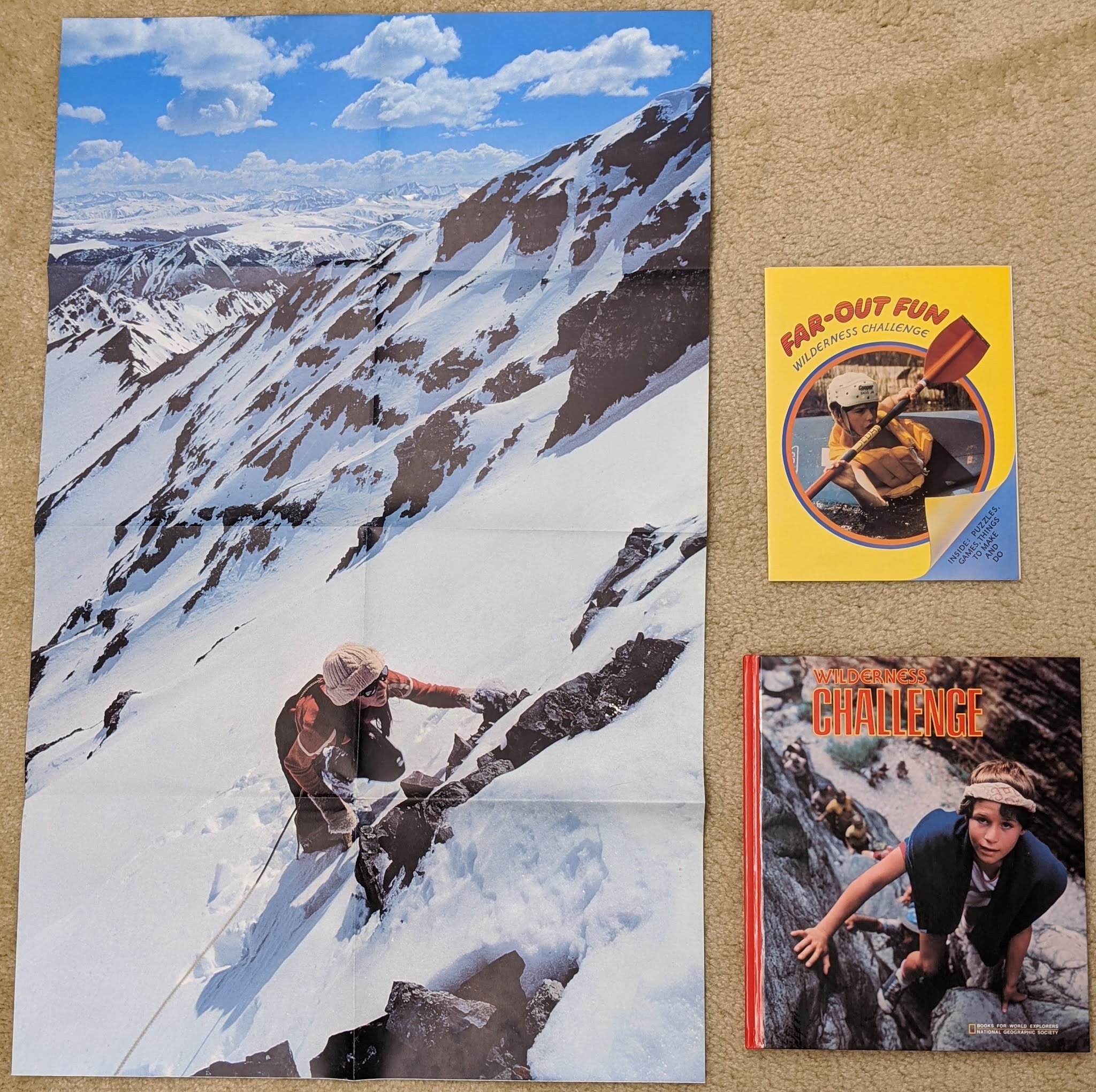
Wilderness Challenge

National Geographic Society.  Wilderness Challenge.  Washington, DC: The National Geographic Society, 1980.  From the Books for World Explorers series.  Wilderness Challenge highlights locations and opportunities for outdoor activities such as hiking, camping, and kayaking and canoeing.  It features wilderness adventures such as climbing in the Rocky Mountains, kayaking New England rivers, horseback riding in the Canadian Rockies, learning wilderness skills in Hawaii, canoeing the Okefenokee Swamp in Georgia, winter camping in Minnesota, backpacking the Yellowstone Trail, and whitewater rafting the Grand Canyon.  All books in the Books for World Explorers series were written for pre-teen readers and included an activities and game booklet and a two-sided poster and game board.  This copy includes the booklet and poster.

Activity book and poster accompanying Wilderness Challenge


Monday, August 31, 2020

August 2020: Viruses and Pandemics

The topic for August 2020 was Viruses and Pandemics.  The topic was inspired by the SARS-CoV-2 virus and the corresponding Covid-19 pandemic, but was selected in March before any shelter-in-place orders and restrictions on public gatherings (which has prevented the group from meeting at its usual location since April).  In the group’s first online meeting since the Covid pandemic began, works of fiction and nonfiction were presented, offering insight, criticism, and parallels to past pandemics.

Fiction

The Decameron

Boccaccio, Giovanni.  The Decameron.  Norwalk, CT: Easton Press, 1980.  Collector’s edition, bound in full leather.  Boccaccio completed The Decameron in 1353, following the Black Plague epidemic in Italy in 1348.  The book is structured as a frame story in which ten characters—seven young women and three young men—flee plague-ridden Florence for a secluded villa in the countryside.  During their ten-day isolation, each person tells a story every day related to a topic chosen by one of the characters.  The one hundred stories of The Decameron include tales of wit, tragedy, and the erotic.  In addition to the frame story, Boccaccio’s “Induction of the Author” (introduction) is considered an important medical piece as he describes the beginning of the illness/plague upon the citizens of his city.  Sixty percent of the population of Florence and its countryside died in the 1348 plague.  The Decameron was first published in English in 1886.


First appearance of "The Masque of the Red Death"

Poe, Edgar Allan.  “The Mask of the Red Death: A Fantasy.” Graham's Magazine Vol. 20 (May 1842).  Six issues of Graham’s Magazine, January through June 1842, bound together.  In the May 1842 number, the first printing of "The Masque of the Red Death" appeared.  This is a famous Poe short story about a horrific pandemic that was devastating the country.  A Poe scholar, M. C. Mabbott, wrote, "This masterpiece is unsurpassed, perhaps unequaled, among Poe's very short stories."  The most apocalyptic of Poe's tales, the story ends, "And Darkness and Decay and the Red Death held illimitable domination over all". 

In its first appearance in 1842, Poe titled the story “The Mask of the Red Death: A Fantasy.”  Poe revised the story in 1845, published in the Broadway Journal, retitled as the now-standard “The Masque of the Red Death.”   While its first appearance in Graham’s Magazine was not illustrated, later publications in book form have generated iconic images of “The Masque of the Red Death,” including Harry Clarke’s 1919 engraving (shown here).


A Poe-related aside...

This collector, over more than 40 years, has assembled an important Edgar Allan Poe book collection (over 500 books) which includes many first editions from the 1830's and 1840's.  He has also assembled a large collection of signed American astronaut books from the 1960's through the present focusing on the first 45 American astronauts.  These two collections did not have much in common until one day he came across and was able to buy a letter linking the two. 

Letters to and from Neil Armstrong regarding Eldorado

An original letter from June 30, 1969, signed by Neil Armstrong on National Aeronautics and Space Administration letter head addressed to a Mr. Pearson.  Also included is a copy of a letter from Mr. Pearson to Neil Armstrong suggesting a name for the site of the first moon landing.  The suggestion was "Eldorado" from an Edgar Allan Poe poem.  Wisely NASA selected another name, the Sea of Tranquility.  Eldorado was a mythical, unattainable city of gold or ideal that many men spent their lives trying to find only to die trying.  This was not what NASA or Neil Armstrong had in mind.  Nevertheless, the letter is an important link between the collector's two main book collections.  Original signed Neil Armstrong letters are now extremely pricey especially with additional provenience material to support the authenticity.

Letter of Provenance and copy of Poe's Eldorado


Now back to viruses and pandemics...

Facing It

Reed, Paul.  Facing It.  San Francisco: Gay Sunshine Press, 1984.  Facing It is regarded as the first novel about HIV/AIDS.  In 1984, Armistead Maupin published Babycakes, the fourth books in his Tales of the City series, in which a character has AIDS; but Reed’s Facing It was the first novel focused solely on AIDS.  In the story, the main character’s health fails, and he is diagnosed with the new immune deficiency syndrome beginning to spread throughout the country.  Reed’s story follows the protagonist’s struggle to understand his illness and reconcile the conflicts it presents.  This copy is signed by the author on the title page.


Flight from Neveryon

Delany, Samuel R.  Flight from Neveryon.  New York: Bantam Books, 1985.  Delany’s fantasy Neveryon trilogy is considered the first work of fiction published by a major publisher to address HIV/AIDS.  The third tale of the Neveryon trilogy, “The Tale of Plagues and Carnivals” tells what happens when the virus attacks the fantasy land of Neveryon.  The purpose of a government, the author asserts, is to protect its citizens.  In Neveryon, the incompetence and apathy of the government fail to protect its people from a devastating infectious disease.  “The Tale of Plagues and Carnivals” is a not-so-veiled critique of New York City’s response to HIV/AIDS early in the pandemic and Mayor Ed Koch’s lackluster leadership during this time.

Medical Note to "The Tale of Plagues and Carnivals"

The story is followed by a Medical Note by the publisher.  The Medical Note conveys an overview of the medical knowledge of HIV/AIDS at the time and information on prevention.  The three-page note concludes with contact information for Gay Men’s Health Crisis in New York and the number for the AIDS Hotline.  A publisher’s Medical Note such as this is rare, if not unprecedented, in literature.


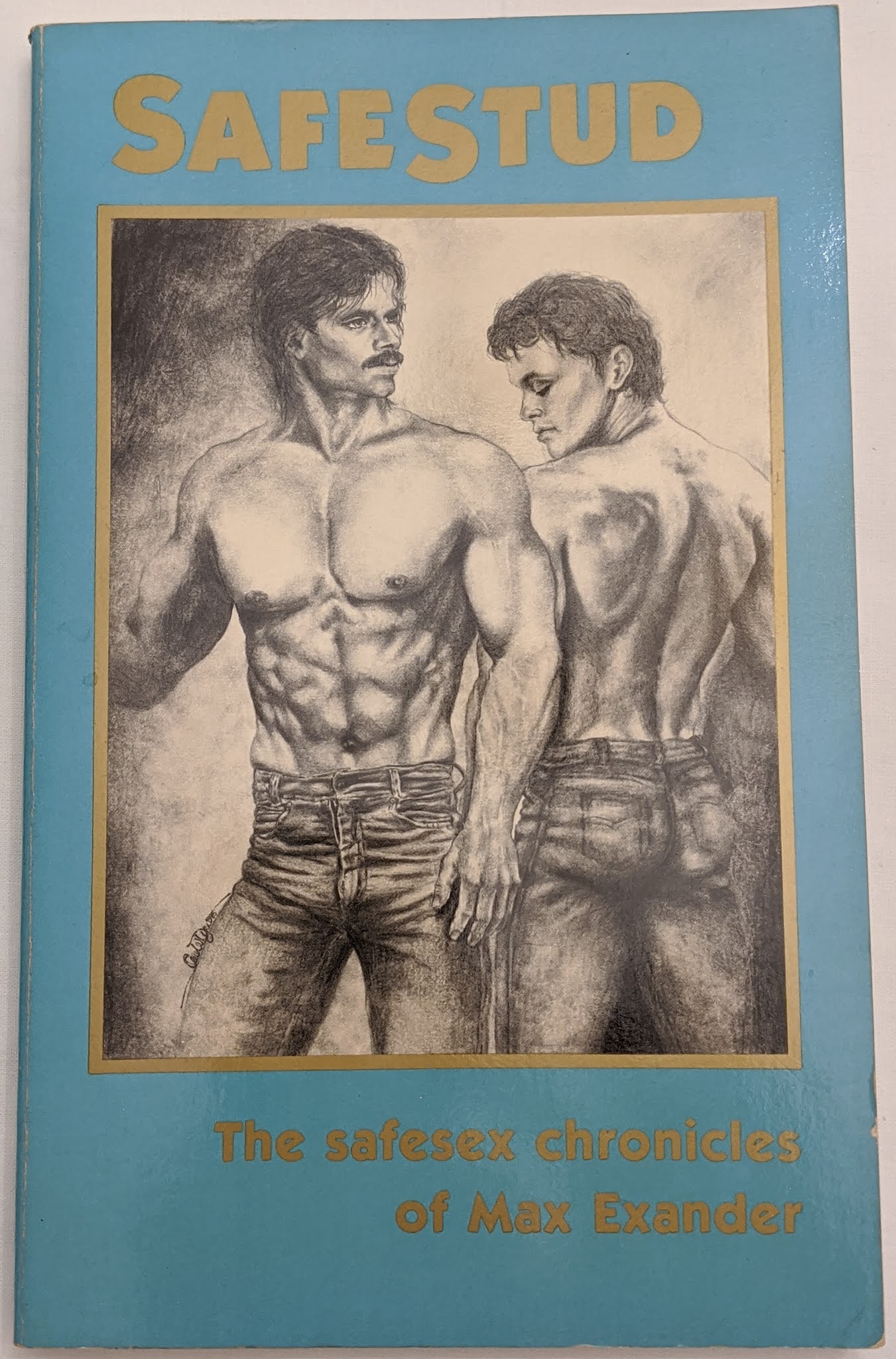
Safestud

Exander, Max.  [Paul Reed]  Safestud: The Safesex Chronicles of Max Exander.  Boston: Alyson Publications, Inc., 1985.  Max Exander is a pseudonym for writer Paul Reed, under which he published erotic fiction.  As a gay writer living through and writing about the emergence of the AIDS pandemic, Reed saw an opportunity to use fiction as a means of educating readers on safer sex practices and helping to normalize the use of condoms and safer sex techniques.  Safestud was Reed’s first erotic fiction to prioritize safe sex in the encounters of his protagonist, Max Exander.  Reed therefore creates a new genre in literature—safe sex erotica—in this seminal work.  Safestud was the first of three novels in the Safesex Chronicles of Max Exander series.

Nonfiction

Epidemics of the Middle Ages

Hecker, Justus Friedrich Carl.  Epidemics of the Middle Ages.  London: Trubner & Co., 1859.  First translated from the German in 1846.  Second edition.  Bound in half leather with marbled boards. 360 pages.  In Epidemics of the Middle Ages, Hecker offers three treatises on different epidemics occurring in the Middle Ages: The Black Death (1346 to 1353); The Dancing Mania (various social outbreaks between the 14th and 17th centuries); and, The Sweating Sickness (five visitations between 1485 and 1551).  Hecker's work is of great importance to both the history of medicine and folklore.


And the Band Played On

Shilts, Randy.  And the Band Played On: Politics, People, and the AIDS Epidemic.  New York: St. Martin’s Press, 1987.  An investigative journalist for the San Francisco Chronicle, Shilts wrote extensively about medical, social, and political aspects of the emerging disease affecting gay men, which came to be known as AIDS.  In And The Band Played On, Shilts set out to chronicle the discovery and spread of HIV/AIDS, with a well-documented critique of the incompetence and indifference on the part of government officials and elected leaders and the apathy toward those infected with, and affected by, the disease.  Shilts later explained the title of the book, And the Band Played On, as a more colorful way of saying “business as usual.”  The title conveys Shilts’s critique of how people responded to HIV/AIDS with an “ordinary pace to an extraordinary situation.”


Tuesday, June 30, 2020

June 2020: COVID-19 Isolation Acquisitions


While the Atlanta Antiquarian Book Circle has been unable to meet in person for the past three months due to coronavirus lockdown restrictions, some members of the group have used email to share photos and descriptions of acquisitions made during isolation.  Gathered here, these books represent finds for the respective collectors which were just too exciting not to share now.  These books will likely appear again in future blogs once they are able to be shared with the group in person, held and inspected, and admired for the incredible finds they are.

In addition to the wonderful books themselves, these new acquisitions highlight the reward of diligently searching for those must-have items.  Each respective collector shares a little about the acquisition itself.  [See the January 2020 blog for additional acquisition stories.]


When you form good relationships with booksellers


Title page of first American prayer book for the Episcopal church
Book of Common Prayer.  A Liturgy Collected Principally from the Book of Common Prayer, for the Use of the First Episcopal Church in Boston; Together with the Psalter, or Psalms of David.  Boston: Peter Edes, 1785.  The first American prayer book for the Episcopal church, bound together with a contemporary revision of the Book of Psalms.  This copy is complete and in the original binding.

As long as the American Colonies were under the authority of the British Crown, the Protestant congregations which later became the Episcopal Church remained a part of the Church of England.  After the Revolutionary War, they continued to be a part of the Anglican community but sought to establish themselves as an independent denomination.  In November of 1784 Samuel Seabury was ordained the first American Bishop.  He had gone to England since new bishops had to be ordained by other bishops but because one of the requirements was to swear allegiance to the King and the Archbishop of Canterbury, he went north and was ordained in the Scottish Episcopal Church.  After returning to Boston, he was able to ordain new Bishops across the country.

In 1785 American congregations began seeking ways to adapt the Anglican Book of Common Prayer to the new Episcopal Church.  The first attempt was completed in 1785 and published under the auspices of King's Chapel—an interesting blend of Episcopal and Unitarian theology. It was too radical to be accepted by the Episcopal Church, and that same year a committee was appointed to revise and authorize an American Book of Common Prayer, which was published in 1789, but superseded the following year by a much more "Anglican" edition.

The Book of Psalms bound with the 1785 prayer book contains a number of revisions to make it more acceptable to Episcopal and Unitarian congregations.  

The collector describes the acquisition: “My new acquisition is a very scarce copy of the 1785 Liturgy Collected Principally from the Book of Common Prayer, for the Use of the First Episcopal Church in Boston.  I can find no other copies listed on the Internet at all.  This copy was listed by a bookseller I have done business with before on eBay, and as soon as I entered my opening bid, he accepted it and closed the auction.”


When you persevere in the hunt


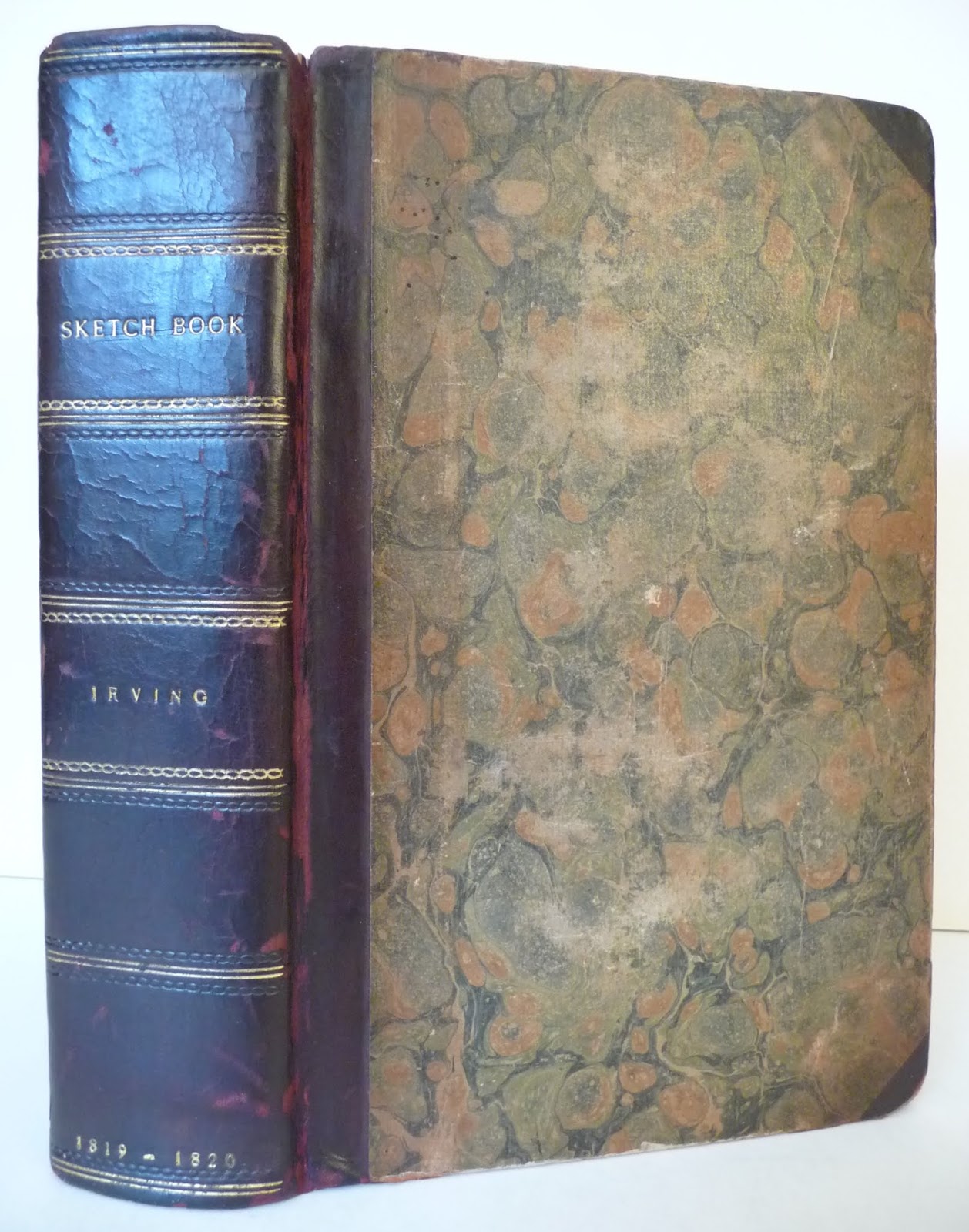
The Sketch Book of Geoffrey Crayon, Gent.
Irving, Washington.  The Sketch Book of Geoffrey Crayon, Gent.  New York: C. S. Van Winkle, 1819-1820.  All seven parts bound in a binding of the period, early half roan, marbled boards.  First edition, first printing of each of the seven parts.  This set contains the uncorrected text points indicating the first printings, as noted in Bibliography of American Literature (BAL).  A fairly clean and attractive copy. 
Title page of The Sketch Book of Geoffrey Crayon, Gent.
This series of tales brought Washington Irving instant fame and made him American's first international literary star.  In Part I, "Rip Van Winkle" made its first appearance.  In Part VI, "The Legend of Sleepy Hollow" made its first appearance.  These classics are the earliest works of American literature that are still commonly read today and of course influenced all authors from that time until now, including Edgar Allan Poe.
First pages of "Rip Van Winkle" and "The Legend of Sleepy Hollow"
The collector writes of this acquisition: “I have been wanting to snare a copy of a famous book by the so-called father of American literature for about 40 years.  At that time, I walked away from a signed copy dated 1819 in Richmond Virginia at a rare bookshop and have regretted my action ever since.  Of course, I was a poor student at the time and the book was very expensive especially being a rare signed copy.  That was one debt worth taking on, but alas...  The seven parts in original wraps are exceedingly rare today making this early bound set the best I could ever hope for.”


When you search unexpected places


England Made Me
Greene, Graham.  England Made Me.  London: Star Editions Ltd., 1947.  England Made Me is Greene’s sixth novel, first published by William Heinemann Ltd. in 1935.  In 1947, Star Editions Ltd., an imprint of Heinemann, published the first paperback edition to be sold only on the continent of Europe.  Star Editions were cheaply printed, and some titles can be difficult to find today in good condition.  This copy is inscribed on the title page to Melle Rennesson.
Inscribed half title page of England Made Me
The collector describes the acquisition: “The lockdown has been very good to me in regard to auctions.  I have picked up several amazing books these last few months, including two items I thought I would never own.  This signed book came up for auction in France with two other Greene titles, each inscribed in the same pen to Miss Rennesson.  The other two books were French translations, including Mère Angleterre (Mother England) the French title of England Made Me.  Bidding on the two French translations was competitive, but I placed the lone bid on this title, the only one in English.  Even with auction fees, international shipping charges, and an unfavorable exchange rate, this inscribed copy was a steal.”


Monday, March 30, 2020

March 2020: Spiritualism and Parapsychology

The March 2020 meeting moved into the realm of spiritualism and parapsychology as we looked into works of nonfiction and fiction which pondered the possibility of a spirit world and its ability to commune with our own.  Some works were lighthearted while others took seriously matters of a spirit life after death, the ability to communicate with the spirits of loved ones who had passed, and abnormal or unexplained phenomena attributed to the presence or intervention of spirits. 

Arthur Conan Doyle's "Behind the Veil of Death"
Doyle, Arthur Conan.  "Behind the Veil of Death."  If I Could Preach Just Once (New York: Harper & Brothers Publishers, 1929): 159-180.  In this anthology, thirteen prominent figures of the time respond to the query: If you could preach just once, what would your message be?  These eminent laity respond with essays which "cover the essentials of religious experience."  A. C. Doyle offers an indictment of the Christian church for its "apathy and ignorance concerning [the] spiritual knowledge" of those who identify as spiritualists, and complains of the church's treatment, "nothing but the coldest of receptions has been accorded us."  While Doyle wrote prolifically about spiritualism, "Behind the Veil of Death" was penned specifically for this anthology and seems never to have been reprinted or published elsewhere.

Life After Life and Making Sense of Nonsense
Raymond Moody, Jr. is a philosopher, psychologist, physician and author known for his books about life after death and near-death experiences (NDE).  Commentators note that several elements and features of the NDE appear to be similar across cultures, but the details of and interpretations of those experiences vary among cultures.
Title pages signed by Raymond A. Moody, Jr.
Moody, Raymond, Jr.  Life After Life: The Investigation of a Phenomenon – Survival of Bodily Death.  Marietta, GA: Mockingbird Books, 1993.  Reprint of the first edition published by Guideposts in 1975.  Second printing.  Signed by the author on the title page.

Moody, Raymond, Jr.  Making Sense of Nonsense: The Logical Bridge between Science & Spirituality.  Woodbury, MN: Llewellyn Publications, 2020.  First edition.  Signed by the author on the half title page.

Saturday, February 29, 2020

February 2020: Books in Series

The February 2020 meeting examined books within series.  The group distinguished between series (individual titles released sequentially over a period of time) and sets (all volumes released together) and focused on series.  Members brought books from a series either by a single author or an edited series by a publisher.  Selections ranged from fictional detective serials and adventure stories to non-fictional Bible commentaries and coveted classics such as The Rivers of America series.  For large series, only one or two volumes were shown.

Nonfiction

The Rivers of America series (1937-1974)

The Rivers of America series
The Rivers of America series was published over a thirty-seven-year span, from 1937 through 1974.  A total of 65 volumes were published by Farrar & Rinehart (1937-1946), Rinehart & Company (1946-1960), and Holt, Rinehart & Winston (1960-1974).  One of the most enticing histories of Americana ever written, each telling the story of the continent's earliest highways, its rivers.  The series was written mainly by fiction writers who studied their history and then imparted the river with a storyline making it the main character.  Each volume tells the stories of the people who traveled on the rivers, lived on their banks, and developed cities around them. 
Shown (below) are the first and last volumes in the series, in their original dust jackets.  The dust jacket's original art helps make the collection especially appealing. 
Coffin, Robert P. Tristram.  The Kennebec: Cradle of the Americans.  New York: Farrar & Rinehart, 1937.  Illustrated by Maitland de Gogorza.  The first volume of The Rivers of America series.
Sanborn, Margaret.  The American: River of El Dorado.  New York: Holt, Rinehart & Winston, 1974.  Illustrated by Jerry Helmrich.  The last volume of The Rivers of America series.
This collection (pictured above) took 38 years to complete, each in fine condition with dust jacket, first editions, some signed by the authors.
Kennebec: Cradle of Americans (1937) and The American: River of El Dorado (1974)

If I Had Only One Sermon to Preach series (1927-1929)

If I Had Only One Sermon to Preach
This series was inspired by a challenge by the Church Advertising Department of the International Advertising Association in 1927 to American clergy to address the theme "If I had only one sermon to preach" and discuss it with "utmost frankness" on a particular Sunday in Lent.  The event drew nationwide attention and was covered by newspapers throughout the country.  Some of the sermons preached during that event are included in the American Series book.  The popularity of the American book inspired an English response.  A third volume explored the topic of immortality and included contributions by both American and English ministers. 
Stelzle, Charles, ed.  If I Had Only One Sermon to Preach: American Series.  New York: Harper & Brothers Publishers, 1927.  First edition.  Sermons by twenty-one American ministers.
Marchant, James, ed.  If I Had Only One Sermon to Preach: English Series.  New York: Harper & Brothers Publishers, 1928.  First edition.  Sermons by twenty English ministers.
Stidger, William L., ed.  If I Had Only One Sermon to Preach on Immortality.  New York: Harper & Brothers Publishers, 1929.  First edition.  Twenty-three sermons on the topic of immortality.

Fiction

The Stephanie Plum series (1994-present)

The Stephanie Plum series, books 1-26
In the first 26 books of this series (as of the time of this writing), Janet Evanovich uses her protagonist, Stephanie Plum, a down-on-her luck bounty hunter, and her dysfunctional New Jersey family to create discord and misadventure as a backdrop for hilarious antics and hijinks.  The case-driven plot of each novel drives the ongoing sexual tensions, jealousies, and down-home family dynamics of Plum's daily life.  The 27th title (forthcoming) will complete the author's current contract with the publisher; readers will have to wait and see if the Plum adventures will continue.
Evanovich, Janet.  One for the Money.  New York: Charles Scribner's Sons, 1994.  First edition.  The first title in the Stephanie Plum series.  Signed by the author on the title page.
Evanovich, Janet.  Twisted Twenty-Six.  New York: Charles Scribner's Sons, 2019.  First edition.  The most recent title in the Stephanie Plum series.  Signed by the author on the title page.
The first and most recent (to date) titles in the Stephanie Plum series

The Montague Siblings series (2017-2020)

Mackenzi Lee's Montague Siblings series
The Montague Siblings series is a trilogy of young adult novels (plus a novella) set in Eighteenth Century Europe.  As a writer and historian, author Mackenzi Lee seeks to bring minority narratives to historical fiction and non-fiction.  The Montague Siblings adventure stories, therefore, also explore the roles of gender, sexuality, race, and medical conditions in the lives of the main characters.  The final volume of the trilogy, The Nobleman's Guide to Scandal and Shipwrecks, is scheduled to be released in August 2020.
Lee, Mackenzi.  The Gentleman's Guide to Vice and Virtue.  New York: Katherine Tegen Books, 2017.  First edition.  The first book of the Montague Siblings trilogy.
_____.  The Lady's Guide to Petticoats and Piracy.  New York: Katherine Tegen Books, 2018.  First edition.  The second book of the Montague Siblings trilogy.
_____.  The Gentleman's Guide to Getting Lucky.  New York: Katherine Tegen Books, 2019.  First edition.  A novella of the Montague Siblings series.  Most likely, the original ending to The Gentleman's Guide to Vice and Virtue.

The Wicked Years series (1995-2011)

Gregory Maguire's The Wicked Years
In the Wicked Years series, Gregory Maguire offers a revisionist story of L. Frank Baum's Oz books.  Maguire's reimagining of the central characters of the land of Oz tells the back stories of the characters and shows how they became their characteristic namesakes.  Written as something of a prequel, the four books ultimately bring the reader right to the point where Baum's stories begin, with the arrival of Dorothy in the land of Oz.
Two members both showed signed first editions of the four books of The Wicked Years.
Signed copies of the Wicked, Son of a Witch, A Lion Among Men, and Out of Oz
Maguire, Gregory.  Wicked: The Life and Times of the Wicked Witch of the West.  New York: Regan Books, 1995.  First edition.  Signed by the author on the half title page.
_____.  Son of a Witch.  New York: Regan Books, 2005.  First edition.  Signed by the author on the title page.
_____.  A Lion Among Men.  New York: William Morrow, 2008.  First edition.  Signed by the author on the title page.
_____.  Out of Oz.  New York: William Morrow, 2011.  First edition.  Signed by the author on the half title page.

Friday, January 31, 2020

January 2020: Acquisition Stories


The January 2020 meeting focused on stories of acquiring various books in our collections.  How, when, or where the book was acquired took priority over the book itself.  Stories of serendipitous finds, chance encounters with an author, and astonishing prices delighted the group.  From the book which started a new collection or sub-collection to the collector's most recent acquisition, these wonderful books were introduced with equally wonderful stories of how they came into the collector's hands.

The Lost Childhood
Greene, Graham.  The Lost Childhood and Other Essays.  London: Eyre & Spottiswoode, 1951.  First edition.  William Hood's copy.  Hood was a CIA officer and novelist who is best known as the CIA senior officer who signed off on the intelligence cable stating that Lee Harvey Oswald was not considered a security threat.  Based on this cable, the FBI removed Oswald from its persons of interest list; six weeks later, Oswald was arrested for the assassination of John F. Kennedy.  Loose laid in the book is a diner order ticket with a note on the back: "William Hood left here Monday night!"  Hood apparently never returned to pick up his book.
William Hood's ownership signature
The collector describes the acquisition: "I first ran across this copy while searching for another book online.  I was intrigued and almost purchased it right then, but I continued my search for what I originally sought.  I thought I might return to it later, but I did not.  Less than a week later, a friend and fellow collector called me from a small bookshop in New York where he was visiting.  As he began to describe the book, I instantly knew the copy he was talking about and knew I wanted it.  Without hesitation, I asked him to get it for me.  Best of all, I did not have to pay for shipping."

A. E. Housman's Last Poems with Graham Greene's ownership signature
Housman, A. E.  Last Poems.  London: Grant Richards Ltd., 1922.  First edition.  Graham Greene's copy.  As a student, Greene was strongly influenced by Housman's writing, and Last Poems was published in September 1922, the same year Greene entered college and began studying poetry.  Greene often quoted Housman in his non-fiction, including citing a poem from this copy of Last Poems in his first travel book, Journey Without Maps.
The collector describes the acquisition: "This book popped up on my radar several years ago.  I had long wanted a book from Graham Greene's library with his ownership signature in it, and this was a prime candidate because of Housman's influence on Greene as a writer.  The book was priced fairly but more than I wanted to pay.  After two and a half years of constantly checking on it, I saw the seller pulled it from the sales inventory and put it up for auction.  With no reserve and little interest from other bidders, I handily won the auction, paying only one-fifth of the original asking price."

July 2025: US Presidents

One member's unintentionally assembled collection of signed presidential books Getting an early start on the Fourth of July festivitie...